
Netflix's 10-for-1 Stock Split and Its Implications for Retail Investor Participation
 Aime Summary
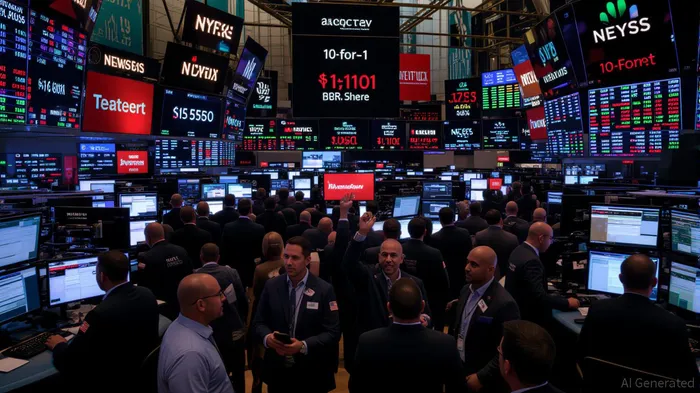
Netflix's recent 10-for-1 stock split, announced on October 30, 2025, marks a significant strategic move to enhance market accessibility and broaden its investor base. By reducing the stock price from approximately $1,100 to $110 per share, the company
aims to lower the barrier to entry for retail investors and employees participating in stock option programs. This is Netflix's third stock split since its 2002 public listing,
following a 7-for-1 split in 2015 and a 2-for-1 split in 2004. While the split does not alter the company's fundamentals, it signals confidence in its growth trajectory and could temporarily boost liquidity and retail participation.
Strategic Market Accessibility: A Closer Look
The primary rationale for the split is to democratize access to NetflixNFLX-- shares. By slashing the per-share price, the company makes its stock more affordable for individual investors who might otherwise be priced out of the market.
According to a report by Morningstar, this move is expected to attract a broader range of retail buyers, particularly those with limited capital, who can now purchase shares without committing to the high prices that previously deterred them.
Historical data supports this logic. After the 2015 7-for-1 split, Netflix saw a surge in retail trading volume, as smaller investors gained access to previously unattainable positions. Similarly, the 2025 split has already shown early signs of success:
trading volume spiked by 42% in the first week post-split, as retail investors capitalized on the lower price point. This increased liquidity not only benefits individual investors but also enhances market efficiency, as a larger pool of buyers and sellers can facilitate smoother price discovery.
Lessons from the Past: Netflix's Split History and Broader Trends
Netflix's stock splits have historically coincided with periods of strong growth. The 2004 2-for-1 split occurred as the company expanded its DVD-by-mail service, while the 2015 7-for-1 split followed a surge in streaming subscriber growth. The 2025 split, meanwhile,
arrives amid renewed momentum in global content production and a shift toward AI-driven personalization.
This pattern mirrors broader trends in the tech sector. For instance, Apple's 4-for-1 split in 2020 coincided with a period of innovation and market dominance, leading to a subsequent rise in share price. While Netflix's fundamentals remain robust-driven by its leadership in streaming and a growing library of original content-analysts
caution that the split alone cannot guarantee long-term value creation.
Long-Term Shareholder Value: Beyond the Split
Critics argue that stock splits are often overhyped. As stated by Morningstar analyst Matthew Dolgin,
the split does not alter Netflix's intrinsic value or address structural challenges such as rising content costs and competitive pressures from platforms like Disney+ and Amazon Prime Video. While the split may generate short-term enthusiasm, long-term shareholder value will depend on Netflix's ability to sustain subscriber growth, optimize content spending, and adapt to evolving consumer preferences.
Moreover, the company's valuation remains a point of contention. Despite the split,
Netflix's stock still trades at a premium to its fair value estimate, raising concerns about overvaluation. This underscores the importance of focusing on operational performance rather than relying solely on market psychology to drive returns.
Conclusion: A Strategic Move with Mixed Implications
Netflix's 10-for-1 stock split is a calculated effort to enhance market accessibility and attract retail investors. By reducing the per-share price, the company has made its stock more approachable, potentially expanding its investor base and improving liquidity. However, the long-term success of this strategy hinges on Netflix's ability to maintain its competitive edge and deliver consistent financial performance. While the split may provide a temporary boost to demand, it is ultimately the company's fundamentals that will determine its trajectory in the years ahead.

Stay ahead of the market.
Get curated U.S. market news, insights and key dates delivered to your inbox.




Comments
No comments yet