
Netflix's 10-for-1 Stock Split: A Catalyst for Retail Appeal and Long-Term Growth?


 Aime Summary
Retail Investor Appeal: A Structural Reset
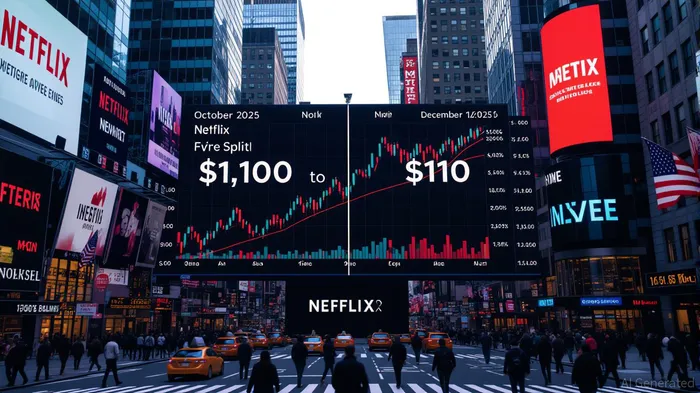
The split directly addresses a key barrier to retail participation: high stock prices. , Netflix's equity was effectively out of reach for many individual investors, particularly those with limited capital. By reducing the per-share price to $110, the company aligns itself with broader trends in retail investing. According to a report, retail trading activity in 2025 reached levels rivaling the pandemic-era surge, driven by younger demographics and commission-free platforms. For instance, over one-third of 25-year-olds in 2024 had already begun investing, . This demographic shift suggests that a lower-priced Netflix stock could attract a new cohort of investors, particularly Gen Z and Millennials, who prioritize accessibility and diversification.
Moreover, the split aligns with the broader normalization of stock splits among large-cap tech firms. As noted by Morningstar analyst , such moves often temporarily boost liquidity and demand, especially among retail buyers. While the intrinsic value of Netflix remains unchanged, the psychological impact of a lower price point-coupled with the company's strong fundamentals-could incentivize first-time investors to allocate capital to the stock.
Long-Term Growth: Fundamentals and Strategic Expansion
Beyond retail accessibility, the split coincides with Netflix's robust financial performance. In Q3 2025, the company reported a 17.2% year-over-year revenue increase, driven by subscription growth, price hikes, and a rapidly expanding advertising segment. The latter, launched less than three years ago, is projected to double its revenue in 2025, offering a critical diversification of income streams. Analysts at Jefferies and Goldman Sachs have maintained optimistic price targets of $1,500 and $1,300, respectively, citing strong content performance and global expansion.
However, challenges persist. A one-time $619 million tax charge in Brazil reduced operating margins to 28.2% in Q3 2025, slightly below the 30% target. Despite this, , underscoring the company's resilience. through innovations in gaming, live streaming, and AI-driven content personalization.
Analyst Perspectives: Optimism Amid Caution
While the split is broadly viewed as a positive signal, analysts caution against over-optimism. A report by Nasdaq notes that Netflix's high price-to-earnings ratio leaves little room for error in a competitive streaming landscape. Additionally, the company's reliance on content-driven growth-rather than traditional advertising-introduces risks if subscriber acquisition slows or production costs rise.
Nevertheless, the split's timing appears strategic. With retail investor participation accounting for 36% of total order flow in April 2025, the move taps into a market segment that has historically amplified rallies in growth sectors. As stated by Morningstar, the split may provide a short-term upward push to the stock, but long-term success will depend on Netflix's ability to sustain revenue growth and innovate.
Conclusion: A Strategic Step, Not a Guarantee
Netflix's 10-for-1 stock split is a calculated effort to democratize access to its equity while signaling confidence in its long-term prospects. By lowering the price barrier, the company positions itself to capitalize on the growing retail investing trend, particularly among younger demographics. However, the split alone cannot offset structural challenges such as valuation concerns or competitive pressures. For investors, the key takeaway is that the split enhances accessibility but should be evaluated alongside Netflix's fundamentals-its revenue diversification, margin resilience, and innovation pipeline.
As the stock trades on a split-adjusted basis, the coming months will reveal whether this move translates into sustained retail enthusiasm and long-term value creation.

Delivering real-time insights and analysis on emerging financial trends and market movements.
Latest Articles
Stay ahead of the market.
Get curated U.S. market news, insights and key dates delivered to your inbox.




Comments
No comments yet