
NET Power's Q3 2025 Earnings Call: Contradictions Emerge on Project Timelines, Financing Strategies, Cost Optimization, and Industrial Platform Revenue Model
 Aime Summary
Guidance:
- Finalize JV with Entropy in Q1 2026 and prepare to FID the first West Texas phase (company expects a financial decision in 1H 2026).
- If FID achieved, begin construction 2H 2026 with commercial operation targeted 2H 2028–1H 2029 for Phase 1.
- Project Permian Phase 1: 60 MW module, >90% CO2 capture, target availability >95%, LCOE < $80/MWh for phase one and <$70/MWh at ~300 MW scale.
- Northern MISO: FID targeted 2027, commercial operations 2029–2030, projected LCOE ~ $100/MWh.
- NET Power will make a small strategic equity investment in Entropy and pursue co-investment/project financing structures to limit equity needs.
Business Commentary:
- Load Growth and Power Demand:
- The power sector is experiencing unprecedented load growth due to artificial intelligence, data centers, and re-onshoring of US manufacturing, which has created a need for faster power generation.
This demand growth is driven by the need to replace aging baseload facilities and the desire to balance society's desire for clean energy without compromising access to affordable, reliable power.
Partnership and Clean Power Solutions:
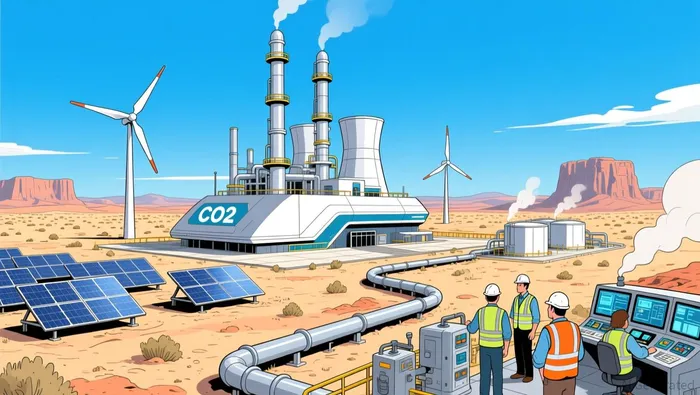
- NET Power has partnered with Entropy to use post-combustion carbon capture technology for natural gas power plants, which will enable the deployment of clean gas projects in the US.
This partnership leverages NET Power's site origination and power generation expertise with Entropy's operational experience in carbon capture, allowing for accelerated deployment of clean gas solutions.
Shift in Strategy and Project Pivot:
- NET Power has pivoted from solely focusing on its oxycombustion technology to a strategy combining clean gas power projects with its proprietary carbon capture solutions.
This pivot is driven by the need for rapid deployment of reliable power, leveraging proven technologies and sites with low-cost natural gas and favorable carbon capture conditions.
Financing Strategy and Project Economics:
- The company aims to finance a significant portion of its project costs through project financing, reducing equity requirements.
- This strategy is possible due to favorable economics driven by low-cost natural gas, carbon sequestration incentives, and industrial CO2 utilization, especially in regions like West Texas.
Sentiment Analysis:
Overall Tone: Positive
- Management framed the call as a constructive strategic pivot: targeting JV finalization in Q1 2026, FID in 1H 2026, COD as early as 2H 2028, and Permian LCOE targets under $80/MWh; they described Entropy as a TRL9, operational partner and emphasized speed-to-market and scalable, repeatable hubs.
Q&A:
- Question from Nate Pendleton (Texas Capital): With the pivot you announced here, can you provide your perspective on what makes NET Power uniquely positioned to take advantage of this opportunity compared to some of the others, given your prior focus on the oxycombustion cycle?
Response: NET Power's key advantage is actionable, high-quality site origination plus subsurface expertise (gas access, nearby sinks, transmission), enabling faster, financeable PCC deployments at sites already assembled for NET Power rather than waiting for oxycombustion commercialization.
- Question from Nate Pendleton (Texas Capital): With Entropy, they seem like a phenomenal partner from what I understand about their history and what they’ve been able to achieve. Can you maybe elaborate on why specifically you chose to partner with them and what you see in that technology that may make post-combustion carbon capture truly competitive economically?
Response: Entropy brings operational experience (Glacier facility), a TRL9 amine solvent optimized over years of runtime with strong capture efficiency and lower energy/degradation characteristics, making PCC bankable and deployable quickly in U.S. power markets.
- Question from Martin Malloy (Johnson Rice): Can you talk broadly about the financing strategy with phase one and then follow-on projects? It sounds like from Marc’s comments with phase one, you’ve got potentially all the power, you’ve got an offtake for it, as well as the CO2 going to Oxy. Maybe if you could talk about, in broad terms, the financing strategy in terms of being able to put debt on these projects. Also, I did see on Entropy’s website that Brookfield is an investor in them, if that plays a role here at all.
Response: Because gas turbines and PCC use proven, bankable equipment, a large portion of CapEx can be project-financed; NET Power expects a materially smaller equity burden than for a first-of-a-kind oxy plant, and Entropy’s investors (e.g., Brookfield) can co-invest via Entropy to further reduce NET Power equity needs.
- Question from Martin Malloy (Johnson Rice): Can you share any anecdotes of conversations with potential off-takers in the data center market that are looking for this type of solution and might be willing to enter into longer-term off-take agreements?
Response: Hyperscalers value speed: projects coming online ~2028 are far more actionable for offtakers than 2031; accelerating deployment via PCC materially improves commercial offtake engagement and interest.
- Question from Betty Jung (Barclays): What enables the sub-$80 LCOE in the Permian compared to roughly $100 in MISO? If you could speak to how you’re thinking about the CapEx cost and some of the other credit stacking attributes on the Permian project.
Response: Permian economics benefit from much lower natural gas feedstock costs and the ability to sell CO2 for industrial use (EOR) in addition to 45Q credits, creating value stacking that materially reduces net power cost versus MISO where sequestration transport costs apply.
- Question from Betty Jung (Barclays): The business model previously was capital-light (licensing); now it seems more capital-heavy. How are you thinking about project financing or the longer-term capital needed to scale this business?
Response: NET Power will pursue a phased, right-sized modular approach to limit equity exposure, use project finance and partner equity (Entropy and others), reallocate some oxy R&D spend to fund initial equity, and rely on demonstrated returns to unlock larger-scale capital.
- Question from Wade Suki (Capital One): Can you give us a sense for what phase one might cost in West Texas or MISO, including the carbon capture component?
Response: Estimated total installed CapEx for Phase 1 is ~$375–425M; with 50–70% project debt and a 50/50 equity split, NET Power's equity commitment would be roughly $75–90M as a rule-of-thumb.
- Question from Wade Suki (Capital One): Would you expand on the Entropy investment to the extent you can at this point?
Response: NET Power will make a small strategic equity investment in Entropy to fund their technical resources and secure their participation in joint project development; the investment is modest but important for program execution.
- Question from Wade Suki (Capital One): Taking a step back, what is the rationale for being a public entity given the current pivot?
Response: Being public preserves access to unparalleled capital which is valuable now that NET Power has actionable near-term, investable projects that can scale and deliver differentiated returns earlier than competing clean firm technologies.
Contradiction Point 1
Project Timing and Milestones
It involves the expected timing for a key project's final investment decision (FID) and its implications for market positioning and investor expectations.
Can you outline the financing strategy for phase one and subsequent projects? - Martin Malloy (Johnson Rice)
2025Q3: We have the ability to execute the project prior to the end of this decade. So we have the opportunity, we have enough time to actually do this. - Bryce Mendes(COO)
Could you clarify the timing and milestones for FID on SN1 and other projects, as well as the timeline to commission them using a simple cycle gas turbine? - Martin Malloy (Johnson Rice)
2025Q2: We have stated that we expect a 2024 financial close and a 2025 FID. If that holds true, the plant would come online in 2030. - Daniel Joseph Rice(CEO)
Contradiction Point 2
Project Financing Strategy
It highlights differences in the company's approach to financing its projects, which could impact financial risk and investor confidence.
Can you outline the financing strategy for Phase 1 and subsequent projects? - Martin Malloy (Johnson Rice)
2025Q3: Financing will largely be project financing, as half the project is proven bankable technology. Long-term contracted cash flows enable project financing for a good portion of CapEx. Equity requirements will be minimized due to project financing, and Entropy's ability to participate in equity will reduce NET Power's burden. - Bryce Mendes(COO)
Can you discuss the behind-the-meter opportunities with the new integrated approach? - Martin Malloy (Johnson Rice)
2025Q2: For Phase 1, we expect that additional equity investment needed will be modest and will be largely covered by Entropy, who has a 49% ownership in NET Power. We believe we can get to first generation with this limited commercial model and leverage that experience for future projects. - Daniel Joseph Rice(CEO)
Contradiction Point 3
Cost Optimization and Modularization Strategy
It involves differing statements regarding the strategy for cost optimization and modularization, which are critical for project efficiency and deployment.
What factors contribute to the lower LCOE in the Permian versus MISO? What are the CapEx costs and credit attributes for the Permian project? - Betty Jung (Barclays)
2025Q3: We will be able to accelerate down the learning curve, down the cost curve, as we're looking at a strategy that is going to be a multi-plant configuration. - Daniel Rice(CEO)
Can you explain the modularization in your path and key milestones? - Martin Malloy (Johnson Rice)
2024Q4: Modularization is key for cost reduction. For inland sites like Permian, we're maximizing truckable loads. For coastal deployment, we're feasible studies for mega modularization. Future design and indicative costs will be quantified this year. - Brian Allen(COO)
Contradiction Point 4
Funding Strategy and Project Financing
It involves differing statements regarding the funding strategy and project financing, which are crucial for project execution and investor confidence.
Can you discuss the financing strategy for Phase 1 and subsequent projects? - Martin Malloy (Johnson Rice)
2025Q3: Financing will largely be project financing, as half the project is proven bankable technology. Long-term contracted cash flows enable project financing for a good portion of CapEx. Equity requirements will be minimized due to project financing, and Entropy's ability to participate in equity will reduce NET Power's burden. - Bryce Mendes(IR)
How will thermal CapEx decline with project completions, and how do data center operators view cost increases as a funding opportunity? - Thomas Sellers Meric (Janney Montgomery Scott)
2024Q4: We're pursuing all these creatively. There are four avenues for funding: project capital, topco capital, government support, and commercial partnerships. - Akash Patel(CFO)
Contradiction Point 5
Industrial Scale Platform and Revenue Model
It involves differing statements regarding the industrial scale platform and its revenue model, which are crucial for understanding the company's future revenue streams and growth strategy.
What factors contribute to the Permian’s sub-$80 LCOE compared to MISO’s $100? What are the CapEx costs and credit stacking attributes of the Permian project? - Betty Jung (Barclays)
2025Q3: NET Power is a licensor for this program, earning revenue on licenses but no material capital outflow. - Akash Patel(CFO)
Can you provide more details on the industrial-scale NET Power platform and how royalties differ between industrial-scale and utility-scale plants? - Nate Pendleton (Texas Capital)
2024Q4: Industrial scale platform opens a new TAM. Size is less than utility-scale but specific target size is being determined. NET Power is a licensor for this program, earning revenue on licenses but no material capital outflow. - Brian Allen(COO)

Discover what executives don't want to reveal in conference calls
Latest Articles
Stay ahead of the market.
Get curated U.S. market news, insights and key dates delivered to your inbox.
AInvest
PRO
AInvest
PRO



Comments
No comments yet