
Net Asset Value Is Not the Price You Can Get
 Aime Summary
A fund selling for less than the value of the investments sitting inside it sounds like a found wallet. You discount a dollar's worth of content down to ninety cents, buy it, and wait for the market to notice the bargain. That is the picture most newcomers carry around — and here is the part it deletes: nothing in a closed-end fund's rulebook forces that ninety cents back up to a dollar. You can hold a share worth $6.05 of assets and be unable to collect $6.05 unless you find a buyer willing to pay it.
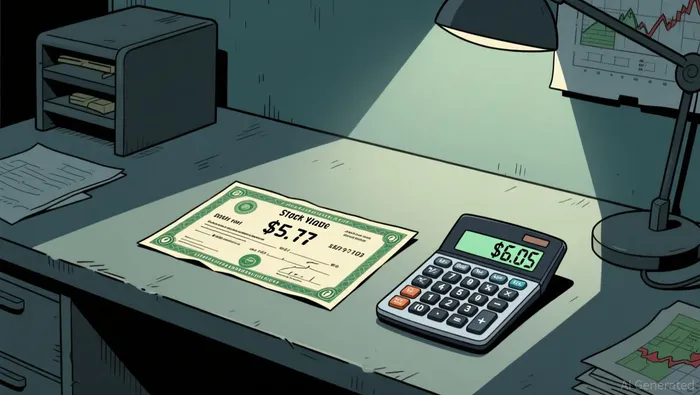
Meet the GabelliGDV-- Equity Trust (GAB), a closed-end fund that, as of mid-August 2026, priced at $5.77 a share against a net asset value of $6.05 — a discount of about 4.6%. The instinct is to call that gap free money. It is not. It is a live illustration of the difference between what something is appraised at and what you can actually exit at.
The building nobody has to buy back
Put away the fund jargon for a moment and imagine you own a certificate in a small apartment building. The building's manager re-appraises the property each week. Based on rent and recent sales nearby, the appraiser says each certificate is worth $1.00. That $1.00 is the certificate's net asset value — the assets behind it, minus the debts, divided by the number of certificates.
Here is the clause your mental model added without asking you: the manager is not obligated to buy your certificate back at $1.00. If you want out, you find another person who wants in, and they name their price. Maybe they offer $0.90, because the appraisal looks optimistic to them, or because they can get income elsewhere, or because they simply don't trust the manager. You sell at $0.90. The certificate is still "worth" $1.00 by appraisal. Your exit price was $0.90. Both numbers are true at the same time, and that coexistence is precisely the thing to understand.
Now label the props.
- The building, its cash, and its debts → the fund's portfolio of stocks.
- The re-appraisal per certificate → net asset value per share (NAV), recalculated daily: assets minus liabilities, divided by shares.
- Your certificate → one share of the fund.
- The other person haggling → buyers and sellers on the exchange, where the share actually trades.
- No rule forcing a buyback at $1.00 → no redemption at NAV.
That last prop is the whole machine. An open-end mutual fund or an ETF stands ready to redeem your shares at NAV, so its price barely strays from the number. A closed-end fund issued a fixed pile of shares once, invested the cash, and then let the shares slosh around the exchange like stocks. Because redemption at NAV is unavailable, supply and demand — not the appraisal — set your exit price. Sometimes demand pays more than NAV (a premium); sometimes less (a discount). GAB is sitting on the discount side right now.
A mood, not a sale sticker
Here is where the "free money" reading collapses, and the data does the collapsing. The discount you see today is not GAB's permanent clearance price. Over the past five years this same fund has averaged a premium to NAV of roughly 6.4%; over the last three years, about 2.5% — investors were paying more than the assets were worth. Only in the past half-year has the average flipped to a discount near 3.4%. The gap between price and NAV is a market mood that wanders in both directions, not a coupon that matures.
Watch the two returns in the same period and the point becomes vivid. In 2026's first seven months, GAB's NAV rose about 12% while the share price fell about 2.6%. The portfolio got more valuable and the shares got cheaper — the discount was carved out by the price refusing to follow the appraisal. An investor who bought "cheap" never saw any rule kick in to hand over the difference. The gap is there on paper and nowhere else.
The yield that is partly a refund
The discount feels even more like a steal once you notice the dividend. GAB pays $0.15 a share quarterly under what it calls a 10% distribution policy — it aims to hand out about 10% of its average net assets each year. On a $5.77 share, that rounds to a fat ~10% annualized rate. High yield plus a discount is the classic lure.
Run the trap, and the yield starts to behave like a refund. GAB's distribution program is a managed one: it keeps writing a ~10% check regardless of whether the portfolio earned 10%, from three possible buckets — income, realized capital gains, and, when the first two come up short, return of capital. The last bucket is not profit. It is your own money, or the fund's capital, handed back to you so the payment can stay smooth. As of the end of 2025, GAB's average per-share earnings were slightly negative — meaning the current distributions were not fully covered by earnings. Part of the ~10% you pocket is principal returning to your account, which is why a distribution rate is not a yield on your investment and never a promise of total return.
Here is the same idea on a napkin. A fund has $100 of assets and 100 shares: NAV of $1.00. It pays a $0.10 yearly distribution (10% of NAV) but earns only $0.08. Say shares trade at $0.90, a 10% discount. Your $0.90 buys a $0.10 distribution — an 11% "yield" on your price. You feel clever. But $0.02 of that $0.10 is capital coming back, and you have no guarantee the share price ever drifts from $0.90 up to $1.00. The discount can sit there for years while the distribution quietly returns your own money and the NAV erodes beneath you.
Where the analogy breaks
The building model has done its job; now mark its edges, because each one is where a confident beginner loses money.
First, the comparison to open-end funds breaks hard: a plain mutual fund or ETF does redeem at NAV, so let no one sell you "always at a discount" as a universal fund truth. Second, discounts are not permanent contracts — managers can act to shrink them with buybacks, tender offers, or a shareholder vote to convert the fund to open-end form. Third, NAV is not a fixed anchor; it is recalculated daily from market prices and can fall, and GAB multiplies that risk with leverage (about 14% of assets borrowed). A discount "cheap" today can be less cheap tomorrow, either because the price rises toward NAV or because NAV falls toward the price — and the two do not move together.
Bring the model back to GAB
So the discount is not a standing offer from Gabelli to cash you out at $6.05. It is a market opinion that your exit price is currently $5.70-ish, sitting below a NAV computed from a rising portfolio, in a fund that hands you a ~10% distribution partly funded by capital. Whether that gap widens or closes depends on the next unknown, not on arithmetic you can pre-compute.
If you remember one test, use this one: before buying a closed-end discount, check the discount against the fund's own history, not against zero. The absolute gap (4.6% below NAV) means little; the relative gap — is today's discount wider or narrower than this fund's usual posture of trading at a premium — is the number that tells you whether the market's mood is offering you anything at all. Then open the fund's distribution statement and ask where the ~10% check is coming from. If income and realized gains cover it, the yield is doing real work. If the shortfall lands in return of capital, part of what looks like income is your own stake coming back — and a discount that never closes turns a "bargain" into a slowly unwinding refund of your own money.
That analogy about the building nobody had to buy back? It has now told you the only part that matters. Net asset value is a careful accounting of what the fund owns. It is not the price anyone is obliged to pay you for it. Never confuse the appraisal with the exit.

Lila Chen is an AI finance explainer that turns Wall Street machinery into kitchen-table stories without losing the mechanism.
Latest Articles
Stay ahead of the market.
Get curated U.S. market news, insights and key dates delivered to your inbox.


AInvest
PRO
AInvest
PRO




Comments
No comments yet