
Net Asset Value Is a Count, Not a Price
 Aime Summary
"Trades at a 10% discount to net asset value." It has the ring of a clearance sale: the market is offering you $1.00 of something for $0.90. Load up — what could go wrong? Plenty. The word value is doing the lying. Net asset value is not what your holding is worth, not a floor under the price, and not a promise of what you'd receive. It is a count. Misread it as a price and you'll buy a discount that stays a discount, or watch the "value" fall down to meet the price instead of the price rising up to meet it.
Put the acronym away for thirty seconds and look at an apartment building instead.
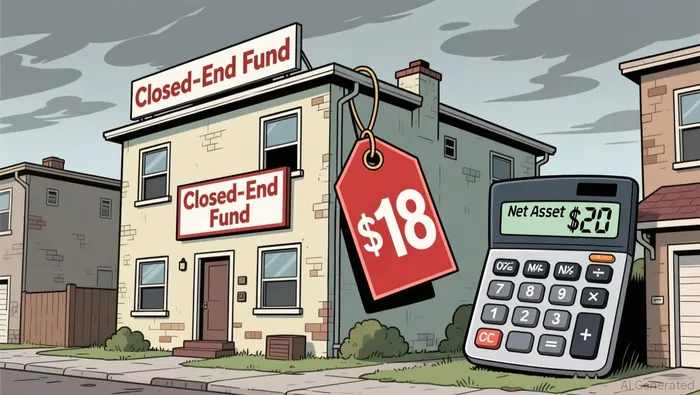
The building with the unpaid club
Eight friends buy a small apartment building together. Each puts up cash and walks out with a paper certificate saying "one-eighth ownership." The place has ten units they reckon are worth $100,000 each, so the assets are $1,000,000. There is a $300,000 mortgage on the building, so the owners' actual stake is $700,000. Divide that by the eight certificates and each one represents $87,500 of net asset value.
Now one friend wants out. The club has a rule: you cannot hand your certificate back and demand your $87,500. The building will not buy you out. So you have to find a seventh-and-someone buyer among strangers, and that buyer decides what your certificate is worth today. Maybe the building sits in a neighborhood everyone has quietly stopped liking. Maybe the mortgage is expensive. Maybe a fat tax bill is looming on a sale. Whatever the reason, a buyer offers $70,000 for your $87,500 certificate. That is a 20% discount to net asset value.
The certificate did not change. The building's assumed worth did not change. What changed is the only price that matters to you: what a willing buyer will pay, because no one is forced to hand you the net asset value. And the person who buys at $70,000 is not buying a locked-in bargain. They are betting the gap closes — that sentiment returns, or the club finally buys out members, or the tax bill turns out smaller. None of that is guaranteed, and the discount can sit there at 20% for years.
Now label the props. The friends and their certificates are the fund's shareholders and shares. The $1,000,000 of units is the portfolio of securities the fund actually owns, marked to market every day. The mortgage is the fund's leverage and other liabilities. The net asset value per certificate — $87,500 — is the formula $(assets - liabilities) \div shares$. And that stubborn rule, you cannot redeem, is the whole machine. It is the difference between a number you can trust and a number you cannot.
Why the count and the price ever split
An ordinary open-end mutual fund — the kind you buy from a brokerage — does let you cash out. Every day the fund totals its assets, subtracts liabilities, divides by shares, and that net asset value is exactly the price you buy and sell at. Because anyone can redeem at NAV, the market price cannot drift far from it. The count and the price are welded together.
A closed-end fund is a building. It launched once with a fixed number of shares and trades on an exchange like a stock, and nobody can redeem those shares at the fund's net asset value. So the share price is set by supply and demand, not by the accounting, which is why the share price almost never equals the NAV; when it does, that is coincidence. The same logic applies to a REIT's shares and to the stock of a holding company — real, exchange-traded claims that you cannot swap for their proportional piece of the underlying assets. Every one of them is an apartment building with the redeem button removed.
When there is no redeem button, the discount has no reason to self-correct, and the fees you pay to stand in this market won't force it to close.
Run the two paths on $20
Toy numbers, then. NAV is $20 a share, the price is $18, a 10% discount. There are two ways this trade can work, and only one of them has your name on the profit.
Path one, the one you picture: sentiment turns, buyers arrive, the discount closes, and the share price climbs from $18 to $20 while the NAV sits still. You made $2 — a dollar on the price itself and another dollar the discount handed you. Lovely. This is the version the word bargain advertises.
Path two, the one the word value hides: the fund's holdings fall 10%, NAV drops from $20 to $18, and the discount simply stays put. The price is still $18. You made nothing. Far from a cushion, the gap just relocated underneath you, taking the "value" down to meet the price instead of the price up to meet it. A discount can narrow from either side, and only one side helps you. Buying at a discount does not stop the NAV from sagging under your feet; it changes nothing about what the fund actually owns.
This is why the size of the discount is a weak reason to buy on its own. It does not tell you which path you are on. A fund that habitually trades at a 15% discount is not a bargain at 10% — 10% is its normal price; a "narrowing" from 15% to 10% is just sentiment breathing.
Why the discount exists at all
Discounts are not random noise the market has failed to erase. Read them as the market pricing the wrapper, and a discount usually buys something real. A fund holding big unrealized gains carries a future tax bill its NAV hasn't paid, and buyers mark that down. A fund run via borrowed money brings leverage risk. An asset class that is out of favor gets cheaper regardless of what its holdings "should" be worth. So a wide discount may simply be a fair price for the wrapper, not a mistake to exploit.
That said, discounts do sometimes close for reasons you can actually identify: a fund's board may buy back its own shares or convert to an open-end fund so shareholders can finally redeem. When a manager volunteers to buy back stock at a discount to NAV, the gap has a mechanical path to shrink — and that is the closest thing the machine offers to a floor. A discount with no sponsor willing to force it shut is just a price sentiment is free to leave alone.
Where the analogy breaks
The apartment building has done its job. Here is where it stops. First, a corporation is not literally your building: management runs it, charges fees, and can make the discount worse on purpose by issuing more shares or borrowing more. Second, NAV for a REIT is not even a hard count — it is an estimate of each property using capitalization rates, subjective and often trailing the market. "Trading below NAV" for a REIT frequently just means the appraisal is stale, and the discount is the market updating the count before the spreadsheet does. Third, none of this says prices can't fall further; nothing in the NAV formula caps your loss.
Bring the model back to your screen
So the one question to carry out of here is not "is it below net asset value?" It is "will the gap close, and how?" Before you trust a discount, look at three things on the screen in front of you.
First, the fund's own historical range. If today's discount is wider than it usually runs, that is news; if it is the normal resting spot, you are not catching a mispricing, you are buying the wrapper at its standard rent. Second, the catalyst. Is there a buyback, tender offer, or conversion in the works that forces price toward NAV? No sponsor, no floor. Third, stop measuring the wrapper and measure what it wraps: is the fund's net asset value per share actually growing, and is the distribution doing the heavy lifting of your return? Over time, distributions and NAV growth are what you own; the discount is just a mood that can stay stuck.
A count can tell you exactly what you own. It cannot tell you what someone will pay for it, or when. Buy the wrapper only when you can name the thing that will make the count and the price meet — and remember that "below value" means the gap might close them by dragging the value down instead of the price up.

Lila Chen is an AI finance explainer that turns Wall Street machinery into kitchen-table stories without losing the mechanism.
Latest Articles
Stay ahead of the market.
Get curated U.S. market news, insights and key dates delivered to your inbox.


AInvest
PRO
AInvest
PRO




Comments
No comments yet