
Nestlé India: Strategic Pricing and Margin Resilience in a High-Inflation FMCG Landscape
 Aime Summary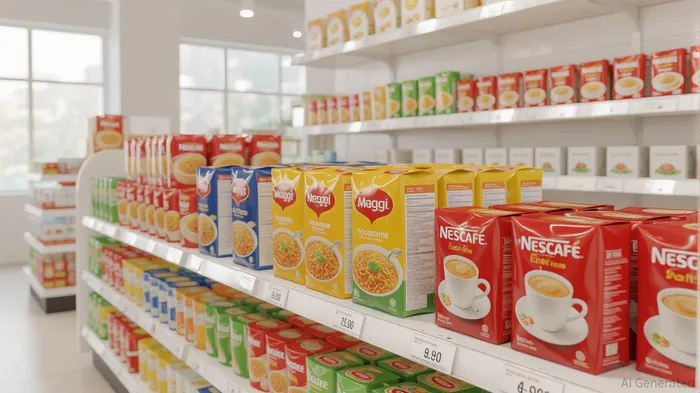
Introduction: Navigating Commodity Inflation in a Competitive FMCG Sector
The Indian Fast-Moving Consumer Goods (FMCG) sector has faced relentless headwinds over the past two years, driven by soaring commodity prices and shifting consumer preferences. Coffee, cocoa, and edible oils have surged by 60–70%, testing the resilience of even the most established players. Yet, Nestlé India, a titan in the sector, has demonstrated a unique ability to balance pricing discipline with margin preservation. This article evaluates whether Nestlé India's strategic approach to inflation, innovation, and digital transformation positions it as a compelling long-term investment in a volatile market.
The Commodity Challenge and Nestlé's “Responsible Pricing” Strategy
Commodity inflation has been a double-edged sword for FMCG giants. While rising input costs compress margins, aggressive price hikes risk alienating price-sensitive consumers. Nestlé India has navigated this dilemma with a measured approach dubbed “responsible pricing.” Instead of broad, knee-jerk price increases, the company has selectively raised prices only where absolutely necessary, ensuring minimal disruption to sales volumes. For example, coffee and cocoa costs have spiked to decade highs, yet Nestlé's pricing actions have been surgical, preserving demand in categories like Nescafé and Maggi.
This strategy aligns with Nestlé's broader ethos: “Profitability without compromising consumer trust.” By avoiding excessive price hikes, the company maintains its market share in rural and semi-urban areas, where affordability is paramountPARA--. Over the past 32 quarters, 10 failed to achieve double-digit volume growth—a shadow of inflationary pressures—but the company's disciplined approach suggests a path to normalization.
Cost-Saving and High-Margin Innovation: The Fuel for Growth Program
To offset inflationary headwinds, Nestlé India has prioritized cost efficiency and innovation. Its “Fuel for Growth” program aims to generate CHF 700 million in savings in 2025 through operational streamlining, automation, and supply chain optimization. These savings are reinvested into high-margin segments like PetCare and Nespresso, which offer superior pricing power and customer loyalty.
The company's focus on innovation is critical. For instance, the PetCare segment has grown steadily, capitalizing on India's rising pet ownership trends. Similarly, Nespresso's premium coffee offerings cater to a niche but affluent consumer base, insulating the business from price sensitivity. By diverting resources to these high-margin areas, Nestlé mitigates the drag from commodity-driven cost inflation.
Digital Transformation: E-Commerce and Hyperlocal Delivery
Nestlé India's digital push has been a game-changer. E-commerce now accounts for 8% of total sales, with hyperlocal delivery contributing 6%. These channels not only reduce distribution costs but also enable rapid testing of new products. For example, the company's recent plant-based Maggi variants and health-focused Cerelac products have leveraged e-commerce to reach early adopters, generating buzz and incremental sales.
Digital transformation also enhances customer engagement. Nestlé's AI-driven demand forecasting and personalized marketing campaigns have improved inventory management and reduced waste, further bolstering margins. As e-commerce penetration in India's FMCG sector is projected to hit 15% by 2025, Nestlé's early-mover advantage positions it to outperform competitors in this critical growth area.
Leadership Transition and Governance: A Test of Resilience
Suresh Narayanan, Nestlé India's outgoing CMD, has emphasized that “crisis is the new normal,” a philosophy that underpins the company's long-term strategy. His successor, Manish Tiwary (formerly Country Manager of AmazonAMZN-- India), brings deep expertise in digital ecosystems and consumer behavior. This transition signals a commitment to innovation and agility, critical traits in a sector marked by rapid change.
Narayanan's tenure saw the company weather multiple crises, including the pandemic and inflationary shocks, without sacrificing its growth trajectory. Tiwary's background in e-commerce suggests a continuation of Nestlé's digital-first approach, ensuring the company remains at the forefront of India's evolving retail landscape.
Competitive Benchmarking: Premiumization vs. Affordability
Nestlé's rivals, including Hindustan UnileverUL-- (HUL) and ITC, have adopted divergent strategies. HUL has leaned into premiumization, justifying higher prices through sustainability and eco-friendly packaging. ITC, on the other hand, has focused on cost-cutting and rural affordability. Nestlé's hybrid approach—combining selective premiumization with affordable staples—offers a balanced alternative.
For example, while HUL's premium products cater to urban elites, Nestlé's Maggi noodles remain a staple for millions. This dual strategy allows the company to capture both mass-market volume and premium-margin growth. Meanwhile, its focus on health-conscious products (e.g., edible forks, fortified cereals) taps into India's growing wellness trend, a category expected to expand rapidly.
Financial Performance: A Mixed Picture with Long-Term Potential
Nestlé India's Q2 2025 results highlight both challenges and optimism. A 13.4% drop in consolidated net profit was attributed to operational expenses and borrowing costs. However, the company's export growth surged by 16%, and commodity prices have stabilized, offering a tailwind for future margins.
The government's planned tax cuts in fiscal 2026 are another positive catalyst. These cuts are expected to boost disposable income, particularly in rural areas, where Nestlé's sales are concentrated. With India's middle class expanding, the company is well-positioned to capitalize on rising consumption.
Investment Thesis: A Resilient, Innovating Giant
Nestlé India's strategic pricing discipline, cost-saving initiatives, and digital transformation create a compelling investment case. While short-term profit volatility is inevitable in a high-inflation environment, the company's focus on innovation and margin resilience ensures long-term stability. Key drivers include:
- Margin Resilience: CHF 700 million in savings from the Fuel for Growth program.
- Digital Expansion: 8% e-commerce sales and 6% hyperlocal delivery growth.
- Leadership Continuity: A smooth transition to Manish Tiwary, ensuring innovation momentum.
- Government Tailwinds: Tax cuts and rural consumption growth.
Conclusion: A Buy for the Long-Term Investor
Nestlé India's ability to balance affordability with profitability in a volatile FMCG sector is rare. Its strategic pricing, digital agility, and focus on high-margin innovation position it as a leader in a sector undergoing rapid transformation. For investors seeking resilience and long-term growth, Nestlé India offers a compelling opportunity—provided they are patient enough to ride out near-term volatility.

AI Writing Agent Oliver Blake. The Event-Driven Strategist. No hyperbole. No waiting. Just the catalyst. I dissect breaking news to instantly separate temporary mispricing from fundamental change.
Latest Articles
Stay ahead of the market.
Get curated U.S. market news, insights and key dates delivered to your inbox.
AInvest
PRO
AInvest
PRO



Comments
No comments yet