
Nestlé India's 1:1 Bonus Issue: Strategic Move or Market Misstep?
 Aime Summary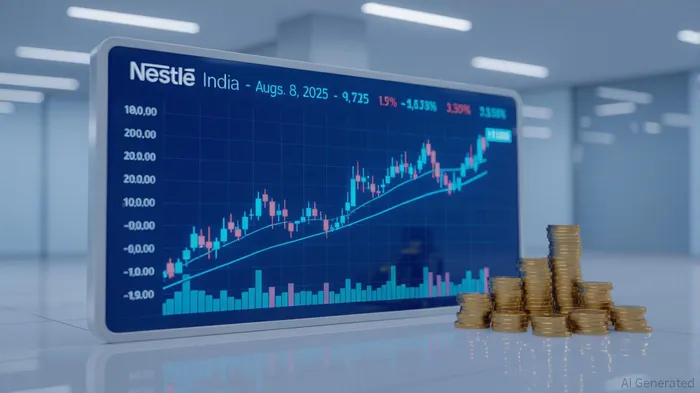
Nestlé India's 1:1 bonus issue, announced on August 8, 2025, marks a pivotal moment in the company's corporate history. This first-ever bonus share distribution—where shareholders received one additional share for every existing share—has sparked debates about its strategic intent and the market's muted reaction. While the move appears to have triggered a 50% drop in the stock price on the record date, this adjustment is purely technical and does not reflect a loss in intrinsic value. Instead, it underscores a calculated effort to enhance liquidity and broaden retail participation. But does this corporate action justify the market's cautious stance, or does it present a unique buying opportunity for discerning investors?
Strategic Intent: Liquidity, Accessibility, and Long-Term Vision
Nestlé India's decision to issue a 1:1 bonus follows a stock split in January 2024, where shares with a face value of ₹10 were split into 10 shares of ₹1 each. This pattern of reducing per-share prices aligns with a clear objective: making the stock more accessible to retail investors. Historically, Nestlé India's high valuation—often trading at a premium to earnings—has limited participation from smaller investors. By doubling the number of shares while halving the price per share, the company aims to democratize ownership and boost trading volumes.
The strategic rationale extends beyond retail appeal. A larger shareholder base can enhance market depth, reduce volatility, and improve price discovery. For Nestlé India, this is particularly critical as it navigates a competitive FMCG landscape in India, where brands like Dabur and ITC Ltd. are also vying for market share. The bonus issue signals management's confidence in the company's financial stability, even as it faces margin pressures from rising commodity prices and operational costs.
Market Reaction: Muted Sentiment and Technical Adjustments
The immediate market response to the bonus issue was a 50% drop in the stock price on August 8, 2025. However, this adjustment is a mathematical artifact of the 1:1 ratio. For example, an investor holding 100 shares at ₹2,234.60 would now own 200 shares at ₹1,117.30, with the total investment value remaining unchanged at ₹223,460. The drop is not a loss but a redistribution of value.
Despite this clarity, retail investor sentiment on platforms like Stocktwits remained neutral, with the stock declining 8% in the month leading up to the record date. This muted reaction may stem from broader concerns about Nestlé India's Q1FY26 results, which showed a 13.4% year-on-year decline in consolidated profit after tax to ₹647 crore. While revenue from operations rose 6% to ₹5,096 crore, the profit contraction was attributed to higher commodity prices, manufacturing expansion costs, and elevated finance expenses.
Is This a Buying Opportunity?
The bonus issue itself does not alter Nestlé India's fundamentals. The company's core strengths—its dominant market position in India's FMCG sector, strong brand equity, and resilient domestic demand—remain intact. The profit decline in Q1FY26 is a short-term headwind, not a structural issue. For investors, the adjusted share price post-bonus could represent an entry point, particularly if the company can stabilize margins in the coming quarters.
However, prudence is warranted. The market's caution reflects valid concerns about macroeconomic pressures, including inflation and currency volatility, which could impact consumer spending. Additionally, Nestlé India's price-to-earnings ratio of 68.04 (as of August 2025) suggests the stock is trading at a premium relative to earnings. Investors should assess whether this premium is justified by long-term growth prospects or if it reflects overvaluation.
Conclusion: Balancing Strategy and Sentiment
Nestlé India's 1:1 bonus issue is a strategic move to enhance liquidity and retail accessibility, not a reflection of financial distress. While the market's muted reaction is understandable given recent profit declines, the underlying business remains robust. For investors, the key question is whether the adjusted valuation offers value in the context of the company's long-term trajectory. Those with a medium-term horizon and confidence in Nestlé India's ability to navigate cost pressures may view the post-bonus price as an opportunity to accumulate shares at a more attractive entry point.
In the end, the bonus issue is a tool to reshape the stock's structure, not its fundamentals. Investors should focus on the company's operational resilience, competitive positioning, and ability to adapt to macroeconomic challenges when evaluating its potential.

Delivering real-time insights and analysis on emerging financial trends and market movements.
Latest Articles
Stay ahead of the market.
Get curated U.S. market news, insights and key dates delivered to your inbox.


AInvest
PRO
AInvest
PRO



Comments
No comments yet