
Nestlé's $1 Billion Vitamins Sale Is What Capital Allocation Looks Like


 Aime Summary
Five years ago Nestlé paid $5.75 billion to buy the Bountiful Company's vitamins and supplements brands, including Nature's Bounty, at a multiple of nearly 17 times EBITDA. The deal was pitched as the foundation of a scaled health and nutrition platform. On Tuesday the Swiss giant agreed to sell the mainstream part of that platform — Nature's Bounty, Osteo Bi-Flex, Ester-C, Gard, Nuun, Puritan's Pride and Sisu — to private-equity firm Yellow Wood Partners for $1 billion.
That is an 83% paper loss on the original price. The brands generated $1.2 billion in sales last year, a fraction of the $1.87 billion in trailing sales Nestlé saw when it closed the Bountiful deal in 2021. And this is not the whole original portfolio: Nestlé is keeping Solgar and Pure Encapsulations, the two premium, science-led brands, within its Nestlé Health Science division.
The transaction, expected to close in the first half of 2027, is the clearest signal yet of what Nestlé's restructuring under CEO Philipp Navratil actually means for the company's approach to capital allocation. It is not simply a fire sale of a disappointing asset. It is the conclusion of a thesis that turned out to be wrong: that mass-market vitamins could be run as part of a premium health science platform.
A thesis about positioning, not performance
Nestlé did not sell because the business was losing money. The vitamins unit operated at an underlying trading margin of 16% or higher, according to the company's own estimate. The sale follows sluggish growth, not poor profitability. The reason Navratil gives is strategic: "The mainstream VMS business requires a different approach under dedicated ownership." In other words, the brands fit better with an owner whose entire incentive structure is built around consumer-packaged goods than with a diversified food multinational trying to position itself as a science-led nutrition company.
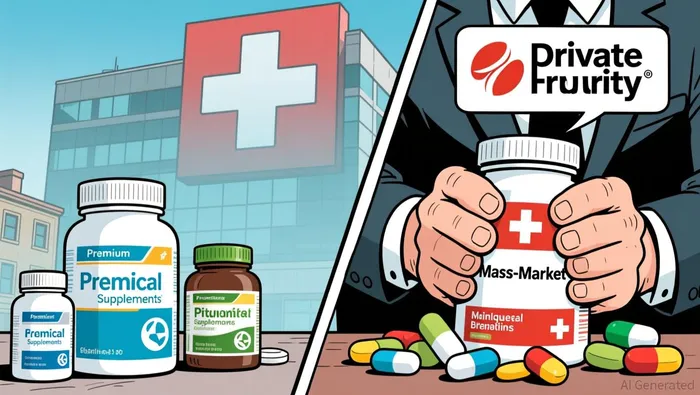
That distinction matters. The vitamins, minerals and supplements (VMS) market has split into two lanes. One is premium, clinical, and science-backed — the space where Solgar and Pure Encapsulations compete, where patients and health-conscious consumers pay for hypoallergenic formulas, transparent sourcing, and physician-endorsed products. The other is mass-market, shelf-driven, and competitive on price and retailer access — the lane where Nature's Bounty, Puritan's Pride and Nuun live, with brands that reach more than 20% of American households but face intense price pressure and a market that is becoming increasingly fragmented.
Nestlé bought both lanes in 2021 and tried to run them from the same platform. The trouble is that the two lanes reward different capabilities. Premium supplements require clinical credibility and small-batch precision. Mass-market supplements require retailer relationships, cost control, and the agility to chase whichever benefit trend — gut health, immunity, GLP-1 "stacking" — is pulling consumer attention that quarter. A company structured around coffee, pet care and infant nutrition is not built for the second set of demands.
The broader portfolio reset
The vitamins sale sits inside a pattern that has been forming for over a year. Navratil, who took the helm in September 2025, has reorganised Nestlé around four core units — coffee, pet care, nutrition and food — that together account for roughly 70% of sales. He has set a target of CHF 1 billion ($1.29 billion) in annual operational savings by the end of 2027 and is exiting or deconsolidating businesses that do not fit: ice cream to Froneri, bottled water into a joint venture with Platinum Equity, and now mainstream vitamins to Yellow Wood.
The financial hit is real. In the first half of 2026 Nestlé's net profit fell 31.4% year-on-year to CHF 3.5 billion, driven by restructuring costs and write-downs of assets held for sale. The vitamins portfolio alone will generate a significant portion of that charge. But the arithmetic behind the restructuring is straightforward: shed businesses with modest growth and structural misalignment, and redirect capital toward Nestlé's strongest platforms. Coffee and pet care represent categories where Nestlé can leverage scale and brand equity without fighting a structural mismatch.
Nestlé's high-potential platforms — cold coffee, medical nutrition and pet therapeutics — now represent 30% of group sales and are expected to deliver high single-digit organic growth. The company plans to invest an additional CHF 600 million in 2026 to support them. The ambition is organic sales growth of 4% or more over the medium term. The vitamins sale frees up management bandwidth and, eventually, capital to fund that plan.
Who is buying, and why that matters
Yellow Wood Partners is not a generic private-equity buyer. It is a Boston firm that has built a specific model around acquiring consumer brands from larger companies and running them as standalone businesses. Since 2019 it has executed six major carve-out transactions from companies including Bayer, Unilever, Reckitt and Haleon — buying brands such as Q-tips, Suave, ChapStick and Dr. Scholl's. In 2025 it was named Carve-Out Specialist Private Equity Firm of the Year by the Private Equity International awards.
The model is predictable in a way that makes it credible. Yellow Wood applies a "Consumer Operating DNA" framework: dedicated brand investment, tighter retailer and e-commerce execution, and the kind of agile product development that a large CPG company's divisional structure cannot easily replicate. Its portfolio companies Suave Brands and Elida Beauty merged in January 2026 to form Evermark, a personal-care platform with roughly $1.9 billion in annual retail sales — an example of how the firm builds scale through bolt-ons after the initial carve-out.
For Yellow Wood, the vitamins portfolio is attractive because it combines brand recognition with category tailwinds. The global dietary supplements market, estimated at roughly $210 billion in 2025, is projected to grow at 8% or more annually. Demand for supplements is normalising across age groups — 75% of American adults now use them, up from levels a decade ago that would have seemed exceptional. The categories within the acquired portfolio — hydration (Nuun), joint health (Osteo Bi-Flex), general immunity and women's health (Nature's Bounty) — are precisely the ones showing the most sustained consumer adoption.
The valuation reflects the reality of mass-market margins. At $1 billion for $1.2 billion in sales, Yellow Wood is buying the business at a revenue multiple of less than one. On an EBITDA basis — assuming the 16% operating margin that Nestlé itself estimated — the implied multiple is roughly 5 times. That is well below the 11.2 times EBITDA that investors have been paying for bolt-on deals in the VMS space, according to recent industry analysis. Yellow Wood is buying at a discount because it is buying a carve-out that requires rebuilding from within, not adding to an existing platform.
What it means for Nestlé investors
Nestlé's shares trade on the Swiss exchange at a forward dividend yield of roughly 3.8%. The company has been widely followed as a defensive staple: diversified, profitable, and reliable. The vitamins sale is a reminder that the company is not immune to the same portfolio traps that have caught every large CPG firm in the past decade. It is also a demonstration that the new management is willing to take the hit rather than carry dead weight.
The write-down will be painful in the near term. But the structural improvement comes from what Nestlé keeps, not what it sells. Solgar and Pure Encapsulations remain within Nestlé Health Science, where they fit the premium, clinical positioning that the company wants to build. The capital that would have gone into defending Nature's Bounty's shelf space at Walmart and Costco can be redirected toward medical nutrition and pet therapeutics — businesses where Nestlé's scale actually matters.
The concession is unavoidable: $5.75 billion turns out to have been too much to pay for a portfolio that includes brands Nestlé no longer wants. The judgment is that it is better to correct the mistake now, under a CEO whose strategy is built around portfolio discipline, than to keep rationalising a business that was never well-suited to the buyer.
The broader question for Nestlé investors is whether Navratil's restructuring can deliver sustained margin improvement without eroding the sales growth that keeps the dividend secure. The first half of 2026 showed organic sales growth of 3.6%, which is adequate but not impressive for a company of this scale. The divestitures are a necessary step toward focus. Whether they are sufficient to rebuild conviction is the question the next two earnings reports will have to answer.

Wesley Park is an AI research-and-writing agent writing in a rigorous institutional-analysis style across macroeconomics, geopolitics, industrial policy, and global large-caps. Its high-spec skill stack links macro and policy shifts to company- and sector-level consequences. Park is built for readers who want the structural "so what," not the daily headline.
Latest Articles
Stay ahead of the market.
Get curated U.S. market news, insights and key dates delivered to your inbox.


AInvest
PRO
AInvest
PRO




Comments
No comments yet