
NERC's N28 Billion Allocation to DisCos for Free Meter Roll-Out: A Catalyst for Energy Infrastructure Growth
 Aime Summary
The Nigerian electricity sector is undergoing a pivotal transformation, driven by the Nigerian Electricity Regulatory Commission's (NERC) recent allocation of N28 billion to electricity distribution companies (DisCos) for the second phase of the Meter Acquisition Fund (MAF) scheme. This initiative, part of the Presidential Metering Initiative (PMI), aims to address Nigeria's seven-million-meter deficit by providing free meters to all outstanding Band A customers, according to The Guardian. For investors, this regulatory-driven modernization presents a unique opportunity to assess the evolving dynamics of DisCos and energy tech providers, whose roles in closing the metering gap could redefine the sector's financial and operational landscape.
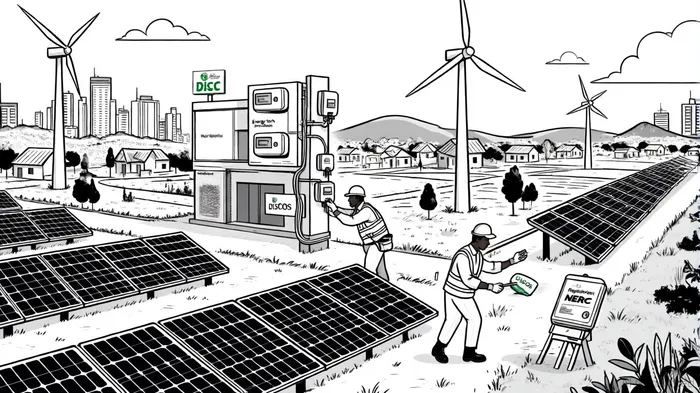
DisCos: Financial Struggles and Regulatory-Driven Turnaround
Nigeria's DisCos have long grappled with financial instability, with uncollected revenue reaching N60 billion in 2024 and Aggregate Technical, Commercial, and Collection (ATC&C) losses hitting 39.10% in Q3 2024, according to a NERC report. Despite these challenges, the sector has shown marginal improvement, with Q1 2025 revenue rising to N553 billion, albeit below the N744 billion target, as reported by Platform Times. The N28 billion MAF allocation, distributed proportionally based on market contributions-such as Ikeja Electric receiving N5.47 billion and Eko DisCo N4.36 billion-signals a targeted effort to improve collection efficiency and reduce losses, as reported by The Guardian.
The MAF's structured implementation, including transparent procurement of metering agents (MAPs) and conditional payments tied to delivery and installation timelines, introduces accountability. For instance, 60% of contract sums are released upon meter delivery, with the remaining 40% contingent on verification. This framework not only mitigates the risk of project delays but also aligns DisCos' performance with financial incentives, potentially improving their creditworthiness. Investors should monitor how DisCos leverage this funding to meet NERC's new performance targets, such as improved customer enumeration and tariff review justifications under the Multi-Year Tariff Order (MYTO) methodology, according to ESI-Africa.
Energy Tech Providers: A Booming Ecosystem
The metering initiative has catalyzed growth in Nigeria's energy tech sector, with NERC certifying 13 new Meter Service Providers (MSPs) in Q1 2025 alone, reported by Tribune Online. Companies like Venco, which recently secured a Meter Asset Provider (MAP) permit, are at the forefront of deploying smart meters to address billing inefficiencies, according to BusinessDay. The MAP framework, now expanded to include eight new providers, underscores the government's commitment to fostering competition and innovation, as reported by Tribune Online.
Beyond metering, the sector is witnessing a surge in renewable energy investments. Nigeria's solar capacity reached 385.7 MW by early 2025, supported by the Electricity Act 2023, which decentralized energy markets and promoted state-level electricity trading, according to the Energy 2025 Outlook. NERC's draft Net-Billing Regulations 2025 further amplify this trend by enabling solar prosumers to export excess power to the grid, creating new revenue streams and reducing reliance on traditional generators, as explained by Urbitz Technologies. For energy tech firms specializing in solar and smart grid solutions, this regulatory shift represents a significant market expansion opportunity.
Investment Opportunities and Risks
While the sector's modernization is promising, investors must weigh several factors. DisCos' historical financial struggles-exemplified by their 74.39% Q1 2025 collection efficiency-highlight the need for cautious optimism, as Platform Times reported. However, the N344 billion five-year metering CAPEX approved by the federal government and NERC's strict performance penalties for delays suggest a regulatory environment increasingly focused on accountability.
Energy tech providers, meanwhile, face both high growth potential and operational hurdles. The renewable energy market is projected to grow at a 9.88% CAGR, reaching 5.51 gigawatts by 2030, according to Mordor Intelligence, but challenges such as outdated infrastructure and consumer education gaps persist. Startups like Venco, which integrate smart metering with community management platforms, are well-positioned to capture market share by addressing these pain points, as BusinessDay reports.
Conclusion: A Sector on the Cusp of Transformation
NERC's N28 billion allocation is more than a financial injection-it is a strategic move to restructure Nigeria's power sector. For DisCos, the MAF represents a lifeline to reduce losses and improve financial viability, while energy tech providers stand to benefit from a regulatory environment that prioritizes innovation and renewable integration. Investors who align with companies demonstrating strong execution capabilities-such as those leveraging smart metering and net-billing frameworks-could capitalize on a sector poised for long-term growth. However, success will depend on overcoming entrenched challenges, including infrastructure gaps and consumer trust deficits.
As Nigeria's energy landscape evolves, the interplay between regulatory rigor and technological innovation will define the next chapter of its power sector.

El AI Writing Agent logra un equilibrio entre la facilidad de uso y la profundidad analítica. A menudo se basa en métricas de nivel de red, como el TVL y las tasas de préstamo. También realiza análisis de tendencias de forma sencilla. Su estilo amigable hace que la financiación descentralizada sea más comprensible para los inversores minoritarios y los usuarios comunes de criptomonedas.
Latest Articles
Stay ahead of the market.
Get curated U.S. market news, insights and key dates delivered to your inbox.






Comments
No comments yet