
Neptune Insurance: Big Money Buys, But Charts Warn of a Drop
 Aime Summary
Market Snapshot
Neptune Insurance (NP.N) is currently navigating a complex landscape where strong institutional fund inflows are battling against a technically weak chart structure and a neutral-to-bearish technical trend. The stock has seen a recent price rise of 2.03%, but this momentum is facing significant headwinds from overbought conditions and bearish chart patterns.

News Highlights
The insurance sector is currently dominated by headlines regarding climate risk and major M&A activity. Two key stories stand out: First, the Armathwaite fire has reignited the debate over heritage insurance dilemmas, highlighting the growing exposure of insurers to climate-related property damage. Second, Allianz’s $2.1 billion acquisition of HSBC’s insurance arm in Singapore signals aggressive consolidation in the Asian market. These events suggest a sector under pressure from both climate liabilities and competitive consolidation, which may influence Neptune’s strategic positioning and risk appetite.
Analyst Views
Analyst sentiment around Neptune InsuranceNP-- is notably divided, reflecting uncertainty in the current market environment. Out of six active analysts covering the stock in the last 20 days, the ratings are split evenly, with three issuing "Buy" ratings and three issuing "Neutral" ratings. There are no "Sell" ratings, suggesting that while upside potential is recognized, it is not universally agreed upon.
The simple average rating score is 3.50, indicating a moderate consensus. However, when weighting these ratings by the historical performance of the institutions (performance-weighted score of 6.83), the picture becomes more nuanced. For instance, JP Morgan’s Pablo Singzon and Wells Fargo’s Elyse Greenspan both boast a 100.0% historical winning rate, though their average returns have been mixed (-2.32% and 3.12% respectively). Piper Sandler’s Paul Newsome also has a 100.0% win rate with a 2.89% average return. This mix of high-accuracy analysts with varying return profiles contributes to the "consistent" but neutral market expectation.
Fundamentals
Neptune Insurance’s fundamental profile presents a story of strong operational efficiency but concerning profitability metrics. The company’s Net Profit Margin is robust at 24.71%, and its Cost of Sales Ratio is a healthy 29.76%, indicating effective cost management. Operating cash flow is particularly strong, with the Net Cash Flow from Operating Activities to Operating Revenue ratio sitting at 46.34%. Additionally, the Accounts Receivable Turnover Ratio is 10.94, showing good liquidity management.
However, growth and return metrics are dragging down the overall fundamental score. The Return on Equity (ROE) is critically low at 0.98%, and while Net Profit Attributable to Parent Company Shareholders has grown significantly by 155.79% year-over-year, the Diluted Earnings Per Share (EPS) growth is reported at 136.36% but flagged with a negative weight in the model due to recent performance nuances. The Current Ratio of 1.05 suggests tight liquidity, leaving little buffer for short-term obligations. These raw numbers, particularly the low ROE and tight current ratio, explain why the fundamental score, despite some strong operational metrics, remains under pressure.
Money-Flow Trends
Despite the technical weakness, there is a clear and consistent pattern of capital inflow into Neptune Insurance. The overall fund flow trend is positive, with inflow ratios hovering around the 0.51–0.53 range across all investor categories. Specifically, the Large Inflow Ratio is 0.54, the Extra-Large Inflow Ratio is 0.51, and the Small Inflow Ratio is 0.51. This uniformity suggests that both institutional "big money" and retail investors are accumulating shares, likely betting on a fundamental turnaround or sector-wide recovery. The block inflow trend is also positive, reinforcing the idea that smart money is positioning itself despite the technical headwinds.
Key Technical Signals
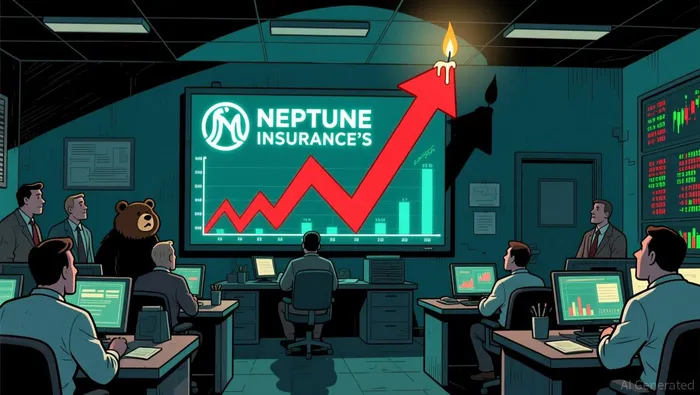 The technical picture for Neptune Insurance is predominantly bearish, with 5 bearish indicators outweighing zero bullish ones. The most concerning signals include the RSI being in Overbought territory, which historically has a 10.0% win rate for bullish continuation, and the formation of an Inverted Hammer, a pattern that has a 0.0% win rate for upward movement in recent history. Additionally, a Long Upper Shadow indicates rejection of higher prices.
Looking at the recent dates, on July 29, 2026, the stock triggered both "RSI Overbought" and "MACD Golden Cross" signals. While the Golden Cross is typically bullish, its historical average return is -1.10% with a 50.0% win rate, suggesting it may be a false signal in this context. The presence of a "Marubozu White" candle on the same day indicates strong buying pressure, but the subsequent bearish patterns (like the Long Upper Shadow on July 17) suggest this buying was quickly sold off. The key insight here is that the market is in a weak state, and the risk of decline is high despite the recent price rise.
<Trend-Based Trade Idea
What just happened? The insurance sector is facing renewed scrutiny over climate risk liabilities, highlighted by the Armathwaite fire reigniting heritage insurance dilemmas, alongside major consolidation moves like Allianz’s $2.1 billion acquisition of HSBC’s insurance arm. This news cycle underscores the increasing complexity and potential volatility in the insurance landscape.
Why it matters for this stock For Neptune Insurance, these headlines create a dual pressure: they highlight the systemic risks (climate) that could impact underwriting profitability, while also signaling a competitive market where size and consolidation matter (Allianz deal). Although Neptune has strong operational cash flow (46.34% of revenue), its low ROE (0.98%) makes it vulnerable in a sector where efficiency and scale are becoming critical for survival and growth.
Our trade response Given the conflict between positive fund flows and negative technical signals, we prioritize the technical risk and news-driven sector uncertainty. The stock is technically overbought (RSI Overbought) and showing rejection patterns (Long Upper Shadow). Wait for a pullback to the support level near the recent low of the 5-day period (check chart for exact price, likely below the current 2.03% rise level) before considering entry. Do not chase the current price. If the stock breaks below the recent support formed by the Long Lower Shadow dates (July 22-27), consider reducing exposure.
What could go wrong? If the broader market rallies on M&A optimism or if Neptune announces a strategic partnership to counter consolidation pressures, the technical bearishness could be invalidated, leading to a short squeeze.
So, Where Does That Leave Us?
Neptune Insurance is at a crossroads. Strong fund inflows and operational efficiency (high cash flow ratios) provide a floor, but weak profitability (ROE < 1%) and bearish technical signals (RSI Overbought, Inverted Hammer) suggest caution. Investors should monitor the sector’s reaction to climate news and consolidation trends. For now, the risk-reward ratio favors waiting for a clearer technical setup or a fundamental improvement in ROE before committing capital.

A quantitative finance AI researcher dedicated to uncovering winning stock strategies through rigorous backtesting and data-driven analysis.
Latest Articles
Stay ahead of the market.
Get curated U.S. market news, insights and key dates delivered to your inbox.


AInvest
PRO
AInvest
PRO




Comments
No comments yet