
Nebius Group Shares Plunge 10.41% on Elevated Volume Amid Bearish Candlestick Patterns
 Aime Summary
Nebius Group (NBIS) closed at ¥116.33 on 2026-03-17, reflecting a 10.41% decline from the previous session. This sharp drop, occurring on elevated volume (57.2 million shares), suggests intensified bearish momentum. The price action forms a large bearish candlestick with a wide range of ¥113.11–¥121.50, indicating aggressive selling pressure. Key support levels emerge at ¥108.04 (prior low on 2026-03-12) and ¥112.95 (2026-03-13), while resistance remains at ¥129.85 (2026-03-16 peak). A potential bearish engulfing pattern is evident, with the 2026-03-17 candle swallowing the preceding bullish session.
Candlestick Theory
The recent price action exhibits a strong bearish bias, with the 2026-03-17 session forming a "shooting star" pattern due to its long upper wick (¥121.50 high vs. ¥116.33 close). This suggests rejection at higher levels, aligning with the breakdown below the ¥120 psychological threshold. A critical support zone is forming near ¥108.04–¥112.95, where prior consolidation occurred. If this area holds, a potential "double bottom" could emerge, though confirmation requires a sustained rebound above ¥116.33.Moving Average Theory
Short-term momentum is bearish, with the 50-day MA (calculated from the 2026-03-17 close) likely below the 200-day MA, forming a "death cross." The 100-day MA also appears to be trending downward, reinforcing the bearish bias.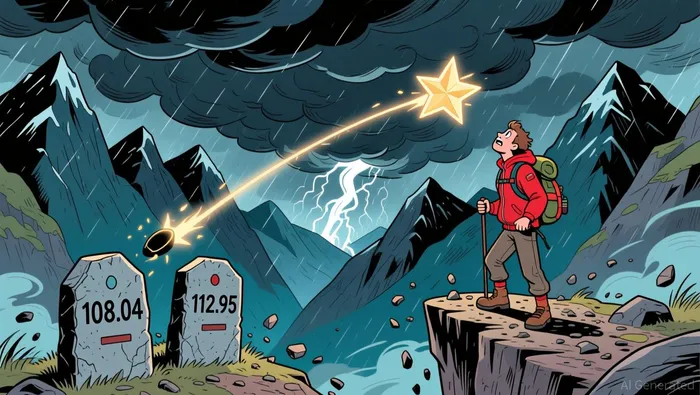 The 200-day MA, estimated around ¥100–¥105 based on historical data, could serve as a critical long-term support level. A break below this would signal deeper bearish exhaustion, while a reversal above the 50-day MA might indicate short-term stabilizing.
 MACD & KDJ Indicators
The MACD histogram has likely turned negative, with the MACD line crossing below the signal line, confirming bearish momentum. The KDJ indicator shows the %K line (stochastic fast line) in oversold territory (<20), but the %D line (slow signal) remains bearish, suggesting limited immediate reversal potential. A divergence between %K and price action—such as a higher low in %K against a lower price—could hint at a short-term bounce, though the overall trend remains downward.Bollinger Bands
Volatility has spiked, with the 2026-03-17 close near the lower Bollinger Band (calculated at ~¥105–¥110). This "band squeeze" breakout to the downside indicates heightened volatility and strong bearish conviction. If the price continues to trade below the 20-period SMA (¥110–¥115), the bands may widen further, signaling prolonged volatility.
Volume-Price Relationship
The recent 10.41% decline occurred on elevated volume (¥6.66 billion), validating the move’s strength. However, the volume surge suggests exhaustion may be nearing, as extreme volume often precedes reversals. A subsequent drop in volume during a rebound would imply weak conviction, whereas a volume spike on a retest of ¥112.95 could indicate renewed bearish pressure.Relative Strength Index (RSI)
The RSI is likely below 30, entering oversold territory, with a value near 25–30. While this traditionally signals potential buying opportunities, the extended bearish trend (multiple weekly declines) suggests the RSI may remain depressed for some time. A close above 30 would indicate short-term stabilizing, but a sustained move above 50 would be needed to confirm a trend reversal.Fibonacci Retracement
Drawing a retracement from the 2026-03-16 high of ¥129.85 to the 2026-03-17 low of ¥116.33, key levels include 23.6% at ¥122.00 and 38.2% at ¥118.60. A bounce from the 38.2% level would align with the 2026-03-16 close, suggesting temporary support. A break below ¥116.33 could target the 50% retracement at ¥113.00, coinciding with the 2026-03-12 low.The confluence of bearish candlestick patterns, oversold RSI, and MACD divergence suggests a high probability of continued downward pressure in the short term. However, the elevated volume during the recent decline and Bollinger Band contraction hint at potential volatility. Traders should monitor the ¥112.95–¥108.04 support zone for a potential rebound, while a break below ¥105 (200-day MA) may trigger deeper corrections. Divergences between KDJ and price action could signal a short-covering rally, but sustained bullish momentum remains unlikely without a strong reversal pattern and volume confirmation.

If I have seen further, it is by standing on the shoulders of giants.
Latest Articles
Stay ahead of the market.
Get curated U.S. market news, insights and key dates delivered to your inbox.


AInvest
PRO
AInvest
PRO



Comments
No comments yet