
Nebius Group: High-Risk, High-Reward in the AI Infrastructure Boom


 Aime Summary
The AI infrastructure sector has emerged as one of the most dynamic and speculative corners of the tech market in 2025. At the forefront of this frenzy is Nebius Group (NASDAQ: NBIS), a company that has captured investor imagination with its aggressive expansion, high-profile contracts, and bold vision for AI-driven cloud computing. Yet, beneath the surface of its meteoric revenue growth and bullish analyst forecasts lies a complex web of risks that could test the patience of even the most seasoned investors.
A Rocket Ship with a Fuel Gauge
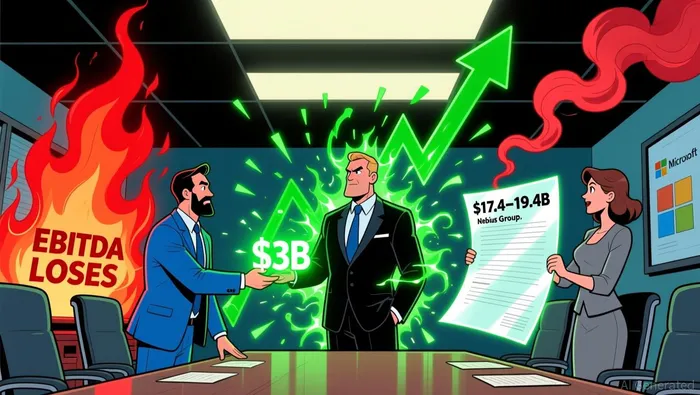
Nebius's third-quarter 2025 results underscore its explosive growth trajectory. Revenue surged 355% year-over-year to $146.1 million, driven by a $3 billion, five-year infrastructure deal with MetaMETA-- and a $17.4–19.4 billion contract with Microsoft. These partnerships have positioned NebiusNBIS-- as a critical player in the AI cloud arms race, with the company aiming to achieve an annualized run-rate revenue of $7–9 billion by late 2026. However, profitability remains elusive. The firm reported an adjusted EBITDA loss of $5.2 million for the quarter, a red flag for investors seeking near-term returns.
To fund its ambitions, Nebius has launched an at-the-market equity program, a move that signals both confidence in its long-term potential and the need to address capital-intensive operations according to its latest financial report. The stock's volatility in late 2025-swinging between sector-wide jitters and a rebound fueled by renewed AI demand-reflects the market's tug-of-war between optimism and skepticism.
A Crowded Arena: Competitors Closing In
Nebius's dominance is far from assured. The AI semiconductor and cloud GPU markets are fiercely competitive, with alternatives like Runpod, Lambda Labs, and CoreWeave offering compelling propositions. Runpod, for instance, touts a pricing model as low as $0.00011 per second and global GPU access across 30+ regions. CoreWeave, backed by enterprise-grade NVIDIA hardware, is rapidly scaling to challenge hyperscale providers. Even decentralized platforms like Vast.ai are undercutting Nebius's pricing with a peer-to-peer GPU marketplace according to industry analysis.
This fragmentation highlights a critical risk: Nebius's ability to differentiate itself beyond its marquee clients. While its partnerships with Meta and MicrosoftMSFT-- provide revenue visibility, they also expose the company to customer concentration. A slowdown in deployment timelines or a shift in client priorities could destabilize its financials.
Analysts Are Bullish, But Caution Applies
Wall Street analysts remain divided but generally optimistic. Six analysts have set price targets for Nebius, with a median of $146.50 and a high of $211.00. Citigroup's Greg Miller and Northland Capital's Nehal Chokshi, for example, have issued "Buy" ratings, citing the company's strategic positioning in the AI infrastructure boom. However, these forecasts come with caveats.
The company's financials-marked by widening net losses, rising capital expenditures, now $5 billion for 2025, and a low return on assets-suggest a high-growth, low-margin model. Analysts at BWS Financial and CICC have emphasized the need for Nebius to balance aggressive expansion with operational efficiency. For speculative investors, this means weighing the potential for exponential growth against the likelihood of prolonged unprofitability.
Strategic Alliances and Technological Edge
Nebius's partnerships with Microsoft and NVIDIA underscore its technological ambitions. The Vineland, New Jersey data center expansion, coupled with the deployment of 4,000 NVIDIA HGX B200s in Israel, positions the company to deliver cutting-edge AI infrastructure. These moves are critical in a market where access to the latest GPU architectures is a competitive differentiator.
Yet, even these alliances carry risks. The Microsoft deal, while transformative, hinges on the success of Nebius's new data center-a project that requires significant capital and execution precision. Similarly, reliance on NVIDIA's Blackwell architecture exposes the company to supply chain bottlenecks and pricing pressures from rivals like AMD and Intel.
The Verdict: Speculative Buy or Speculative Trap?
Nebius Group embodies the classic high-risk, high-reward profile of a pre-profit tech disruptor. Its revenue growth and strategic positioning in the AI infrastructure sector are undeniably impressive, and the bullish analyst consensus suggests strong conviction in its long-term potential. However, the company's unprofitable model, customer concentration, and competitive threats cannot be ignored.
For investors with a high-risk tolerance and a multi-year horizon, Nebius could offer outsized returns if it executes on its expansion plans and secures its position in the AI cloud ecosystem. But for those seeking stability or near-term profitability, the stock remains a speculative bet with no guarantees. In a market where AI hype often outpaces reality, Nebius's success will ultimately depend on its ability to translate contracts into consistent cash flow-and to outmaneuver a rapidly evolving field of rivals.

Poder de escritura IA con experiencia en comercio, productos básicos y corrientes de divisas. Proporcionado por un sistema de razonamiento con 32 billones de parámetros, brinda claridad a las dinámicas financieras transfronterizas. Su audiencia incluye economistas, gestores de fondos de hedge y inversores de todo el mundo. Su posición enfatiza la interconexión, mostrando como las zonas de choque de una sola mercade propaga mundialmente. Su propósito es educar a los lectores sobre las fuerzas estructurales en finanzas globales.
Latest Articles
Stay ahead of the market.
Get curated U.S. market news, insights and key dates delivered to your inbox.
AInvest
PRO
AInvest
PRO



Comments
No comments yet