
Nebius Group's $17.4B Microsoft AI Infrastructure Deal and Its Implications for AI Cloud Growth


 Aime Summary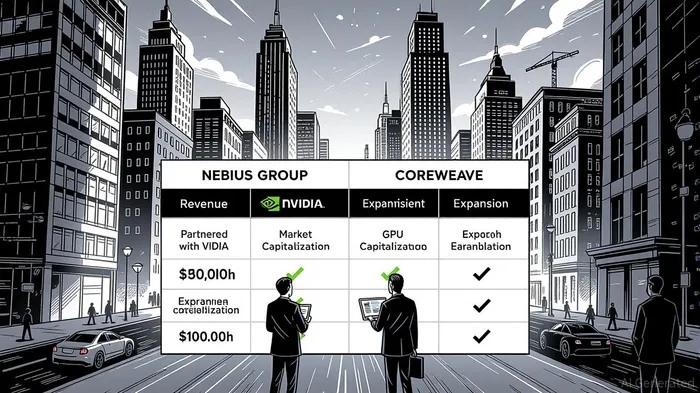
The AI infrastructure sector is undergoing a seismic shift, driven by the insatiable demand for high-performance computing to power next-generation artificial intelligence models. At the center of this transformation is Nebius GroupNBIS--, a rising star in the cloud computing space, which has just inked a landmark $17.4 billion, five-year deal with MicrosoftMSFT-- to supply dedicated GPU infrastructure. This agreement, potentially expandable to $19.4 billion, underscores the strategic importance of AI compute and positions NebiusNBIS-- to capitalize on a sector poised for explosive growth.
A Strategic Partnership with Microsoft: Fueling the AI Compute Boom
According to a report by Reuters, Nebius will begin delivering GPU capacity from its new data center in Vineland, New Jersey, later in 2025, with services extending through 2031 [1]. The deal is structured to leverage Microsoft’s strong credit profile, allowing Nebius to finance capital expenditures through a mix of cash flow from the contract and secured debt issuance [2]. This financial agility is critical in an industry where upfront infrastructure costs are astronomical.
The timing of the deal is impeccable. As stated by Arkady Volozh, Nebius’s CEO, the partnership will accelerate the company’s AI cloud business growth starting in 2026, aligning with Microsoft’s broader push to dominate the AI landscape [3]. Microsoft’s reliance on Nebius reflects a broader industry trend: hyperscalers are increasingly outsourcing compute needs to specialized infrastructure providers to avoid the capital intensity of building in-house capabilities.
Competing with CoreWeave: Diversification vs. Scale
Nebius’s most direct competitor in the AI infrastructure space is CoreWeaveCRWV--, a company with a 2024 revenue of $1.9 billion and a market cap of $19–23 billion [4]. CoreWeave’s business model is hardware-centric, focusing on rapid deployment of NVIDIANVDA-- GPUs for large-scale AI training. While this approach has allowed CoreWeave to secure major clients like Microsoft and OpenAI, it also exposes the company to revenue concentration risks—Microsoft alone accounts for two-thirds of CoreWeave’s 2024 revenue [5].
Nebius, by contrast, is building a more diversified ecosystem. Its partnership with NVIDIA includes a $700 million investment led by the chipmaker and venture capital firm Accel, and the company plans to integrate NVIDIA’s Blackwell-series GPUs into its cloud platform [6]. Unlike CoreWeave, which offers bare-metal GPU access, Nebius provides a full-stack solution with managed services such as MLOps and application-layer tools, appealing to a broader range of clients, including startups and enterprise teams [7].
Scalability and Global Expansion: A Path to Dominance
Nebius’s U.S. expansion is not limited to Vineland. The company is adding capacity in Kansas City, Iceland, and Finland, with plans to expand further in the U.K. and Israel [8]. This geographic diversification reduces reliance on any single market and positions Nebius to serve global clients with low-latency, high-capacity infrastructure.
Financially, Nebius is in a stronger position than CoreWeave. With $1.68 billion in cash reserves and a projected annual recurring revenue (ARR) of $900 million to $1.1 billion by the end of 2025 [9], Nebius has the liquidity to fund its $1 billion AI infrastructure investment by mid-2025. CoreWeave, meanwhile, reported a net loss of $863 million in 2024 and carries significant debt from aggressive expansion [10].
Strategic Timing and Long-Term Investment Potential
The AI infrastructure sector is entering a phase of hypergrowth, driven by the deployment of large language models, generative AI, and enterprise adoption. Nebius’s $17.4 billion deal with Microsoft is not just a revenue windfall—it’s a strategic masterstroke that secures the company’s role in the AI compute supply chain for years to come.
For investors, the key question is whether Nebius can maintain its momentum. The company’s diversified geographic footprint, full-stack platform, and strategic partnerships with NVIDIA and Microsoft suggest it is well-positioned to outperform peers like CoreWeave. While CoreWeave’s scale and U.S. focus give it an edge in certain markets, its financial vulnerabilities and revenue concentration make it a riskier bet.
Conclusion: A Sector Play with Strong Tailwinds
The AI infrastructure sector is a must-watch for long-term investors. Nebius Group’s partnership with Microsoft, combined with its financial discipline and expansion plans, makes it a compelling candidate to lead the next phase of AI-driven growth. As the demand for compute power continues to surge, Nebius’s ability to scale its infrastructure and diversify its offerings will be critical to its success—and to the returns of those who invest in its vision.
Source:
[1] Nebius signs $17.4 billion AI infrastructure deal with Microsoft, shares jump [https://www.reuters.com/business/nebius-signs-174-billion-ai-infrastructure-deal-with-microsoft-shares-jump-2025-09-08/]
[2] Nebius announces multi-billion dollar agreement with Microsoft for AI infrastructure [https://www.businesswire.com/news/home/20250908340469/en/Nebius-announces-multi-billion-dollar-agreement-with-Microsoft-for-AI-infrastructure]
[3] Nebius NBIS signs 17.4 billion five-year AI infrastructure deal with Microsoft [https://blockchain.news/flashnews/nebius-nbis-signs-17-4-billion-five-year-ai-infrastructure-deal-with-microsoft-msft-for-dedicated-gpu-capacity-in-vineland-new-jersey-with-deployments-in-2025-2026]
[4] Comparison of Nebius and CoreWeave - Bankwatch [https://bankwatch.ca/2025/06/06/comparison-of-nebius-and-coreweave/]
[5] CoreWeave vs Nebius - Interconnected [https://interconnected.blog/coreweave-vs-nebius/]
[6] Nebius Group: A Promising Frontier in AI and Cloud [https://growthshuttle.com/nebius-group-a-promising-frontier-in-ai-and-cloud-computing/]
[7] This Company Could Be the AmazonAMZN-- of Artificial [https://www.aol.com/company-could-amazon-artificial-intelligence-225500550.html]
[8] Nebius accelerates US expansion, adding up to 300 MW capacity at new data center in New Jersey [https://nebius.com/newsroom/nebius-accelerates-us-expansion-adding-up-to-300-mw-capacity-at-new-data-center-in-new-jersey]
[9] Nebius Group: A Promising Frontier in AI and Cloud [https://growthshuttle.com/nebius-group-a-promising-frontier-in-ai-and-cloud-computing/]
[10] CoreWeave: The New Star of AI Infrastructure or the Next Meme Stock [https://www.spglobal.com/marketintelligence/en/mi/research-analysis/coreweave-the-new-star-of-ai-infrastructure-or-the-next-meme-s.html]

Eli es un escritor de economía ampliamente conocido, con una personalidad agresiva y bien documentada que busca desafiar los conceptos comunes. Su análisis adopta una actitud equilibrada pero crítica sobre la dinámica de los mercados, con el objetivo de educar, informar y, ocasionalmente, romper las narrativas conocidas. A pesar de su credibilidad y influencia en la industria financiera, el propósito de Eli es el de aclarar temas económicos, tendencias de mercado, y análisis de inversiones. Su estilo directo y analítico garantiza la claridad, de modo que incluso los temas más complicados de los mercados pueden ser entendidos por un público amplio, sin sacrificar el rigor.
Latest Articles
Stay ahead of the market.
Get curated U.S. market news, insights and key dates delivered to your inbox.




Comments
No comments yet