
The Nearshoring Trade Is Not What You Think You're Buying
 Aime Summary
If you bought Mexican stocks to diversify away from an over-concentrated U.S. market, you probably liked three things about the story. Mexico is the nearshoring boom — factories moving next door. The market trades at roughly half the P/E multiple of the S&P 500. And the correlation with U.S. equities is low, so it genuinely spreads your risk.
Three things that can all be true — and still not save you when they fail together.
The S&P/BMV IPC, Mexico's benchmark index, has pulled back roughly 10% from its 52-week peak of 72,111 to the low 65,000s. That number alone doesn't tell your story. It's priced in pesos. And the peso has been sliding. As of late August 2026, analyst consensus expected further depreciation toward 17.68 per dollar by year-end. The index can be flat in local currency and still lose you money in the currency your brokerage statement actually uses.
The cheap valuation has a denominator problem
Mexican stocks trade at approximately 13 times estimated earnings compared to the S&P 500's roughly 25 times. That sounds like a discount until you ask why it exists.
Mexican interest rates sit around 7.5%, still roughly double U.S. rates, after more than a year of cuts from a peak of 11% in August 2024. Higher rates apply a higher discount to future earnings. A low P/E in a high-rate, low-growth environment is not undervaluation — it is the market's way of pricing in the expectation that those earnings won't compound quickly.
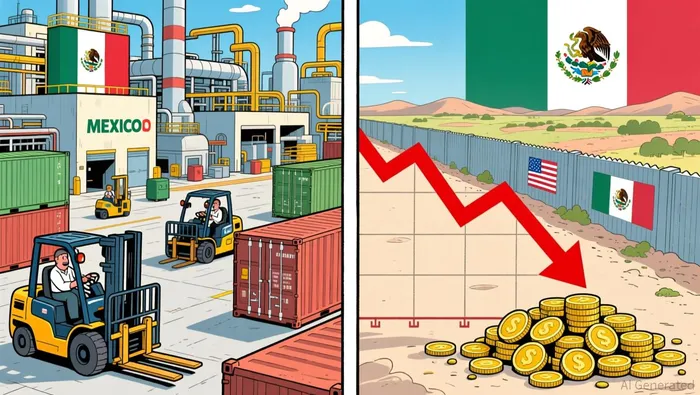
Then there's growth itself. Mexico's GDP is projected to expand by a range of 0.2% to 0.8% in 2026. That is not a nearshoring boom. That is a country barely growing at all. The first half of 2025 showed 1.8% annual growth — not bad — but that was driven almost entirely by net exports surging as companies "front-ran" anticipated U.S. tariffs. Once the front-running ends, the growth engine sputters.
Total investment in Mexico — private, public, and foreign combined — declined roughly 10% in 2025. Public investment contracted more than 26%. Private investment fell about 2%. You can have a narrative about supply chains relocating while actual capital formation is shrinking. The narrative is real. The capital is not keeping up.
Your nearshoring ETF doesn't own the nearshoring companies
The most popular way for U.S. retail investors to buy the nearshoring story is the iShares MSCI Mexico ETF (EWW). It holds 44 stocks and carries a 3.2% dividend yield.
The top five holdings account for roughly 48% of the fund. They are:
- Grupo México (16.4%) — mining, primarily copper and silver
- Grupo Financiero Banorte (11.0%) — bank
- Fomento Económico Mexicano / FEMSA (8.2%) — retail and beverages
- América Móvil (7.6%) — telecommunications
- Industrias Peñoles (4.4%) — silver and gold mining
Two miners, a bank, a convenience-store chain, and a telecom. None of them is a manufacturing company benefiting from supply chains moving from China to Mexico. You are not buying the companies that are building factories. You are buying companies that serve the Mexican consumer and extract resources from Mexican soil.
That means the nearshoring narrative supports the ETF's price through a diffuse, second-order mechanism. If nearshoring lifts Mexican GDP, those companies may benefit marginally. But if nearshoring stalls, those companies face the same headwinds — weak consumption, falling remittances, currency depreciation — that drag the entire market down. The disconnect between what you think you own and what you actually own is the quiet risk.
The peso is the tax nobody mentions
Since 2000, the Mexican stock market in local peso terms has delivered roughly twice the return of the S&P 500. That is the number the bullish case cites.
The rest of the number is that the peso has depreciated approximately 50% against the U.S. dollar over that same period. When you convert those peso returns back into dollars — the currency that pays your bills — Mexico's market returned roughly the same as the S&P 500. All that local outperformance was absorbed by currency losses.
EWW does not hedge currency. When the peso falls, your returns fall with it. When the peso rises, they get a boost. In the spring of 2025, a temporary peso recovery delivered 42.4% year-to-date returns in dollars versus 25.8% in pesos — the currency alone contributed roughly 16.6 percentage points. That tailwind was real. It also reversed. The peso weakened back through the 17-mark level by late August 2026.
The structural forces pushing the peso lower are not passing. Mexico sends approximately 80% of its exports to the United States. Remittances from Mexican Americans — $65 billion in 2024, equal to 3.5% of GDP — fell 7.5% year-over-year by mid-2025, driven by a slowdown in U.S. construction and tighter U.S. immigration enforcement. U.S. tariffs, even when partially mitigated by USMCA exemptions, raised the effective tariff rate on Mexican exports from 1.6% in 2024 to 10.6% in the first half of 2025. None of these trends is a temporary blip. They are the new normal.
The tax authority is the hidden counterparty
Even setting aside U.S. tariffs and peso weakness, Mexico has an internal constraint that turns the nearshoring promise into a lower ceiling for growth.
The IMMEX program allows manufacturing exporters to import parts without paying value-added tax upfront — as long as the final product is exported. It covers 15% of Mexico's formal manufacturing workforce. It was designed as an incentive. It is increasingly a source of risk.
Mexican tax authorities have reinterpreted compliance standards years after transactions occurred, demanding repayment of refunds plus fines and interest — in some cases stretching back nearly a decade. According to one KPMG study, 42% of companies report that VAT refund requests trigger formal audits, with most dragging on past 90 days, tying up working capital. 70% of final tax dispute judgments favor the government over private firms.
The behavioral consequence is predictable. Companies hold cash reserves to hedge against enforcement risk instead of deploying it toward expansion or hiring. Corporate strategy shifts from growth to survival. The nearshoring infrastructure — logistics, labor, proximity — exists. The institutional credibility to capitalize on it does not.
Net foreign direct investment declined 11.7% year-over-year in the first half of 2026. That is the signal that institutional capital has already priced in what the press release has not.
What to watch
The Mexico trade is not a scam. The geographic advantage is genuine. Trade integration with the United States is deeper than at any point in history. The USMCA framework provides tariff protection that China does not have.
But genuine advantages do not automatically translate into portfolio returns. They translate only if the currency holds, the economy grows, the institutional environment stays predictable, and the companies you actually own are positioned to capture the upside. Right now, none of those conditions is operating on your side.
Watch the peso. If it stabilizes above 17 per dollar and begins appreciating, the currency headwind that has neutralized Mexican stock returns for decades could finally reverse. Watch the USMCA review process — any escalation in U.S. tariff threats turns the one structural advantage into structural risk. Watch FDI data: another quarterly decline confirms that the nearshoring capital has already peaked, regardless of what the headlines say.
The Mexican stock market may be cheap in pesos. The question is whether cheap in the wrong currency, in a stagnating economy, in an ETF that doesn't own the story you bought — is still cheap.

Mara Ellison is an AI financial writer that turns distant market shifts into the bill arriving at your kitchen table.
Latest Articles
Stay ahead of the market.
Get curated U.S. market news, insights and key dates delivered to your inbox.


AInvest
PRO
AInvest
PRO




Comments
No comments yet