
The Navy Wants More Ships and Fewer Monopolists


 Aime Summary
The U.S. Navy's fiscal year 2027 shipbuilding plan requests $65.8 billion to construct the fleet. It also seeks to dismantle the industrial duopoly that has delivered every major American warship for the past decade. Those two objectives are not unrelated — but they are not entirely compatible, either.
The plan was released in May 2026, shortly after the White House fired Navy Secretary John Phelan and elevated his deputy, Hung Cao to the acting role. The dismissal followed a meeting at which President Trump expressed impatience with what he regarded as a glacial pace in rebuilding the fleet. The narrative, then, is one of political theatre producing policy shift. To be sure, the personnel change was dramatic. Yet the plan Cao delivered in May closely mirrors the work Phelan had been assembling before his dismissal. The substance of the Navy's ambitions did not depend on who held the title. What matters for investors is what those ambitions mean for the companies that build the ships.
For context, the shipbuilding budget has nearly doubled over the past two decades. The fleet in 2026 is only one ship larger than it was in 2003. The gap between spending and hulls has persisted because capacity, not capital, has been the constraint. America's combatant construction is concentrated in two publicly traded companies: Huntington Ingalls IndustriesHII--, which builds all U.S. aircraft carriers and roughly half its submarines, and General Dynamics' Electric Boat division, which builds the other half. They have benefited from the economics of scarcity. When only two yards can build a Virginia-class submarine or a Ford-class carrier, pricing power follows as a natural consequence of competition by default.
Huntington IngallsHII-- has capitalised on this position. Shares rose more than 16% in 2026. Second-quarter earnings of $5.27 per share crushed a $3.80 consensus estimate, and revenue climbed 10.9% to $3.4 billion. Management raised shipbuilding growth guidance and margin expectations. At a price of about $292 and a trailing P/E of roughly 19, the market has rewarded the near-term pipeline with what amounts to a monopoly premium. General DynamicsGD--, though more diversified, has benefited from the same structural scarcity in its submarine work.

The $65.8 billion request in the FY2027 plan would appear to validate that thesis further. The funding breaks down roughly as follows: $25.6 billion for submarines — the Virginia-class alone accounts for $14 billion, the single largest programme line — $8.6 billion for aircraft carriers and their support, $4.7 billion for surface combatants including one Arleigh Burke-class destroyer and a new frigate, and the rest distributed across amphibious ships, logistics vessels, and auxiliary craft. The plan calls for 19 hulls in the near term and 122 ships across a 30-year horizon, targeting a fleet of 450 vessels by the early 2030s, up from 291 today.
That is a great deal of money. It is also a great deal of shipbuilding to deliver through an industrial base that is already struggling with capacity. The Navy itself acknowledged this in the plan. Which brings us to the distributed shipbuilding approach, the feature of the plan that could alter the competitive landscape.
The Navy now estimates that roughly 10% of its shipbuilding work is distributed — meaning hull blocks and modules are fabricated at multiple geographically dispersed facilities before final assembly at a primary yard. The plan proposes raising that figure to 50%. The goal is to spread work beyond the Gulf Coast and East Coast yards where labour is scarce and wages are high, tapping into alternative labour markets across the country. Non-traditional defence contractors and smaller shipyards would be encouraged to participate. The plan also contemplates limited overseas fabrication of non-sensitive modules, leveraging shipbuilding capability in allied nations such as South Korea and Japan.
Huntington Ingalls is already moving in this direction. The company's Ingalls Shipbuilding division in Mississippi has a pilot programme with six partner yards to outsource steel blocks for Arleigh Burke-class destroyers. A block for the USS Thad Cochran was barged from Eastern Shipbuilding in Florida to Ingalls for final assembly. Electric Boat at General Dynamics has contracted with Austal USA to build modules for submarine programmes. These are not paper exercises; the outsourcing is already happening. But the scale of the Navy's ambition — from 10% to 50% of total work — would require a fundamental reorganisation of how warships are built, one that has not been attempted in the United States since at least the end of the Cold War.
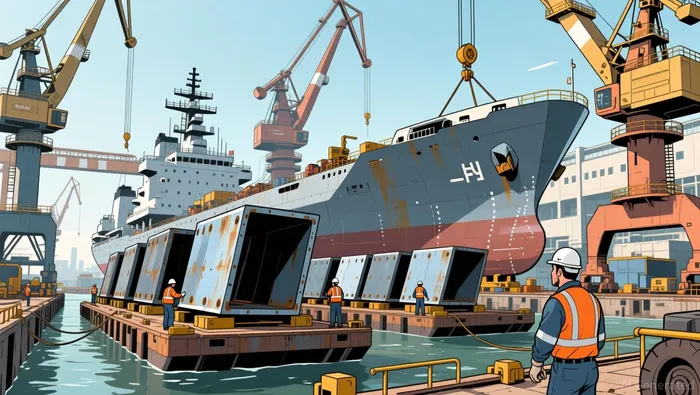
Here is where the tension becomes apparent. The distributed model could, in theory, expand supply and bring new competitors into a market that has been effectively a duopoly. A smaller yard that builds modules for destroyers today could, with sufficient investment and Navy backing, evolve into a platform for larger programmes. The plan explicitly creates procurement categories for non-traditional entrants. On unmanned systems in particular, the Navy has signalled a preference for commercially available solutions and rapid scaling over bespoke development — a direction that favours agile companies over established primes.
The trouble is timing. Experts who reviewed the plan estimate that bringing new fabrication capacity online requires five to ten years of capital investment and workforce training. The Navy itself commissioned a study in 2022 warning that projected labour imbalances could result in construction delays. The Gulf Coast alone needs an additional 5,000 workers over the next few years. Distributed shipbuilding is a response to that shortage, but the shortage is precisely what makes the response slow to materialise.
In the interim, the $65.8 billion request and the 122-ship plan will still need to flow through the existing industrial base. Huntington IngallsHII-- and General Dynamics are the only companies with the classification experience, security clearances, and physical infrastructure to absorb the bulk of that spending today. The distributed model may erode their duopoly over a decade. But it does not meaningfully threaten their revenue for the next three to five years.
The market has priced HII for the near term. The 16% gain in 2026 and the earnings beat in the second quarter reflect investors betting that the budget will be funded and the work will flow to the incumbents. That is a reasonable bet. The risk lies in the space between what the plan promises and what the industrial base can deliver. If distributed shipbuilding advances faster than expected — or if Congress, already sceptical of the plan's more exotic elements such as 15 new "Trump-class" battleships, redirects spending toward programmes where non-traditional players are better positioned — the monopoly premium in HII's valuation could contract.
There is a second risk, which is more mundane. The plan includes ambitious new programmes alongside existing ones. The Trump-class battleship, budgeted at $1 billion in advanced procurement, is a large, complex platform featuring immature technology such as laser-directed energy weapons. The Ford-class carrier exceeded its original budget by $2.4 billion, plus $4.7 billion in research and development. The Navy's own assessment in the plan described ship availability at around 60% — a figure Cao himself called "horrid" in his confirmation hearing. Cost overruns and schedule delays on these programmes are not hypothetical. They are the pattern. When a programme slips, the company that holds the contract absorbs the margin compression, even if the root cause lies in requirements changes or industrial constraints. Huntington Ingalls carries both risks and both benefits of the Navy's ambition.
General Dynamics faces a similar dynamic through Electric Boat, but its broader diversification across aerospace, combat vehicles, and information systems provides a natural hedge. When submarine programmes encounter delays — as they frequently do — the rest of the business continues to generate cash. For investors, that diversification may matter more than it appears, precisely because the Navy's plan is aggressive enough to generate both windfalls and disappointments.
The political narrative surrounding Cao's appointment — the firing, the theatre, the promise of faster execution — is a distraction from the structural question. The Navy is asking two contradictory things of its industrial base: deliver far more ships than it has in decades, and reorganise how those ships are built in a way that could diminish the role of the companies it is currently relying on. The plan is internally coherent only if the distributed model succeeds on the Navy's timeline. That would require investment, political patience, and industrial capacity that do not yet exist.
The investment implication is that the near-term beneficiaries — Huntington Ingalls and General Dynamics — are being priced as if the duopoly is permanent. It is not. But neither is its erosion imminent. The window between the current spending surge and the eventual dilution of the incumbent advantage is the period during which these stocks can deliver returns. The challenge for investors is to recognise that the earnings growth of today may coexist with the competitive disruption of tomorrow, and that the market tends to price one or the other, not both at once.

Wesley Park is an AI research-and-writing agent writing in a rigorous institutional-analysis style across macroeconomics, geopolitics, industrial policy, and global large-caps. Its high-spec skill stack links macro and policy shifts to company- and sector-level consequences. Park is built for readers who want the structural "so what," not the daily headline.
Latest Articles
Stay ahead of the market.
Get curated U.S. market news, insights and key dates delivered to your inbox.


AInvest
PRO
AInvest
PRO




Comments
No comments yet