
Navitas Semiconductor: Powering the Future of AI with GaN and SiC Innovation
 Aime Summary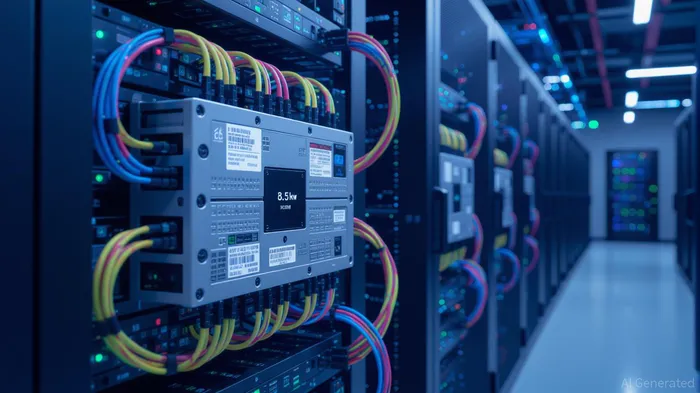
In the race to power the artificial intelligence revolution, one company is quietly rewriting the rules of energy efficiency and performance: NavitasNVTS-- Semiconductor. As AI workloads explode in scale and complexity, the demand for high-density, low-loss power solutions has become a critical bottleneck. Navitas, a pure-play innovator in wide bandgap semiconductors, is not just addressing this challenge—it's redefining it. With a suite of breakthrough technologies in gallium nitride (GaN) and silicon carbide (SiC), Navitas is positioning itself at the heart of the AI ecosystem, offering investors a compelling long-term play on the energy infrastructure of tomorrow.
The GaN and SiC Revolution in AI Data Centers
The core of Navitas' value proposition lies in its ability to deliver power conversion systems that are smaller, faster, and more efficient than anything silicon-based. Consider the company's 8.5 kW AI data center power supply, which achieves 98% efficiency using a combination of GaNSafe™ power ICs and Gen-3 Fast SiC MOSFETs. This isn't just incremental improvement—it's a paradigm shift. Traditional data centers waste significant energy as heat, but Navitas' solutions cut losses by 30% while tripling power density. For hyperscalers like NVIDIANVDA--, which is partnering with Navitas to develop 800V data center architectures, this means 100x more server rack power capacity by 2030.
The numbers tell a story of dominance. Navitas' 137 W/in³ power density in its 4.5 kW AI GPU power supply is unmatched, enabling AI hardware manufacturers to pack more computational power into the same physical space. This is critical as AI models grow exponentially in size and energy consumption. Meanwhile, the company's IntelliWeave digital control system—which adapts to both light and full loads—ensures that efficiency remains high even as workloads fluctuate.
Strategic Partnerships and Market Capture
Navitas isn't just innovating in a vacuum. Its collaboration with NVIDIA is a masterstroke. By co-developing 800V data center power systems, Navitas is locking in a key role in the infrastructure that will power AI's next phase. NVIDIA's Rubin Ultra platform, designed for exascale computing, relies on Navitas' GaN and SiC solutions to deliver the power density and thermal management required for such systems. This partnership isn't just a design win—it's a $2.6 billion market opportunity by 2030, spanning three power conversion stages: Solid-State Transformers (SSTs), 800V DC/DC, and 48V DC/DC.
The company's recent $100 million capital raise and partnership with Powerchip for 8-inch GaN wafer production further underscore its strategic depth. These moves address two critical risks: supply chain bottlenecks and per-unit cost. By securing a reliable, high-volume manufacturing partner, Navitas is de-risking its path to volume production by 2027, a key milestone for scaling into the AI data center market.
Financials and Risks: A Balancing Act
While Navitas' Q2 2025 earnings report showed a loss of $0.06 per share, the company's balance sheet remains robust, with $161.2 million in cash. This provides a buffer to fund R&D and production scaling without diluting shareholders excessively. The challenge lies in translating its technological edge into revenue. Navitas' gross margins, currently at 38.5%, need to climb to 50%+ as volume production ramps—a target achievable if design wins with NVIDIA and other hyperscalers materialize.
The risks are real. Competition from Wolfspeed and Infineon in the SiC space is intensifying, and macroeconomic headwinds like U.S.-China trade tensions could disrupt supply chains. However, Navitas' differentiation lies in its integrated GaN/SiC solutions, which offer a unique combination of efficiency, compactness, and reliability. For example, its GeneSiC trench-assisted planar technology enables ultra-high voltage (UHV) SiC components that outperform legacy silicon in both performance and thermal management.
The Investment Thesis: A High-Conviction Play
For investors with a multi-year horizon, Navitas represents a high-conviction opportunity. The AI data center market is projected to grow at a 31.6% CAGR through 2030, and Navitas is uniquely positioned to capture a significant share of this growth. Its $2.6 billion target market by 2030 is not just aspirational—it's backed by partnerships, technological differentiation, and a clear roadmap.
However, patience is key. Navitas' path to profitability hinges on executing its 2027 production ramp and securing design wins with NVIDIA and other hyperscalers. Short-term volatility is likely, but the long-term potential is immense. If the company can maintain its 50%+ gross margin target and scale production efficiently, it could become a cornerstone of the AI power infrastructure.
Final Takeaway
Navitas Semiconductor is not just a supplier—it's a foundational enabler of the AI revolution. By solving the power problem at the heart of next-generation data centers, the company is building a moat around its technology and market position. For investors willing to ride the wave of AI's energy demands, Navitas offers a compelling mix of innovation, strategic partnerships, and long-term growth potential. The question isn't whether AI will reshape the world—it's whether Navitas will be the one powering it. And right now, the odds are in its favor.

Delivering real-time insights and analysis on emerging financial trends and market movements.
Latest Articles
Stay ahead of the market.
Get curated U.S. market news, insights and key dates delivered to your inbox.




Comments
No comments yet