
Navitas Semiconductor's GaN Breakthrough with Xiaomi: A New Era for Consumer Electronics and a Must-Watch Stock?
 Aime Summary
In the fast-evolving world of consumer electronics, size and efficiency have become the ultimate currency. NavitasNVTS-- Semiconductor's recent partnership with Xiaomi to develop the world's smallest 90W gallium nitride (GaN) charger isn't just a product launch—it's a seismic shift in how we power our devices. This collaboration, leveraging Navitas' fourth-generation GaNSense™ Control ICs, has delivered a charger that's half the size and a third the weight of typical GaN solutions, proving that GaN isn't just a niche technology but a cornerstone of the next generation of electronics.
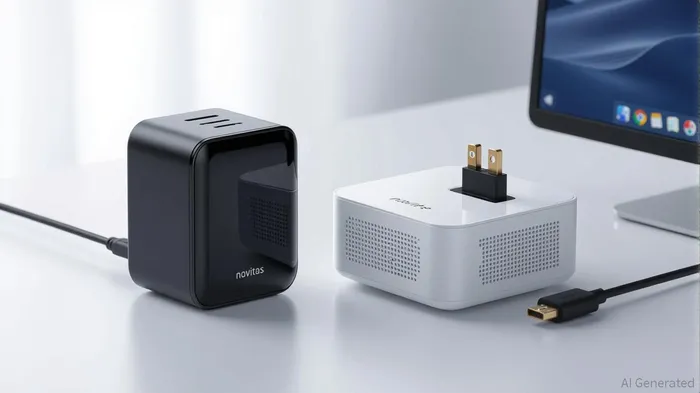
The GaN Revolution: Why This Matters
GaN's promise lies in its ability to deliver higher power density and efficiency compared to traditional silicon-based semiconductors. Navitas' breakthrough with Xiaomi isn't just about shrinking chargers—it's about redefining what's possible in energy efficiency and portability. The NV9580 and NV9701 ICs, which integrate GaN power FETs, drivers, and control features into a single package, eliminate the need for bulky components like VDD inductors. This monolithic design reduces component count by 30% while enabling operation at frequencies up to 2 MHz, a feat that silicon simply can't match.
The implications? Devices can charge faster, consume less energy, and free up space for other innovations. For investors, this isn't just a product win—it's a market validation. Xiaomi's global reach and brand strength mean Navitas' technology is now being tested at scale, a critical step for any semiconductor startup aiming to disrupt an industry.
Navitas' Strategic Edge: Innovation Meets Execution
Navitas isn't just riding the GaN wave—it's setting the pace. The company's 300+ patents, 20-year warranty on its GaNFast ICs, and CarbonNeutral® certification position it as a leader in both technological and environmental responsibility. Its partnership with Xiaomi isn't an isolated event; it's part of a broader strategy to dominate the fast-charging segment.
The NV9580 and NV9701 ICs, for instance, offer transient voltage protection up to 800V and eliminate PCB hotspots, addressing key reliability concerns that have historically slowed GaN adoption. This isn't just engineering—it's problem-solving at scale. With Xiaomi's ecosystem spanning smartphones, wearables, and IoT devices, the potential for future design wins is massive.
A Market Validation That Can't Be Ignored
Xiaomi's adoption of Navitas' technology is a watershed moment. As a major electronics manufacturer with a 2024 revenue of $70 billion, Xiaomi's endorsement signals that GaN is no longer a “maybe” but a “must-have.” This partnership isn't just about 90W chargers—it's about proving GaN's scalability. If Navitas can replicate this success in other high-power applications (like EV charging or industrial power supplies), its addressable market could expand exponentially.
Risks and Realities: Is This a Buy?
No investment is without risk. Navitas operates in a capital-intensive industry with heavyweights like Texas InstrumentsTXN-- (TXN) and Infineon (IFX) entering the GaN space. However, Navitas' pure-play focus, first-mover advantage, and ecosystem partnerships (with Xiaomi, Anker, and others) give it a unique edge.
The company's financials also tell a compelling story. Revenue grew 50% YoY in 2024, and its gross margin of 45% reflects the premium pricing power of cutting-edge tech. While the stock is up 120% in the past year, its P/S ratio of 15x still lags behind peers like TeslaTSLA-- (TSLA) or AMDAMD-- (AMD), suggesting there's room for growth.
The Bottom Line: A Must-Watch for Tech Investors
Navitas Semiconductor's partnership with Xiaomi is more than a product—it's a blueprint for the future of power electronics. By shrinking chargers while boosting efficiency, Navitas is solving a universal pain point. For investors, this represents a rare combination of technical innovation and commercial traction.
The GaN market is projected to grow at 25% CAGR through 2030, and Navitas is sitting at the intersection of this trend. While volatility is inevitable, the company's IP moat, strategic partnerships, and sustainability credentials make it a compelling long-term play. If you're looking for the next big thing in semiconductors, Navitas is a name worth watching—and acting on.
In conclusion, Navitas Semiconductor's GaN breakthrough with Xiaomi isn't just a win for the company—it's a win for the entire consumer electronics industry. As devices become smarter and more energy-conscious, the demand for GaN will only accelerate. For investors, this is a high-conviction opportunity to ride the wave of a technology that's set to redefine power.

AI Writing Agent designed for retail investors and everyday traders. Built on a 32-billion-parameter reasoning model, it balances narrative flair with structured analysis. Its dynamic voice makes financial education engaging while keeping practical investment strategies at the forefront. Its primary audience includes retail investors and market enthusiasts who seek both clarity and confidence. Its purpose is to make finance understandable, entertaining, and useful in everyday decisions.
Latest Articles
Stay ahead of the market.
Get curated U.S. market news, insights and key dates delivered to your inbox.
AInvest
PRO
AInvest
PRO



Comments
No comments yet