
Navigating the Yield Volatility Storm: How Trade Wars and Fed Uncertainty Are Reshaping Fixed-Income Strategies
The U.S. Treasury market has become a battleground for geopolitical tensions and central bank policy whiplash. As of July 2025, the 10-year Treasury yield hovers near 4.3%, oscillating wildly in response to tariff threats, Fed rhetoric, and Middle East conflicts. This volatility isn't just noise—it's a signal for investors to rethink their fixed-income strategies.
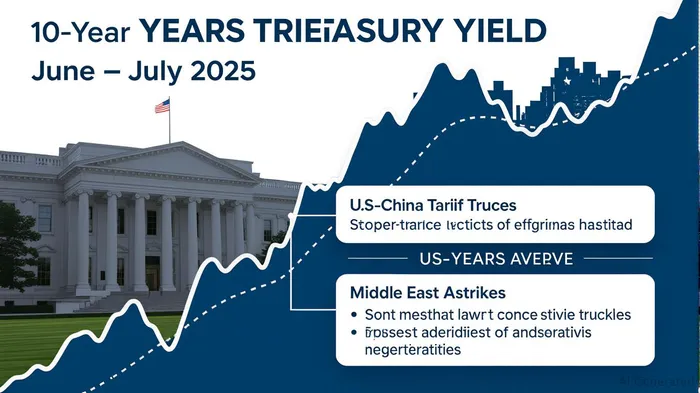
The Perfect Storm: Tariffs, Trade, and Fed Uncertainty
Recent tariff developments have turned trade policy into a seesaw for bond markets. The June 2025 U.S.-China “Geneva deal” temporarily reduced reciprocal tariffs to 10%, easing immediate inflation pressures. Yet, this truce expires in August, leaving a 34% tariff cliff looming over global supply chains. Meanwhile, new Section 232 tariffs on steel-containing appliances (e.g., refrigerators, dishwashers) at 50% have injected uncertainty into consumer goods pricing.
The Federal Reserve's internal divisions further complicate matters. While the June 2025 FOMC statement held rates steady at 4.25%-4.50%, seven of 19 policymakers argued against even considering cuts—a stark contrast to the median forecast of two 25-basis-point reductions by year-end. This inconsistency has flattened the yield curve, with the 10-year/2-year spread now at -0.10%, signaling a recessionary overhang.
How Geopolitical Risks Are Shaping Bond Markets
Geopolitical events act as “risk-off” catalysts, boosting Treasury demand. The June 2025 Israel-Iran conflict, for instance, spiked oil prices by 9% but drove investors into safe havens, pushing the 10-year yield down to 4.24%. Conversely, tariff-induced inflation—such as the 20% fentanyl-related duty on all Chinese imports—threatens to erode the Fed's credibility on price stability.
Opportunities in Fixed Income: Duration Management and Inflation Hedges
The current environment rewards strategic investors with two clear paths:
Shorten Duration, but Stay Flexible
The Fed's reluctance to cut rates quickly means long-dated Treasuries remain vulnerable. Consider reducing exposure to 10-year or 30-year bonds and favoring 2-year Treasuries (yielding 3.3% as of July 2025). Pair these with floating-rate notes or short-term corporate bonds to capture yield while hedging against curve steepening.Inflation-Linked Securities for Protection
Treasury Inflation-Protected Securities (TIPS) offer a hedge against tariff-driven price spikes. While breakeven inflation rates are muted (2.35% as of June), TIPS' principal adjustments for inflation make them a prudent diversifier. For example, the iShares TIPS ETF (TIP) has outperformed nominal Treasuries by 0.8% year-to-date.Alternative Plays for Volatility
Consider high-yield savings accounts (4.5% APY) or commodity ETFs (e.g., GLD for gold) to capitalize on market dislocations. A 5-10% allocation to these assets can buffer portfolios against sudden tariff escalations or Fed missteps.
Risks to Avoid
- Overcommitting to Long-Dated Bonds: A Fed policy error or tariff de-escalation could trigger a sharp yield rise, eroding long-term Treasury values.
- Ignoring Fiscal Risks: The August 2025 debt ceiling “X-date” looms, with default risks potentially spiking yields to 5% or higher.
Final Take: Position for the Cliff Edge
Investors must treat Treasury volatility as a tactical advantage, not a distraction. The August tariff deadline is a critical inflection point—if the U.S.-China truce collapses, yields could spike, signaling recession risks. If it extends, yields may drift lower, rewarding duration extenders.
In the meantime, short-duration, inflation-protected portfolios offer the best balance of safety and yield. As Sorkin often notes, “In volatile markets, the winners are those who prepare for every scenario.”
The next three months will test both trade diplomacy and central bank resolve. For fixed-income investors, the path forward is clear: stay nimble, hedge inflation, and keep an eye on the Fed's next move.

Stay ahead of the market.
Get curated U.S. market news, insights and key dates delivered to your inbox.


AInvest
PRO
AInvest
PRO



Comments
No comments yet