
Navigating Yield Volatility and Sector Shifts in the June Jobs Report Aftermath
The U.S. labor market's resilience in May 2025, as captured by the June jobs report, has reignited debates over the Federal Reserve's policy path, Treasury yield trajectories, and equity market dynamics. With bond markets pricing in reduced expectations for rate cuts and equities oscillating between optimism and caution, investors must navigate a landscape where sector rotations—driven by labor cost pressures, policy uncertainty, and inflation—will define returns.
The Labor Market: Strength Amid Softening Undercurrents
The May jobs report revealed a contradictory narrative. While nonfarm payrolls rose by 139,000, surpassing forecasts, downward revisions to prior months' data (totaling 95,000 jobs) underscored fragility. Wage growth accelerated to 3.9% year-over-year, narrowing the gapGAP-- with stubbornly high inflation (2.4% in May). The unemployment rate held steady at 4.2%, but labor force participation dipped to 62.4%, signaling sidelined workers remain on the sidelines.
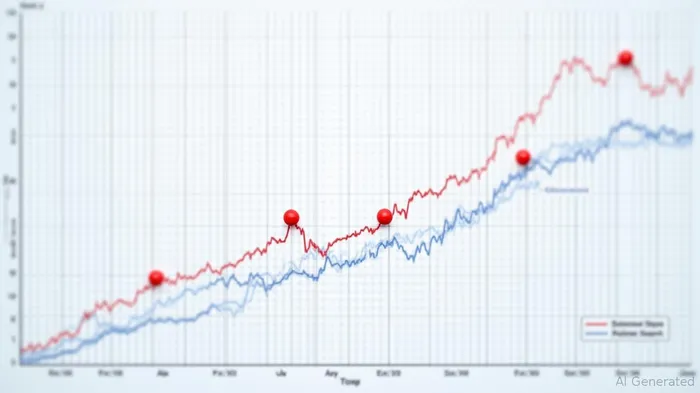
The Fed's dilemma is clear: labor market resilience supports consumer spending but risks reigniting inflation. This tension has kept the 10-year Treasury yield near 4.5%, up 10 basis points post-report, as markets recalibrate rate-cut expectations.
Bond Market: The Fed's Tightrope Walk
The jobs report's mixed signals amplified volatility in fixed-income markets. The 10-year yield surged to 4.49%, while shorter-dated yields rose even more sharply, reflecting reduced bets on near-term rate cuts. Fed Chair Powell's emphasis on “durable disinflation” during June policy discussions reinforced the central bank's reluctance to ease prematurely.
Investors now face a conundrum: yields are elevated, but the Fed's caution limits their upside. Short-duration bond strategies remain prudent, as the curve's inversion—now at 13 bps between 2- and 10-year yields—hints at lingering recession risks.
Equity Markets: Growth vs. Value in a Tight Labor Market
Equities initially rallied, with the S&P 500 climbing 0.7% on the report, but gains faded as traders parsed Fed hawkishness. Sector rotations intensified:
- Financials and Energy Led the Charge: Banks (e.g., JPMorganJPM--, Bank of America) benefited from steeper yield curves and resilient loan demand, while energy stocks (XLE) rose 4% on oil price stability.
- Tech and Consumer Staples Lagged: Growth-heavy sectors (e.g., Meta, Amazon) retreated amid rising discount rates, while defensive staples (e.g., Procter & Gamble) saw modest outflows.
- Sector Rotation to Rate-Resistant Plays: Utilities and infrastructure stocks (e.g., NextEra Energy, Brookfield Infrastructure) gained traction as investors sought income amid Fed uncertainty.
Opportunities in Sector Rotation: Where to Deploy Capital
The jobs report's data points to two key themes: labor market tightness and policy uncertainty. Investors should focus on sectors that benefit from one or both.
1. Healthcare and Social Assistance:
These sectors added 62,000 and 16,000 jobs, respectively, reflecting long-term demand for elder care and mental health services. Companies like UnitedHealth GroupUNH-- (UNH) and CVS HealthCVS-- (CVS), with exposure to aging demographics and telehealth, offer defensive growth.
2. Financials:
Banks (BKX) and insurers (KIE) should thrive in a high-rate environment, provided credit quality holds. Look for institutions with strong capital buffers and exposure to fee-based income (e.g., mortgage servicing).
3. Tariff-Proof Sectors:
Manufacturing and retail faced headwinds, but firms with supply chain agility (e.g., Home DepotHD--, Walmart) or pricing power (e.g., Coca-ColaKO--, PepsiCo) can navigate trade frictions.
4. Infrastructure and Utilities:
As the Fed delays cuts, sectors with low beta and regulated returns—such as NextEra Energy (NEE) or Duke EnergyDUK-- (DUK)—offer ballast against volatility.
Risks to Avoid:
- Overexposure to Tech and Biotech: Elevated rates pressure high-growth stocks lacking earnings visibility.
- Manufacturing and Aerospace: Federal job cuts and trade tariffs are weighing on sectors like BoeingBA-- (BA) and CaterpillarCAT-- (CAT).
Conclusion: Balance Resilience with Caution
The June jobs report underscores a labor market that remains a “bright spot” but is increasingly bifurcated: healthcare thrives, while federal and manufacturing sectors falter. Investors should prioritize sectors benefiting from labor demand (healthcare, financials) or insulated from policy risks (utilities, infrastructure). Equity portfolios should maintain a tilt toward value and rate-sensitive plays while hedging inflation risks via TIPS or gold (e.g., GLD).
In this environment, patience and diversification will be rewarded. As the Fed navigates its tightrope walk, the sectors that adapt to labor cost dynamics—and avoid the crossfire of trade wars—will define the next phase of returns.

Stay ahead of the market.
Get curated U.S. market news, insights and key dates delivered to your inbox.


AInvest
PRO
AInvest
PRO



Comments
No comments yet