
Navigating Year-End Portfolio Adjustments in Light of December 2025 Policy Shifts


 Aime Summary
The December 2025 fiscal calendar has ushered in a series of policy shifts that demand a recalibration of investment strategies. Among the most consequential are updates to the (SSA) framework, . These changes, coupled with broader fiscal uncertainties, necessitate a nuanced approach to asset reallocation. Investors must now balance immediate tax implications with long-term sustainability concerns, particularly as
the SSA's trust fund faces projected depletion by 2034.
The 2026 COLA and Tax Cap: Immediate and Structural Implications
The SSA's 2.8 percent COLA for 2026, effective January 2026,
will increase benefits for 71 million recipients. While this provides a modest buffer against inflation, it does not offset the structural challenge of a system nearing insolvency. For high earners,
. This translates to
. Such changes amplify the urgency for strategic tax planning, particularly for those nearing or exceeding the cap.
The earnings test further complicates matters. For those younger than full retirement age in 2026,
. . Investors must weigh the trade-off between labor income and guaranteed benefits, especially as
for those born in 1960 or later.
Tax-Efficient Strategies for a Shifting Landscape
Given these dynamics, tax-efficient investment strategies are paramount. , for instance, offer a compelling avenue. By converting traditional IRA assets to Roth accounts during market downturns,
Social Security tax rates rise in response to fiscal pressures. The December 2025 fiscal calendar also underscores the importance of . With
(OBBBA) introducing new limitations on charitable deductions in 2026, . Similarly, , as
.
For high earners, . , such as 401(k) plans or (HSAs). The Medicare tax, , further complicates the calculus. Here, .
Long-Term Planning and the Shadow of Insolvency
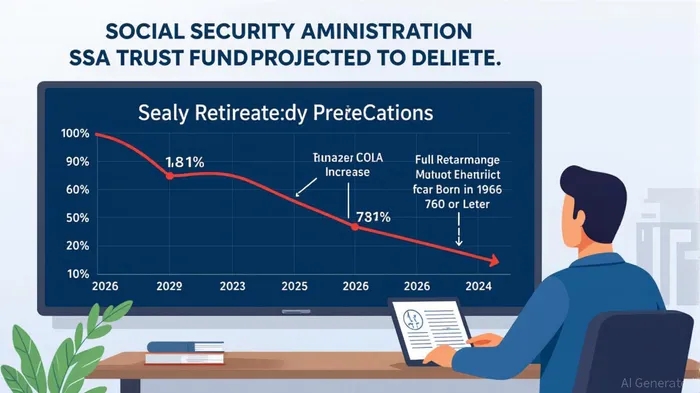
The SSA's long-term solvency crisis, , demands a broader rethinking of retirement income strategies. Investors should diversify beyond Social Security, . For those with estates,
.
Conclusion: Proactive Adaptation in a Time of Uncertainty
The December 2025 policy shifts underscore a fundamental truth: fiscal uncertainty demands proactive, adaptive planning. . By leveraging tools such as Roth conversions, tax-loss harvesting, and income deferral, they can navigate the SSA's evolving landscape while safeguarding their financial resilience. As the trust fund's depletion looms, .

Stay ahead of the market.
Get curated U.S. market news, insights and key dates delivered to your inbox.


AInvest
PRO
AInvest
PRO



Comments
No comments yet