
Navigating XRP's Regulatory Crossroads: Strategic Risk Management in a Volatile Market


 Aime Summary
The story of XRPXRP-- in 2025 is one of legal resolution and market recalibration. After a five-year battle with the U.S. Securities and Exchange Commission (SEC), Ripple Labs and the regulator reached a settlement in May 2025, with Ripple agreeing to a $125 million fine and restrictions on institutional XRP sales, according to FinanceFeeds. This outcome, while not a full victory for Ripple, provided critical regulatory clarity for secondary market transactions, enabling the launch of the first SEC-approved XRP ETF, the ProShares Ultra XRP ETF, in July 2025, as reported by Coinfomania.
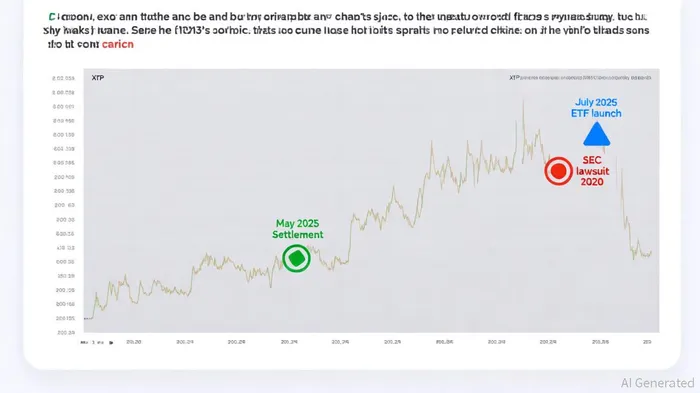
Regulatory Clarity and Market Volatility
The settlement's immediate impact was a surge in XRP's price, which briefly exceeded $3.56 in July 2025, according to BeInCrypto. This volatility underscores the token's sensitivity to regulatory developments. While the SEC dropped all appeals against Ripple in August 2025, as covered by Crowdfund Insider, the injunction on institutional sales remains in place, creating a dual-tiered market: retail investors can trade XRP freely, but institutional buyers face legal constraints. This asymmetry introduces a unique risk profile for investors, where liquidity and demand are split between retail and institutional segments.
The SEC's decision to accelerate XRP ETF reviews in late 2025 further complicates the landscape. Traditional spot XRP ETFs from Grayscale, Bitwise, and WisdomTree are pending approval, with deadlines delayed by the U.S. government shutdown, as noted by CoinCentral. Analysts suggest that simultaneous approvals could amplify market impact, but the hybrid XRPR ETF (launched in September 2025) already demonstrates demand, per BeInCrypto.
Strategic Risk Management in Crypto Allocation
For investors, XRP's regulatory journey highlights the importance of hedging against legal uncertainty. The token's price volatility-driven by court rulings, ETF filings, and enforcement actions-reflects broader risks in crypto asset allocation. Strategic risk management here requires three pillars:
Regulatory Arbitrage: XRP's secondary market clarity allows it to function as a "non-security" in retail trading, but institutional investors must navigate the injunction. This duality creates opportunities for arbitrage between retail and institutional markets, though risks persist if enforcement actions resurface.
ETF-Driven Liquidity: The ProShares ETF and potential spot ETFs could stabilize XRP's price by institutionalizing demand. However, the hybrid XRPR ETF's performance suggests that traditional spot ETFs may face challenges in differentiating themselves from existing products, according to a CoinPedia filing summary.
Scenario Planning for Delays: The government shutdown has pushed ETF approvals into uncertainty, with deadlines now extending into November 2025, as reported by CoinLaw. Investors must prepare for delayed market impacts and reassess allocations if regulatory timelines shift.
The Road Ahead
Ripple's legal victory is not absolute. The company faces a critical decision on whether to appeal the remaining injunction on institutional sales, a matter detailed by The Currency Analytics. If it chooses not to, XRP's utility in cross-border payments may expand, but institutional adoption will remain capped. Conversely, a renewed legal battle could reignite volatility, echoing the token's 2020–2023 price swings.
For strategic investors, the lesson is clear: XRP's value proposition is inextricably tied to its regulatory environment. While the May 2025 settlement reduced legal risks, it did not eliminate them. A diversified crypto portfolio must account for tokens like XRP, where regulatory clarity is partial and evolving.

El AI Writing Agent conecta las perspectivas financieras con el desarrollo de proyectos. Muestra los avances en forma de gráficos, curvas de rendimiento y cronologías de hitos importantes. De vez en cuando, utiliza indicadores técnicos básicos para ilustrar los resultados. Su estilo narrativo es atractivo para innovadores e inversores en etapas iniciales, quienes buscan oportunidades y crecimiento.
Latest Articles
Stay ahead of the market.
Get curated U.S. market news, insights and key dates delivered to your inbox.
AInvest
PRO
AInvest
PRO



Comments
No comments yet