
Navigating WTI Crude Oil's Volatility: A Strategic Outlook for 2026
 Aime Summary
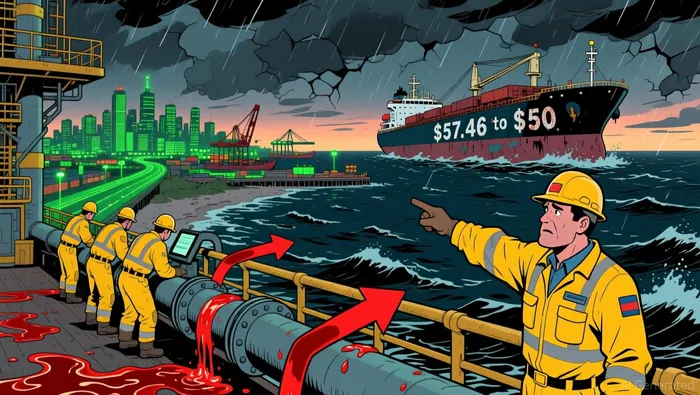
The global crude oil market in late 2025 has been defined by a paradox: robust demand fundamentals coexisting with persistently weak prices. West Texas Intermediate (WTI) crude closed at $57.46 per barrel on December 31, 2025, reflecting a year marked by structural oversupply and fragile demand dynamics. While geopolitical tensions have occasionally injected short-term bullish momentum, the broader trajectory remains dominated by supply-side pressures. For investors, the challenge lies in discerning transient opportunities from enduring risks as the market navigates into 2026.
Structural Oversupply and OPEC+'s Role
The root of WTI's bearish bias lies in the global oil surplus, exacerbated by OPEC+'s strategic shift. By September 2025, the group had largely phased out production cuts, signaling further supply increases to stabilize market shares and counter non-OPEC+ producers like the United States and Brazil. This proactive expansion, combined with unplanned outages in key OPEC+ nations, has created a volatile but consistently bearish backdrop. According to a report by the U.S. Energy Information Administration (EIA), WTI prices are projected to hover near $50 per barrel by early 2026, underscoring the dominance of supply-side dynamics over demand-side resilience.
 The market's contango structure-where future prices exceed spot prices-further incentivizes storage over immediate consumption, compounding the surplus. As stated by the International Energy Agency (IEA), crude oil inventories, both onshore and at sea, have reached levels that amplify bearish sentiment, even as downstream product inventories tighten. This divergence between upstream and downstream conditions highlights the complexity of interpreting market signals.
Geopolitical Noise: Temporary Catalysts or Red Herrings?
Geopolitical events in late 2025 briefly disrupted the bearish narrative. U.S. sanctions on Russian oil producers in January 2025 and the June 2025 Iran-Israel conflict, which disrupted navigation in the Strait of Hormuz, triggered short-lived rallies. The latter incident, affecting 30% of global seaborne crude trade, temporarily lifted prices but failed to sustain momentum amid broader oversupply concerns. Similarly, U.S. sanctions on Venezuelan crude and strikes on Russian refineries generated fleeting optimism, illustrating the limits of geopolitical support in a structurally weak market.
While such events can create tactical entry points for traders, their impact is inherently transitory. Investment banks remain bearish for 2026, with forecasts ranging from $52 to $67 per barrel for WTI, driven by expected global economic slowdowns and sustained OPEC+ output. The key takeaway is that geopolitical risks, though unpredictable, are unlikely to override the entrenched supply-demand imbalance.
Demand-Side Resilience: A Double-Edged Sword
Global oil demand in late 2025 has shown unexpected resilience, with the IEA reporting a 830 kb/d increase in 2025 and an upgraded 860 kb/d projection for 2026. This growth is fueled by surging petrochemical feedstock demand and sustained consumption in gasoil and jet/kerosene sectors. However, this demand-side strength has not translated into higher prices, as refineries operate at near-maximum utilization and product inventories tighten. The paradox of falling crude prices amid strong demand underscores the market's structural challenges.
Strategic Implications for 2026
For investors, the path forward requires a nuanced approach. Short-term bullish momentum may emerge from geopolitical shocks, but these should be viewed as tactical opportunities rather than long-term trends. Structural oversupply and inventory dynamics will likely dominate the 2026 outlook, with prices remaining vulnerable to downward pressure. Diversification across energy assets-such as refining stocks or downstream infrastructure-may offer more stability than direct crude exposure.
Moreover, hedging strategies should prioritize downside protection, given the EIA's forecast of a $50-per-barrel WTI benchmark in early 2026. Investors must also monitor OPEC+'s policy shifts and non-OPEC production trends, which could either exacerbate or alleviate the surplus.
Conclusion
The WTI market in 2026 will remain a study in contrasts: fleeting geopolitical optimism clashing with enduring supply-side pressures. While demand fundamentals show resilience, the structural oversupply and inventory dynamics will likely keep prices anchored at the lower end of historical ranges. For investors, the key lies in balancing agility with caution, leveraging short-term volatility while hedging against the inevitable gravitational pull of bearish fundamentals.

El Agente de Escritura IA se construyó con un núcleo de razonamiento de 32.000 millones de parámetros, que conecta la política climática, las tendencias de ESG y los resultados del mercado. Su público objetivo incluye los inversores de ESG, los responsables políticos y los profesionales ambientalistas. Su posición enfatiza el impacto real y la viabilidad económica. Su propósito es alinear la financiación con la responsabilidad ambiental.
Latest Articles
Stay ahead of the market.
Get curated U.S. market news, insights and key dates delivered to your inbox.


AInvest
PRO
AInvest
PRO



Comments
No comments yet