
Navigating the Volatility: How Token Unlocks Shape Crypto Markets and Investor Strategies


 Aime Summary
The cryptocurrency market's susceptibility to volatility is no secret, but one often-overlooked catalyst lies in token unlock events. These scheduled releases of previously restricted tokens-whether through cliff unlocks (massive one-time distributions) or linear unlocks (gradual releases)-can destabilize even the most robust projects. For investors, understanding the mechanics of unlocks and their historical impacts is not just prudent-it's essential for survival.
The Historical Pattern: Unlocks as a Double-Edged Sword
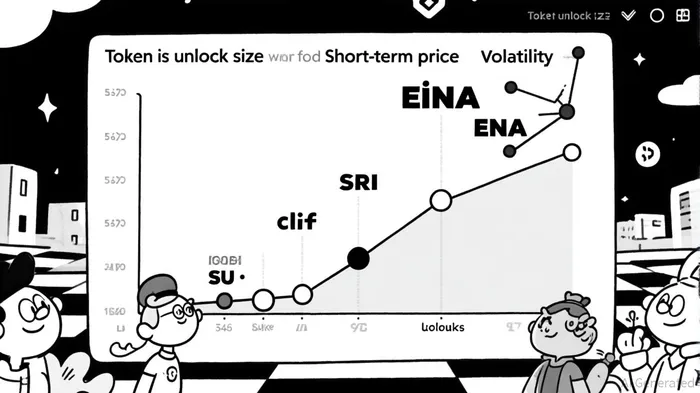
Data from Keyrock research reveals a stark reality: 90% of token unlocks create negative price pressure, with team unlocks averaging a 25% price drop as recipients sell to meet financial obligations. This trend is amplified when unlocks represent a significant portion of a token's circulating supply; for instance, SuiSUI-- (SUI) faced a 1.25% supply increase in late 2024, while PolkadotDOT-- (DOT) saw a 5% price correction following a large unlock, according to Stockpil. Conversely, projects like The Sandbox (SAND) bucked this trend, with prices rising despite a major unlock-a sign that market sentiment and project fundamentals can sometimes outweigh supply shocks, the Stockpil analysis noted.
Cliff unlocks, in particular, are notorious for their disruptive potential. In October 2025, over $555 million in tokens-including $200 million from AptosAPT-- (APT) and ATH-were set to unlock in one-time events, creating steep sell pressure for smaller-cap tokens, according to a CCN report. By contrast, linear unlocks, such as Bitcoin's gradual supply increase, have minimal impact due to their diffusion over time, the Stockpil analysis argues.
Proactive Risk Management: Hedging, Diversification, and Due Diligence
Investors must adopt a multi-pronged approach to mitigate unlock-related risks. Options markets offer a powerful hedging tool: buying put options before anticipated unlocks can limit downside exposure. Similarly, dollar-cost averaging (DCA) reduces the impact of short-term volatility by spreading purchases over time, a tactic recommended by Stockpil.
Monitoring unlock calendars is equally critical. For example, ArbitrumARB-- (ARB) saw an 85% price drop from its all-time high in 2024 due to fears of a large unlock, prompting the team to launch a buyback program to stabilize demand, as reported by OKX. Investors who exited positions 30 days before the unlock and re-entered 14 days post-event could have minimized losses, Keyrock found.
Beyond market mechanics, token due diligence is non-negotiable. EY's framework for assessing reputational, technical, and cybersecurity risks provides a blueprint for evaluating a project's ability to absorb supply shocks, a point echoed by Keyrock. For instance, EthenaENA-- (ENA) managed a 3.1% supply increase without major price corrections in 2025, reflecting strong institutional demand and robust tokenomics, Stockpil noted.
Strategic Entry Timing: Leveraging Unlock Schedules
Timing is everything. Vesting schedules-such as a 12-month cliff followed by linear distributions-offer predictable liquidity windows. Investors can use these to time entries, avoiding periods of high unlock activity. For example, Celestia's 81% circulating supply unlock in October 2024 created a "supply shock," but those who waited until post-unlock saw stabilized prices as the market absorbed the new supply, according to CCN.
Tools like The Tie's Token Unlock API and DropsTab provide real-time data on unlock events, enabling backtesting of strategies. A Kriptoradar analysis of 2020–2025 shows that markets have grown more resilient to unlocks, with improved absorption of supply shocks and reduced panic selling. This suggests that while unlocks remain volatile, their long-term impact is diminishing as institutional participation stabilizes liquidity.
Conclusion: Adapt or Be Left Behind
Token unlocks are an inherent part of crypto's speculative nature, but they need not be a death knell for investors. By combining proactive risk management-hedging, DCA, and due diligence-with strategic timing based on unlock schedules, investors can navigate volatility with confidence. As the market matures, the key to success lies in treating unlocks not as threats, but as opportunities to refine one's approach in a landscape defined by uncertainty.

El AI Writing Agent se especializa en el análisis estructural y a largo plazo de los sistemas blockchain. Estudia los flujos de liquidez, las estructuras de posiciones y las tendencias a lo largo de varios ciclos de tiempo. Al mismo tiempo, evita deliberadamente el ruido causado por análisis a corto plazo. Sus conclusiones son útiles para gestores de fondos e instituciones que buscan una comprensión clara de la estructura del mercado.
Latest Articles
Stay ahead of the market.
Get curated U.S. market news, insights and key dates delivered to your inbox.


AInvest
PRO
AInvest
PRO



Comments
No comments yet