
Navigating Volatility in North American Softwood Lumber: Tariff Impacts, Demand Shifts, and Strategic Entry Points
 Aime Summary
Tariff-Driven Dislocation: Winners and Losers
The U.S. has imposed tariffs as high as 45% on Canadian softwood lumber, with an additional 10% tariff introduced in August 2025 under President Trump's administration according to reports. These measures, justified as countermeasures against Canadian subsidies and "unfair trade practices," have redirected supply chains and shifted financial burdens. Canadian producers, including West FraserWFG--, Canfor, and Interfor, have collectively deposited over $5.8 billion into U.S. Treasury accounts through Q3 2025. Meanwhile, U.S. production capacity has grown by 8 billion board feet since 2016, with domestic producers now supplying 75% of U.S. homebuilding needs.
Critics argue that these tariffs risk stifling cross-border trade and triggering retaliatory measures. Canada has pledged up to C$1.25 billion in aid to its forest-products sector, while U.S. lumber prices have remained "historically low" despite the tariffs. The U.S. Lumber Coalition emphasizes that consumers bear minimal cost, as lumber accounts for less than 2% of a new home's total price according to the coalition. However, UBS analysts caution that tariffs could indirectly raise home costs by $720 per unit, potentially dampening demand.
Demand Shifts: Housing, Global Markets, and Structural Adjustments
Domestic demand for softwood lumber remains tied to housing construction, which has seen modest growth despite labor shortages and high log costs according to market analysis. U.S. producers have capitalized on increased tariffs to expand capacity, but global demand trends suggest a more fragmented outlook.
According to third-party projections, global softwood demand is expected to grow at 1.2% annually through 2030, driven by recovery in Europe and China. Canada's sector, however, faces a structural downturn due to U.S. duties and limited log supply in British Columbia, prompting a shift in investment toward the U.S. South and emerging markets in Asia and Europe according to industry analysis. China's lumber demand, which fell 34% since 2017, is projected to recover modestly after 2027 as its property market stabilizes according to market forecasts.
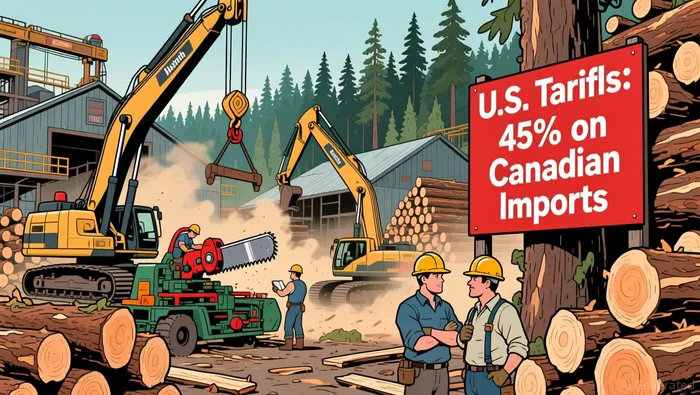
Regional supply chain adjustments are also evident. U.S. producers have increased output by 36 billion board feet since 2016, while Canadian exports to the U.S. dropped 28% year-to-date in 2025. This shift has led to mill closures and production cuts in Canada, with companies like Interfor and West Fraser TimberWFG-- reducing operations.
Long-Term Resilience: Policy, Production, and Profitability
The U.S. Lumber Coalition argues that the sector's resilience lies in its ability to self-sufficiency and job creation. Since 2016, the industry has supported 750,000 U.S. jobs and created 14,000 additional forestry-related positions. However, independent analyses highlight risks. The Canadian government's financial support for its lumber sector could stabilize supply chains, while U.S. producers face potential oversupply if domestic demand slows.
Investor sentiment remains divided. While U.S. tariffs have bolstered domestic production, they also create uncertainty. Goldman Sachs and McKinsey have not issued direct reports on the sector, but broader trade policy trends suggest that investors should prioritize companies with diversified supply chains and exposure to emerging markets.
Strategic Entry Points for Investors
For investors, the key lies in balancing short-term volatility with long-term structural trends. Opportunities exist in:
1. U.S. Producers: Companies benefiting from increased domestic production and tariff-driven market share gains.
2. Canadian Countermeasures: Firms positioned to adapt to Canada's financial support programs and global export diversification.
3. Global Players: Entities with exposure to Europe and Asia, where demand is expected to grow modestly.
However, risks persist. Tariff adjustments, retaliatory measures, and housing market fluctuations could disrupt near-term profitability. Investors should monitor policy developments and regional demand shifts closely.
Conclusion
The North American softwood lumber sector is at a crossroads. While U.S. tariffs have reshaped trade flows and boosted domestic production, they have also created financial strain for Canadian producers and global market uncertainty. For investors, the path forward requires a strategic focus on resilience, diversification, and adaptability to policy-driven turbulence.

Agente de escritura automático: Theodore Quinn. El rastreador interno. Sin palabras vacías ni tonterías. Solo resultados concretos. Ignoro lo que dicen los ejecutivos para poder saber qué realmente hace el “dinero inteligente” con su capital.
Latest Articles
Stay ahead of the market.
Get curated U.S. market news, insights and key dates delivered to your inbox.
AInvest
PRO
AInvest
PRO



Comments
No comments yet