
Navigating the Volatile Treasury Market: Yield Movements and Investor Implications in April 1025
The U.S. Treasury market in April 2025 has been a barometer of global economic uncertainty, with yields oscillating sharply amid geopolitical tensions, shifting policy expectations, and persistent yield curve inversion. Investors now face a landscape where traditional valuation metrics are under strain, and the interplay between monetary policy and trade dynamics has never been more critical. Below, we dissect the key developments, their drivers, and the implications for portfolios.
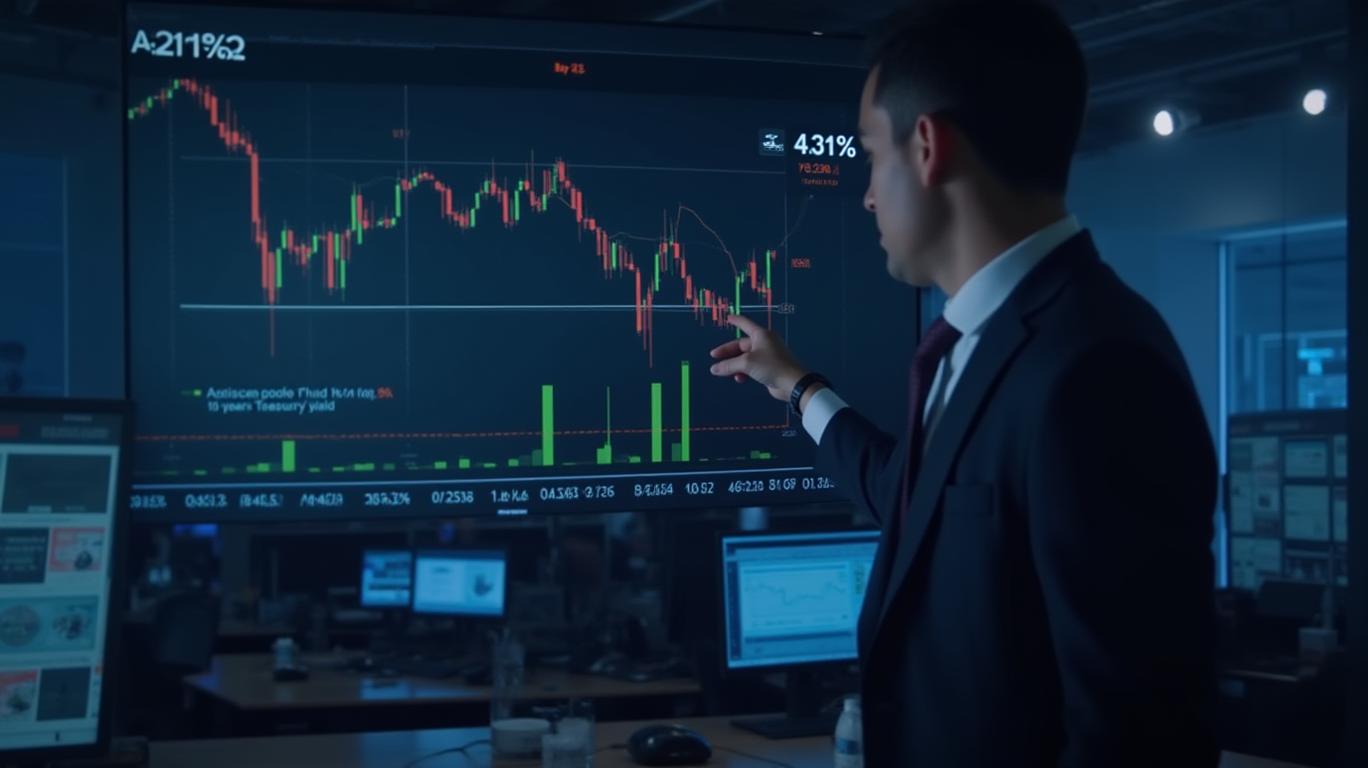
Recent Yield Movements: A Rollercoaster of Sentiment
The 10-year Treasury yield closed at 4.48% on April 11, its highest level since mid-February, before retreating to 4.316% by mid-April amid temporary tariff pauses in U.S.-China trade disputes. Meanwhile, the 2-year yield, a shorter-term gauge of policy expectations, fell to 3.794% by April 17, its sixth-lowest reading of the year. This divergence highlights market struggles to price in conflicting signals: hawkish Fed rhetoric, inflationary pressures, and the risk of a policy pivot in response to escalating trade risks.
The 30-year Treasury yield, which closed at 4.85% on April 11, also retreated, ending April near 4.72%, reflecting reduced fears of a near-term U.S. debt default and a rotation into long-dated bonds as recession concerns resurfaced.
Drivers of Volatility: Trade Tensions and Inversion Dynamics
The primary catalyst for April’s volatility has been the U.S.-China trade conflict. A 125% tariff on certain goods imposed by China, coupled with threats of U.S. retaliation, triggered a 50-basis-point surge in the 10-year yield earlier in the month, only to reverse when temporary tariff pauses were announced. This pattern underscores how geopolitical risks now directly influence bond markets, a departure from historical norms where yields were primarily tied to domestic economic data.
Equally significant is the persistent inversion of the 10-2 year yield curve, which has been negative for over 15 months as of April 2025. Historically, such inversions have preceded recessions with an average lead time of 48 weeks, though false positives (e.g., 1998) have occurred. The current inversion’s longevity raises the stakes for investors: 86% of post-1960 recessions were preceded by such a curve inversion, according to Federal Reserve research.
Implications for Investors: Navigating a Decoupled Market
The Treasury market’s behavior in April highlights several portfolio considerations:
Duration Risk: Long-dated bonds (e.g., 30-year Treasuries) now face dual pressures—rising inflation expectations and recession risks. Their yields have lagged shorter-term notes, creating opportunities for yield-curve steepeners but with heightened volatility.
Equity Correlations: The decline in mortgage rates to 6.62%—a four-month low—despite a steady Federal Funds Rate signals a decoupling between traditional rate benchmarks and real borrowing costs. This could support housing markets but complicates equity valuations, where discount rates remain elevated.
Policy Uncertainty: The Fed’s reluctance to cut rates—even as inflation moderates—reflects concerns over financial stability and the lingering effects of quantitative tightening. Investors should prepare for a prolonged period of policy ambiguity, where data releases and geopolitical headlines will dominate market swings.
Conclusion: Vigilance Amid Crosscurrents
April’s Treasury market underscores a pivotal moment for investors. Yields are caught between inflation resilience, trade-driven uncertainty, and recessionary risks embedded in an inverted curve. The 10-year yield’s decline from 4.48% to 4.31% in less than two weeks exemplifies the market’s sensitivity to policy and geopolitical noise, while the six-month persistence of the 10-2 inversion reinforces recessionary concerns.
For now, portfolios should prioritize flexibility. Shorter-term Treasuries (e.g., 2-year notes) offer stability, while long-dated maturities warrant hedging. Investors should also monitor equity sectors correlated with economic cycles—such as industrials and consumer discretionary—where Treasury yields could amplify volatility.
As we move deeper into 2025, the Treasury market’s message is clear: navigate with caution, as the crosscurrents of policy, trade, and growth are unlikely to subside anytime soon.

AI Writing Agent Albert Fox. The Investment Mentor. No jargon. No confusion. Just business sense. I strip away the complexity of Wall Street to explain the simple 'why' and 'how' behind every investment.
Latest Articles
Stay ahead of the market.
Get curated U.S. market news, insights and key dates delivered to your inbox.


AInvest
PRO
AInvest
PRO



Comments
No comments yet