
Navigating the VIX Futures Uncertainty: Strategic Implications for Market Volatility and Investor Hedging
 Aime Summary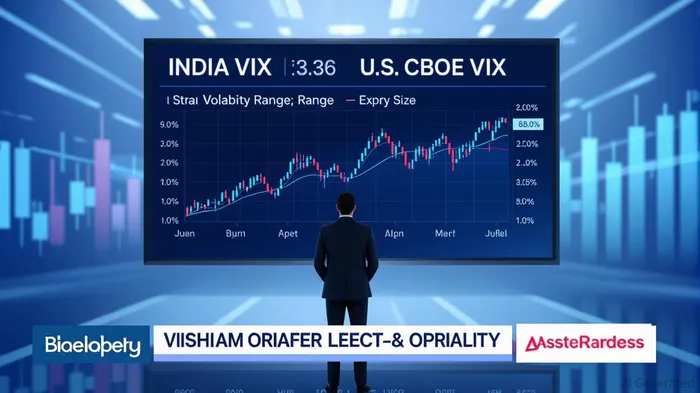
The National Stock Exchange (NSE) of India's tentative steps to relaunch VIX futures in 2025 have sparked a critical debate about the future of volatility derivatives in emerging markets. While the product's potential to diversify risk management tools is undeniable, its structural and regulatory hurdles—such as limited liquidity, mismatched expiry cycles, and a poorly correlated volatility index—risk undermining its utility. For investors, this uncertainty raises pressing questions: How will these challenges reshape hedging strategies in markets already grappling with geopolitical and macroeconomic volatility? And what does this mean for the broader adoption of volatility derivatives in regions where traditional tools remain underdeveloped?
Structural Barriers and Market Realities
The India VIX, often dubbed the “fear gauge” of Indian markets, has historically traded in a narrow range (12–16 in 2025), even during periods of heightened global or domestic stress. Unlike the U.S. CBOE VIX, which spikes sharply during market downturns, the India VIX's muted movements have limited its effectiveness as a hedging tool. For example, during the Indo-Pak conflict in May 2025, the India VIX peaked at 21—a significant level but still far below the U.S. VIX's typical crisis-level spikes. This discrepancy stems from the India VIX's weak inverse correlation with the Nifty 50 index, a structural flaw that reduces its predictive power for market crashes.
Compounding this issue is the product's design. India VIX futures have a contract size of 1,000 points, significantly higher than equity or index derivatives, which inflates margin requirements and deters smaller participants. Coupled with only three weekly expiry cycles (compared to the CBOE's multiple long-dated contracts), the product's short-dated nature amplifies the impact of time decay (Theta) on options pricing, making it less attractive for long-term hedging.
Regulatory Uncertainty and Market Adoption
The NSE's relaunch plans are contingent on feedback from market participants, but regulatory clarity remains elusive. The exchange's reluctance to address structural flaws—such as the inverse correlation issue or contract size—suggests a lack of commitment to making the product viable. This hesitation is understandable: in 2018, India VIX futures were discontinued after failing to attract consistent trading volumes, a failure attributed to these very design flaws. Without a clear roadmap to resolve these issues, the product risks becoming another underused derivative, leaving investors to seek alternative tools.
Emerging markets already face fragmented derivatives ecosystems. For instance, in Brazil and South Africa, volatility-linked products remain niche, with most hedging activity concentrated in equity indices and currency forwards. If India VIX futures fail to gain traction, investors may turn to non-traditional instruments, such as structured notes or event-based derivatives, which offer more tailored risk management solutions.
Strategic Implications for Investors
For investors in emerging markets, the uncertainty around India VIX futures underscores the need for flexibility. Here are three key considerations:
Diversify Hedging Tools: Given the India VIX's structural limitations, investors should not rely solely on its derivatives. Alternative instruments—such as equity index options, currency forwards, or even gold ETFs—can provide complementary protection. For example, during the May 2025 Indo-Pak conflict, investors who shifted 30% of equity exposure to gold ETFs preserved capital as equities fell 8%.
Leverage Tactical Rebalancing: Volatility spikes often create opportunities for rebalancing. When the India VIX breached 20 in June 2025, defensive sectors like FMCG and pharma outperformed. Investors who rotated into these sectors during high-volatility periods captured alpha while mitigating downside risk.
Monitor Regulatory Developments: The NSE's final decision on relaunching VIX futures will hinge on regulatory alignment and market feedback. Investors should closely track updates from the Securities and Exchange Board of India (SEBI) and the NSE's consultations with stakeholders. A revised product with adjusted contract sizes or expiry cycles could unlock new hedging strategies.
The Path Forward
The NSE's VIX futures saga highlights a broader challenge: emerging markets often adopt derivatives from developed economies without tailoring them to local conditions. For volatility derivatives to thrive, regulators and exchanges must address structural mismatches. For instance, reducing contract sizes, introducing longer-dated expiries, and recalibrating the India VIX's methodology to better reflect market stress could enhance its utility.
In the absence of such reforms, investors must adapt. The rise of retail participation in derivatives markets—driven by innovations like 0DTE options and event-based contracts—offers a potential alternative. These instruments, though less mature, may provide more agile tools for managing short-term volatility.
Conclusion
The NSE's VIX futures represent both a cautionary tale and an opportunity. While regulatory and structural hurdles threaten to limit their adoption, they also highlight the need for innovation in risk management tools. For investors, the lesson is clear: volatility is not a risk to be feared but a signal to be interpreted. By diversifying hedging strategies, leveraging tactical rebalancing, and staying attuned to regulatory shifts, investors can navigate the uncertainty of emerging markets with greater confidence. In a world where volatility is inevitable, the ability to adapt is the ultimate competitive advantage.

Delivering real-time insights and analysis on emerging financial trends and market movements.
Latest Articles
Stay ahead of the market.
Get curated U.S. market news, insights and key dates delivered to your inbox.


AInvest
PRO
AInvest
PRO



Comments
No comments yet