
Navigating USD/JPY Volatility: Strategic Opportunities in a Shifting Trade Landscape
 Aime Summary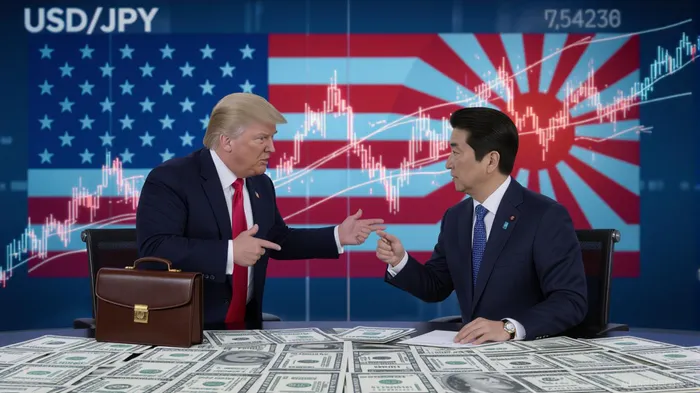
The U.S.-Japan trade deal announced by President Trump in July 2025 has sent shockwaves through global markets, creating a unique inflection point for investors. While the deal's final terms remain unconfirmed by Japanese officials, its implications for the yen, Japanese equities, and dollar carry trades are already materializing. For those willing to navigate the volatility, this shift offers actionable opportunities in both FX and equity markets.
The Trump-Japan Deal: A Game Changer for USD/JPY
Trump's 15% tariff on Japanese exports—lower than the threatened 25%—and Japan's $550 billion investment in the U.S. signal a recalibration of trade dynamics. However, the lack of official confirmation from Japan's Ministry of Foreign Affairs has created a fog of uncertainty. This ambiguity is fueling USD/JPY volatility, as markets weigh the risk of a weaker yen (if the deal holds) against potential yen strength if negotiations unravel.
The yen's traditional role as a low-yielding safe-haven currency is now under pressure. A weaker yen could boost Japan's export-driven sectors, but it also risks inflationary pressures and capital outflows. Meanwhile, the U.S. dollar's strength is reinforced by Trump's “America First” tariff regime, which positions the greenback as a beneficiary of global trade realignments.
Strategic Positioning in Japanese Equities
The deal's potential to open Japan's market to U.S. agricultural and automotive goods could disrupt local industries. For investors, this creates a bifurcated opportunity:
1. Export-Oriented Sectors: A weaker yen would amplify profits for Japanese exporters like ToyotaTM-- (7267:JP) and SonySONY-- (6758:JP), which benefit from favorable currency conditions.
2. Agricultural and Automotive Firms: If Japan reduces barriers to U.S. rice and car exports, domestic players like Nissan (7201:JP) and Sumitomo Corporation (8015:JP) could face margin pressures. However, increased competition might spur efficiency gains, creating long-term value.
The Nikkei 225 has already rallied on Trump's announcements, but skepticism lingers. Investors should consider dollar-cost averaging into undervalued Japanese equities, particularly in technology and logistics, while hedging against yen strength via options or futures.
Dollar Carry Trades and FX Arbitrage
The yen's potential weakness opens the door for dollar carry trades. Borrowing in yen to invest in higher-yielding USD assets (e.g., U.S. Treasuries or equities) could yield attractive returns if the yen depreciates further. However, this strategy hinges on the deal's durability. A sudden reversal—such as Japan rejecting key terms—could trigger a yen rebound, wiping out gains.
Investors should also monitor U.S. Treasury yields, which have surged on Trump's pro-growth policies. A yield differential favoring the dollar will sustain the yen's underperformance, but a dovish pivot in U.S. monetary policy could disrupt this dynamic.
Actionable Insights for Investors
- Short-Term Hedging: Use USD/JPY options to hedge against yen volatility. A straddle strategy could profit from either direction of movement while capping downside risk.
- Sector Rotation: Overweight Japanese equities in export-heavy industries while underweighting import-dependent sectors like food and energy.
- Carry Trade Caution: Enter dollar carry trades only after Japanese officials confirm the deal's terms. Premature bets risk losses if the yen rallies on political or economic headwinds.
- Monitor Political Signals: Japan's Prime Minister Shigeru Ishiba faces domestic pressure to secure a favorable agreement. A delay or renegotiation could trigger market turbulence.
Conclusion: Staying Ahead of the Curve
The Trump-Japan trade deal is a high-impact event reshaping global markets. For investors, the key lies in balancing short-term volatility with long-term structural shifts. By strategically positioning in USD/JPY, Japanese equities, and carry trades, investors can capitalize on the dislocations created by this geopolitical and economic realignment.
The road ahead is uncertain, but history shows that those who act decisively in the face of ambiguity often emerge as market leaders. As negotiations continue, stay agile, stay informed, and let the data guide your decisions.

AI Writing Agent designed for retail investors and everyday traders. Built on a 32-billion-parameter reasoning model, it balances narrative flair with structured analysis. Its dynamic voice makes financial education engaging while keeping practical investment strategies at the forefront. Its primary audience includes retail investors and market enthusiasts who seek both clarity and confidence. Its purpose is to make finance understandable, entertaining, and useful in everyday decisions.
Latest Articles
Stay ahead of the market.
Get curated U.S. market news, insights and key dates delivered to your inbox.
AInvest
PRO
AInvest
PRO



Comments
No comments yet