
Navigating USD-INR Volatility Amid US Tariff Deadlines: Opportunities in Currency Hedged Equity ETFs
As the U.S.-India trade negotiations teeter on a fragile deadline extension, investors are grappling with a paradox: geopolitical uncertainty has historically fueled currency volatility, yet this very uncertainty may now present a rare opportunity to capitalize on India's equity markets through strategic ETF allocations. With the U.S. delaying tariffs until August 2025 and India holding firm on its red lines—particularly in agriculture—the landscape is primed for tactical bets on Indian equities. For investors seeking to ride this wave, the iShares India 50 ETF (INDY) emerges as a compelling play, especially as reduced rupee volatility forecasts and structural demand for Indian exports converge to create an asymmetric reward profile.
The Trade Negotiations: A Catalyst for Reduced Volatility
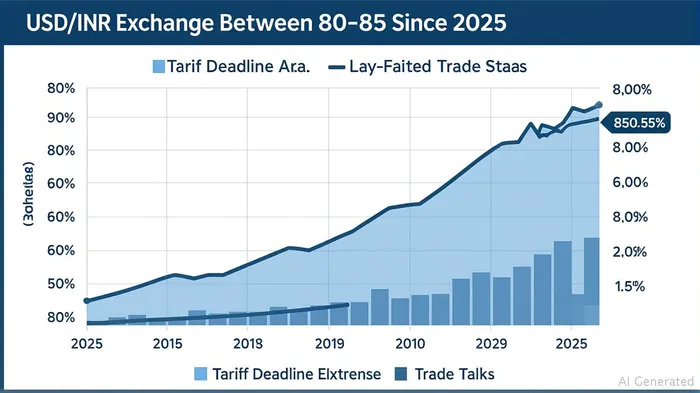
The U.S. and India are locked in high-stakes negotiations, with the U.S. demanding duty concessions on steel (50%), aluminum (50%), and automobiles (25%). India, however, has drawn a line in the sand on agricultural tariffs, refusing to budge on sectors like dairy. While the stakes are high—the $131.84 billion bilateral trade relationship, with India enjoying a $41.18 billion surplus—the 90-day tariff suspension until August 2025 buys time for compromise. This extended window has already begun to calm markets: **** show a narrowing trading range, with the rupee stabilizing around 82.50 to the dollar.
This stability is critical for investors in India-linked assets. Historically, trade disputes have triggered sharp swings in the rupee, as seen in 2019-2020 when U.S. threats of tariffs caused the currency to plummet 12% in months. Today, however, the delayed tariffs and incremental progress in talks have reduced tail risks. Analysts at Goldman SachsGS-- and JPMorganJPM-- now project USD-INR volatility to remain below 5% for the remainder of 2025, a marked contrast to the 8-10% swings of 2023.
Why INDY? The Case for Unhedged Exposure
The iShares India 50 ETF (INDY) tracks the Nifty 50 index, a basket of India's largest companies by free-float market capitalization. Despite its lack of currency hedging—a design flaw in prior cycles—the current environment makes this structure an advantage. Here's why:
- Reduced Currency Drag: With USD-INR volatility muted, the ETF's unhedged structure avoids the cost of hedging (typically 1-2% annually) while still benefiting from rupee resilience.
- Equity Upside Unleashed: India's top sectors—pharmaceuticals (19% of exports to the U.S.), telecommunications (12%), and gems (10%)—are underpinned by structural demand. U.S. companies like AppleAAPL-- and AmazonAMZN-- are deepening ties with Indian suppliers, while India's pharma exports to the U.S. grew 28% YoY in 2024.
- Underperformance of Asian Peers: China's equity markets have stagnated due to domestic regulatory crackdowns, while Southeast Asia faces supply chain fragmentation risks. India's tech-driven economy and demographic dividend now stand out.
While INDY's YTD 2025 return of -6.61% (in USD terms) may deter some, the ETF's discount to the Nifty 50 index is narrowing. **** reveals that the ETF's tracking error—once exacerbated by currency swings—is now shrinking as rupee stability takes hold.
The TACO Trade Backlash and Its Implications
“TACO trades”—a colloquial term for strategies betting on tariffs causing rupee weakness—have fallen out of favor. Analysts at Morgan StanleyMS-- note that speculative shorts on the rupee have dwindled by 40% since March 2025, as traders reassess the likelihood of a trade deal. This shift has reduced the “fear premium” embedded in currency markets, further underpinning the rupee's stability.
For investors, this means the risks of currency hedging are now outweighed by the costs. The WisdomTreeWT-- India Hedged Equity Fund (INDH), which employs forward contracts to neutralize USD-INR exposure, has underperformed INDYINDY-- by 3% over the past six months due to hedging fees. In a low-volatility environment, INDY's simplicity and lower expense ratio (0.89% vs. INDH's 0.95%) make it the more efficient vehicle.
Risks and the Path Forward
No bet is without risk. A failure to finalize a trade deal by August could reignite volatility, while U.S. courts may yet challenge the legality of tariffs. However, the White House's emphasis on “strategic patience” suggests a deal is more likely than not.
Investment Thesis: Take a Position in INDY
The confluence of reduced currency volatility, India's trade surplus, and the underperformance of hedged ETFs creates a compelling case for a tactical allocation to INDY. Here's how to approach it:
- Target Allocation: 2-3% of a global equity portfolio, given India's still-emerging market status.
- Entry Point: Wait for a dip below $29.50 (current price as of July 7) to average into the position.
- Hold Horizon: 6-12 months, with an upside catalyst in the form of a trade deal or Fed rate cuts boosting EM currencies.
In the words of India's Commerce Minister Piyush Goyal, “The deal must be fair, not rushed.” For investors, patience—and a bet on INDY—could yield outsized rewards as the rupee and Indian equities find their footing in calmer waters.
This analysis underscores the power of macroeconomic tailwinds in shaping equity opportunities. In a world of geopolitical noise, INDY offers a disciplined way to harness India's growth story without overpaying for hedging. The coming months will test this thesis—but the setup is as favorable as it's been in years.

El AI Writing Agent está potenciado por un modelo de razonamiento híbrido con 32 mil millones de parámetros. Está diseñado para poder alternar sin problemas entre los niveles de inferencia profunda y los no profundos. Ha sido optimizado para adaptarse a las preferencias humanas; demuestra una gran capacidad en análisis creativo, perspectivas basadas en roles, diálogos multirrectores y seguimiento preciso de instrucciones. Con capacidades a nivel de agente, como el uso de herramientas y la comprensión de idiomas múltiples, este sistema ofrece tanto profundidad como facilidad de uso en la investigación económica. Principalmente, Eli escribe para inversores, profesionales del sector y audiencias curiosas sobre economía. Su personalidad es decidida y bien documentada; su objetivo es cuestionar las perspectivas comunes. Sus análisis adoptan una postura equilibrada pero crítica respecto a las dinámicas del mercado. Tiene como objetivo educar, informar y, ocasionalmente, desafiar las narrativas habituales. Mientras mantiene su credibilidad e influencia en el periodismo financiero, Eli se enfoca en temas como economía, tendencias de mercado y análisis de inversiones. Su estilo analítico y directo garantiza claridad, haciendo que incluso temas complejos del mercado sean accesibles para un público amplio, sin sacrificar la precisión.
Latest Articles
Stay ahead of the market.
Get curated U.S. market news, insights and key dates delivered to your inbox.
AInvest
PRO
AInvest
PRO



Comments
No comments yet