
Navigating Uncertainty: Strategic Positioning in a Stagnant Policy and Trade-Turbulent World
 Aime Summary
The global investment landscape in 2025 is defined by two pivotal forces: the Federal Reserve's cautious, data-dependent policy stance and the seismic shifts in U.S.-China trade dynamics. These factors have created a volatile environment where traditional market assumptions are being upended. For investors, the challenge lies in balancing defensive strategies with opportunities in yield-hungry alternatives, all while navigating the fog of central bank inaction and geopolitical uncertainty.
Fed Policy Stagnation: A Double-Edged Sword
The Federal Reserve's decision to maintain the federal funds rate at 4.25%–4.5% since December 2024 reflects a delicate balancing act. While core PCE inflation has eased to 3.1%, the Fed remains wary of potential inflationary shocks from tariffs and lingering supply chain frictions. This “wait-and-see” approach has led markets to price in a 75% probability of a September rate cut, yet the central bank's hesitation has prolonged volatility.
For investors, this policy stagnation has two key implications. First, it has pushed bond yields to multiyear lows, incentivizing a shift toward growth-oriented assets. Second, it has amplified the importance of sectors insulated from rate sensitivity—such as technology and industrials—while penalizing those reliant on steady cash flows, like real estate and utilities.
China's Trade Reconfiguration: Winners and Losers
The U.S.-China trade conflict, reignited by Trump's tariffs and tempered by temporary agreements like the May 2025 deal, has reshaped global supply chains. U.S. companies are increasingly pivoting to Southeast Asia, India, and Mexico, while Chinese exports are redirecting to the euro area. This realignment has created both risks and opportunities:
- Technology and Semiconductors: Chinese tech giants like AlibabaBABA-- and Tencent have rebounded 15% in Q1 2025, driven by AI innovation and easing export restrictions. A resolution in trade negotiations could further unlock capital flows into high-growth tech sectors.
- Automotive and Industrials: U.S. automakers like General MotorsGM-- and Ford stand to benefit from a potential 25% tariff reduction on Chinese components, which could cut production costs by 8–12%.
- Emerging Markets: The MSCIMSCI-- EM Index is up 1.7% year-to-date, with Brazil and India leading gains. Brazil's 15% surge in USD terms is fueled by commodity exports to China, while Southeast Asia's manufacturing hubs (Vietnam, Indonesia) gain from tariff-driven trade diversion.
However, the path forward is fraught. Tariff uncertainty continues to disrupt project planning in sectors like construction, where combined tariffs on steel and materials now reach 50%. This volatility underscores the need for diversification and risk management.
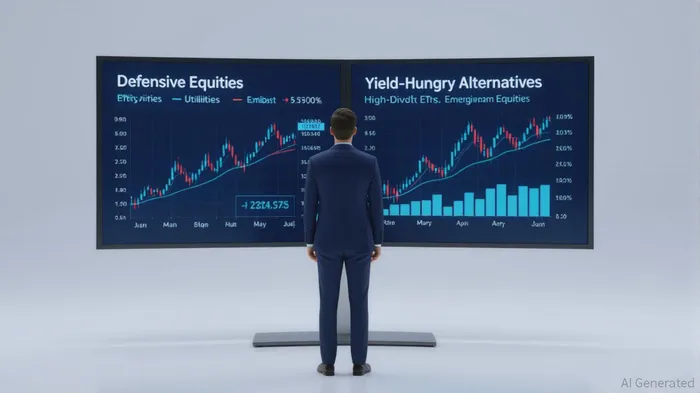
Strategic Positioning: Defensive Equities and Yield-Hungry Alternatives
In this environment, defensive equities and yield-hungry alternatives emerge as critical tools for portfolio resilience.
- Defensive Equities:
- Technology and Semiconductors: AI-driven innovation and policy tailwinds make this sector a cornerstone. Companies with localized production, like TeslaTSLA-- and BYD, are well-positioned to benefit from nearshoring and lower financing costs.
- Industrials and Automotive: Proximity to U.S. nearshoring demands and potential tariff cuts offer margin expansion.
Clean Energy and Critical Minerals: Both the U.S. and China are prioritizing resource security, creating opportunities for firms in renewables and battery production.
Yield-Hungry Alternatives:
- High-Dividend ETFs: Funds like the Schwab U.S. Dividend Equity ETF (SCHD) offer a 3.72% yield with low volatility (beta of 0.88), making them ideal for income-focused investors.
- International High-Yield ETFs: The Vanguard International High Dividend Yield ETF (VYMI) and Schwab International Dividend Equity ETF (SCHY) provide geographic diversification and exposure to sectors like utilities, which are less sensitive to trade wars.
A Balanced Approach: Hedging and Diversification
To navigate the crosscurrents of Fed inaction and trade turbulence, investors should adopt a diversified, multi-asset strategy:
- Overweight Sectors Aligned with Policy Easing: Technology, industrials, and clean energy are prime candidates.
- Allocate to Inflation-Protected Assets: Treasury Inflation-Protected Securities (TIPS) and gold can hedge against unexpected inflationary shocks.
- Leverage Emerging Markets: While volatile, markets like Brazil and India offer compelling growth opportunities and are less exposed to U.S.-China tensions.
- Monitor Trade Developments: Flexibility is key. For instance, a potential easing of tariffs could unlock value in sectors like semiconductors and automotive, while a hardening of trade policies may justify defensive positions in consumer staples.
Conclusion
The intersection of stagnant Fed policy and shifting China trade dynamics demands a nuanced, adaptive approach. Defensive equities provide stability, while yield-hungry alternatives offer income and growth potential. By strategically balancing these elements—and remaining agile in the face of evolving macroeconomic conditions—investors can not only weather the storm but also position themselves to capitalize on emerging opportunities in 2025 and beyond.

Delivering real-time insights and analysis on emerging financial trends and market movements.
Latest Articles
Stay ahead of the market.
Get curated U.S. market news, insights and key dates delivered to your inbox.
AInvest
PRO
AInvest
PRO



Comments
No comments yet