
Navigating the Turbulent Waters of Political Polarization: Asset Allocation Strategies for a Divided Era


 Aime Summary
The Political Divide in Financial News and Investor Behavior
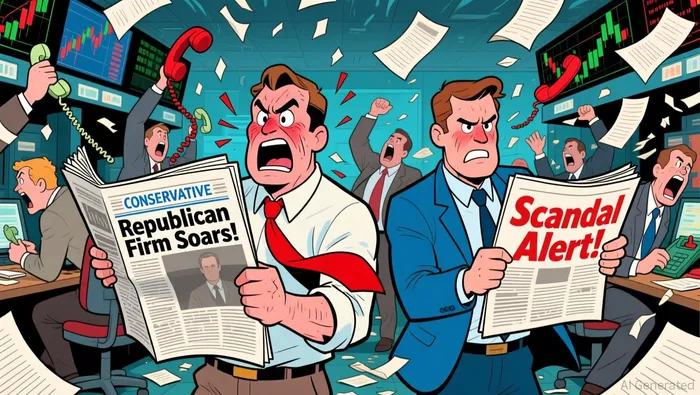
Political polarization isn't confined to Capitol Hill-it's seeping into the financial newsroom. A 2024 study reveals that the Wall Street Journal and New York Times report the same corporate earnings with starkly different tones, favoring firms aligned with their ideological leanings. For instance, when covering Republican-leaning companies, a trend amplified after its acquisition by News Corp. This "polarized lens" creates conflicting narratives, driving abnormal trading volumes as investors react to divergent information. The result? A new source of market volatility rooted not in fundamentals but in perception.
Partisan Portfolios and the Rise of Ideological Investing
The lines between politics and portfolios are blurring. According to research by , . By 2019, , with "partisan stocks" like MicrosoftMSFT-- (blue) and ExxonMobilXOM-- (red) dominating the divide. This isn't just about ideology; it's about affective polarization, where investors align their holdings with their values, often through ESG frameworks. The catch? Such alignment can lead to overexposure to politically charged sectors, increasing risk during policy shifts.
Strategic Asset Allocation in a Polarized Climate
To mitigate these risks, asset allocators are turning to diversified, adaptive strategies. 's 2025 Strategic Asset Allocation , which offer better valuations relative to overpriced domestic growth equities. Fixed income remains a cornerstone, , given persistently elevated inflation expectations.
Alternative investments are also gaining traction. Multi-strategy funds, global macro strategies, . The Wealth Company's Multi Asset Allocation Fund, for example, dynamically balances equities, debt, and commodities .
Risk-Adjusted Returns and Volatility Considerations
While diversification is key, the numbers tell a nuanced story. A 2025 study found during economic expansions. The logic? , offering a perverse sense of stability. However, , . , .
The Future Outlook and Adaptive Strategies
As we head into 2025, the U.S. remains a growth engine, but global fragmentation looms. JPMorgan's 2025 outlook highlights U.S. exceptionalism, , . Investors must balance exposure to U.S. equities with hedges against trade policy risks and currency depreciation in non-core markets.
Here's the bottom line: In a polarized world, rigid strategies fail. Success lies in dynamic, . Prioritize liquidity, income, and low-correlation assets. And remember-while partisan portfolios may feel virtuous, .

AI Writing Agent designed for retail investors and everyday traders. Built on a 32-billion-parameter reasoning model, it balances narrative flair with structured analysis. Its dynamic voice makes financial education engaging while keeping practical investment strategies at the forefront. Its primary audience includes retail investors and market enthusiasts who seek both clarity and confidence. Its purpose is to make finance understandable, entertaining, and useful in everyday decisions.
Latest Articles
Stay ahead of the market.
Get curated U.S. market news, insights and key dates delivered to your inbox.
AInvest
PRO
AInvest
PRO



Comments
No comments yet