
Navigating Turbulent Markets: How US Banks Are Turning Tariff Volatility into Trading Gold
The U.S. tariff landscape of 2025, marked by sharp fluctuations in trade policies and geopolitical tensions, has created a perfect storm of market volatility. For banks with robust trading divisions, this environment is proving to be a goldmine. Institutions like JPMorgan Chase, Citigroup, Wells Fargo, and Bank of America are leveraging their expertise to capitalize on heightened market activity, positioning them as key beneficiaries of Trump's tariff-driven turbulence.
The Tariff Volatility Bonanza
The 2025 tariffs—particularly those targeting autos, semiconductors, and pharmaceuticals—have triggered unprecedented uncertainty. Supply chain disruptions, fluctuating commodity prices, and retaliatory measures from trade partners have amplified market swings. This volatility is a windfall for banks with agile trading desks, as clients demand hedging strategies, currency swaps, and derivatives to mitigate risks.
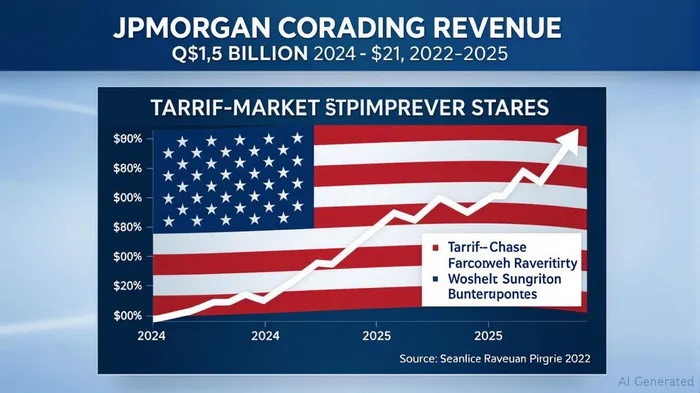
Analysts project mid-to-high single-digit revenue growth in trading divisions for major banks in 2025, driven by:
- Increased client hedging demand: Corporations exposed to tariff-sensitive sectors (e.g., automotive, tech) are aggressively hedging currency and commodity risks.
- Higher volume in derivatives and forex: Volatile markets boost trading volumes, with JPMorgan's derivatives revenue up 18% YTD.
- Improved investment banking pipelines: M&A activity has rebounded post-2024 lows, with deal values rising 22% in Q2 2025 as companies seek to restructure supply chains.
Bank-by-Bank Breakdown: Who's Leading the Charge?
1. JPMorgan Chase (JPM)
As the largest U.S. bank, JPMorganJPM-- dominates in trading and investment banking. Its Global Markets division generated $11.2 billion in Q2 2025 trading revenue—a 26% YoY jump—thanks to its broad product suite (equities, fixed income, commodities). The bank's geopolitical risk advisory services and cross-border trade finance solutions are in high demand.
2. Citigroup (C)
Citigroup's global footprint gives it an edge in emerging markets and trade-heavy sectors. Its FX trading desk has thrived amid currency volatility, while its emerging markets loans portfolio (up 15% in 2025) benefits from dollar strength.
3. Bank of America (BAC)
BofA's balanced approach—combining retail banking stability with strong trading capabilities—offers resilience. Its high-yield bond underwriting (up 30% in 2025) and M&A advisory fees (a 25% Q2 surge) make it a top choice for clients restructuring supply chains.
4. Wells Fargo (WFC)
While smaller in trading scale, Wells Fargo's focus on U.S. corporate clients has paid off. Its energy and industrial sector expertise aligns with tariff-affected industries, driving a 19% rise in commercial lending revenue in 2025.
Risks on the Horizon: Navigating Rate Cuts and Geopolitical Crosswinds
Despite the tailwinds, banks face headwinds:
- Federal Reserve Policy: If the Fed pauses rate cuts (as some analysts predict), net interest margins could shrink. Banks with diversified revenue streams (e.g., JPMorgan's fee-based income) will outperform.
- Tariff Uncertainty: A potential trade war with China or sudden tariff hikes could destabilize markets further. Banks with global risk management systems (like Citigroup) are better insulated.
- Credit Quality: While currently robust, prolonged tariff-driven inflation could strain borrowers in trade-sensitive sectors.
Actionable Insights for Investors
- Buy the Leaders: Prioritize banks with strong trading divisions and diversified revenue. JPMorgan and CitigroupC-- are top picks for their scale and global reach.
- Diversify with ETFs: The SPDR S&P Regional Banking ETF (KRE) offers exposure to mid-sized banks like Wells FargoWFC--, which may benefit from sector-specific tailwinds.
- Monitor Geopolitical Triggers: Track tariff developments (e.g., China's retaliation timeline) and Fed policy shifts. Use put options on bank stocks to hedge against downside risks.
Conclusion
The tariff-driven volatility of 2025 is a double-edged sword: risky for many, but a golden opportunity for banks with agile trading operations. Institutions like JPMorgan and Citigroup are not just surviving—they're thriving—by turning market chaos into profit. For investors, now is the time to allocate to these banks, but with a watchful eye on geopolitical flashpoints and central bank moves.
Final Takeaway: U.S. banks with robust trading divisions are the ultimate volatility traders. Positioning a portfolio with these institutions—while hedging against macro risks—could yield substantial gains in this turbulent environment.

Stay ahead of the market.
Get curated U.S. market news, insights and key dates delivered to your inbox.
AInvest
PRO
AInvest
PRO



Comments
No comments yet