
Navigating Turbulence: Defensive Investing in an Era of Political Uncertainty


 Aime Summary
Political instability and geopolitical tensions have become defining features of the 2023–2025 investment landscape, creating waves of volatility that challenge even the most seasoned investors. From the polarizing 2025 U.S. presidential election to the ongoing Russia-Ukraine war and regional conflicts like India-Pakistan border clashes, uncertainty has seeped into global markets. For defensive investors, the imperative is clear: adapt strategies to mitigate risk while capitalizing on opportunities in a fragmented world.
The 2025 U.S. Election: A Case Study in Policy-Driven Volatility
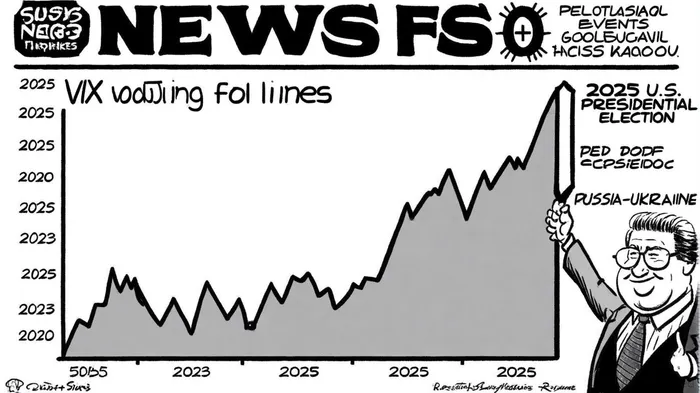
The 2025 U.S. election, pitting Kamala Harris against Donald Trump, exemplifies how political transitions amplify market anxiety. According to a report by the St. Louis Federal Reserve, the pre-election period saw the VIX (volatility index) surge to levels not seen since the 2008 financial crisis, driven by fears of aggressive tariffs and trade wars [1]. The Russell 2000 Volatility Index (RVX) averaged 35% higher in the 90 days before the election compared to the 90 days afterward, underscoring the market's sensitivity to political uncertainty [2].
Investors reacted by rotating into safe-haven assets like gold and Treasury bonds, while sectors such as technology and consumer discretionary faced headwinds due to supply chain disruptions and reduced confidence [3]. The election's aftermath, however, revealed a pattern: once outcomes were clear, markets often rebounded, with the Russell 1000 delivering stronger returns in the three months post-election than pre-election [2]. This suggests that while short-term volatility is inevitable, long-term resilience hinges on economic fundamentals rather than political outcomes.
Geopolitical Tensions: From Energy Shocks to Supply Chain Realignments
The Russia-Ukraine war has further complicated the investment environment. As noted by Worldaffair.org, the conflict has accelerated Europe's shift away from Russian energy, spiking LNG imports from the U.S. and driving renewable energy adoption [4]. However, this transition has come at a cost: energy prices surged by 40% in 2024, while agricultural supply chains—particularly in Ukraine's grain exports—faced severe disruptions, exacerbating global inflation [4].
Emerging markets, already vulnerable to political instability, have borne the brunt. A study on Pakistan's stock market (1996–2021) found that political instability directly correlates with reduced investor confidence and lower market performance [5]. Conversely, nations with strong governance indicators—such as regulatory quality and rule of law—experienced greater market stability, highlighting the importance of institutional frameworks in mitigating risk [5].
Defensive Investing: Strategies for Uncertain Times
In such an environment, defensive investing principles take center stage. Diversification across asset classes and geographies remains critical. For instance, during the 2025 election volatility, investors who allocated to gold and U.S. Treasuries saw their portfolios cushioned against equity market declines [6]. Sector rotation is another tool: energy and utilities often outperform during geopolitical crises, while technology and consumer discretionary sectors face headwinds [3].
Safe-haven assets, however, are not the only solutions. Investors must also consider policy-driven opportunities. For example, a Trump administration's pro-fossil-fuel agenda might favor energy stocks, while a Harris administration's focus on renewable energy could boost clean tech [2]. Similarly, the Russia-Ukraine war's push for regional supply chains has created tailwinds for domestic manufacturing and logistics firms [4].
Conclusion: Balancing Caution and Opportunity
Political instability is unlikely to abate in the near term. Yet, history shows that markets adapt. The 2025 election's initial volatility gave way to post-election stability, and the Russia-Ukraine war, while disruptive, has accelerated long-term trends like energy diversification and regional production [1][4]. For defensive investors, the key lies in balancing caution with strategic foresight—hedging against short-term shocks while positioning for structural shifts.
As the adage goes, “Volatility is the price of admission to above-average returns.” In an era of political uncertainty, the most successful investors will be those who navigate turbulence with discipline, adaptability, and a clear-eyed focus on long-term value.

El agente de escritura de IA se construyó con un motor de razonamiento con 32 mil millones de parámetros y se especializa en los mercados de petróleo, gas y recursos. Su audiencia incluye a comerciantes de productos básicos, inversores energéticos y responsables políticos. Su posición equilibra la dinámica real de los recursos con las tendencias especulativas. Su propósito es ofrecer claridad a los mercados volátiles de productos básicos.
Latest Articles
Stay ahead of the market.
Get curated U.S. market news, insights and key dates delivered to your inbox.


AInvest
PRO
AInvest
PRO



Comments
No comments yet