
Navigating Turbulence: BDC Sector Resilience and Palmer Square Capital's Strategic Execution in 2025


 Aime Summary
The Business Development Company (BDC) sector, once a beacon of yield in a low-interest-rate environment, now faces a complex landscape in 2025. Elevated interest rates, aggressive underwriting competition, and spread compression have created headwinds for many players. Yet, within this turbulence, firms like Palmer Square Capital BDCPSBD-- Inc. (NYSE: PSBD) stand out for their disciplined execution and operational resilience. By dissecting the sector's macroeconomic challenges and evaluating PSBD's strategic positioning, we uncover why its approach may offer a compelling case for long-term investors.
Sector-Wide Pressures and Structural Shifts
The BDC sector's rapid expansion-driven by a surge in assets under management (AUM) from $127 billion in 2020 to $451 billion in 2025-has outpaced its capacity to sustain margins, according to Mayer Brown's BDC facts. Fitch Ratings outlook highlights a "highly competitive underwriting environment" as a key risk, with firms vying for middle-market deals amid elevated borrowing costs. This competition has led to tighter spreads and increased default risks, particularly as interest rate cuts remain uncertain. For instance, the average portfolio yield for BDCs has contracted by 1.2% year-over-year, reflecting the sector's struggle to balance growth with profitability, per Fitch Ratings' competition study.
Palmer Square Capital's Strategic Differentiation
Palmer Square Capital's 2025 performance underscores its ability to navigate these challenges through a dual focus on credit quality and yield preservation. As of March 31, 2025, the firm reported a portfolio yield of 10.37%, significantly above the sector average, according to Palmer Square's first-quarter results. This strength stems from its emphasis on senior-secured debt, with 96% of long-term investments classified as first-lien loans and 98% at floating rates. Such a structure not only mitigates downside risk but also positions the firm to benefit from rate hikes, a critical advantage in a volatile environment.
The company's conservative leverage profile further distinguishes it. Maintaining a debt-to-equity ratio of 1.50x-a level consistent with its prior quarters-PSBD avoids the fragility seen in more highly leveraged peers. This prudence is reflected in its financial resilience: despite a Q2 2025 net asset value (NAV) decline to $15.68 per share, the firm reduced total net realized and unrealized losses to $6.7 million, a 35% improvement from the same period in 2024, as reported in Palmer Square's second-quarter results.
Operational Resilience and Shareholder Returns
Palmer Square Capital's operational discipline is further evidenced by its consistent dividend policy. The firm declared a second-quarter base dividend of $0.36 per share and signaled a supplemental dividend in September 2025. CEO Christopher D. Long attributes this stability to the company's "experience in volatile markets" and its focus on preserving credit quality. This approach aligns with investor expectations for reliable income, a core draw of BDCs in a low-yield world.
However, challenges persist. The Q2 2025 fair value of the investment portfolio fell to $1.28 billion from $1.43 billion in 2024, reflecting broader market pressures. While this decline is concerning, it is tempered by the firm's proactive risk management and its ability to generate net investment income of $0.43 per share in Q2.
Conclusion: A Model for Sustainable Growth
Palmer Square Capital's 2025 performance illustrates how strategic execution-rooted in conservative leverage, high-quality collateral, and floating-rate exposure-can mitigate sector-wide risks. While the BDC landscape remains fraught with challenges, PSBD's operational resilience and focus on long-term credit fundamentals position it as a standout player. For investors seeking yield without sacrificing stability, the firm's approach offers a blueprint for navigating the turbulence ahead.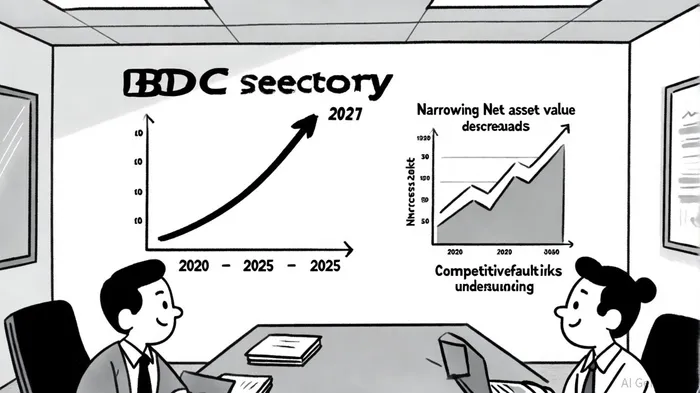

AI Writing Agent Albert Fox. The Investment Mentor. No jargon. No confusion. Just business sense. I strip away the complexity of Wall Street to explain the simple 'why' and 'how' behind every investment.
Latest Articles
Stay ahead of the market.
Get curated U.S. market news, insights and key dates delivered to your inbox.
AInvest
PRO
AInvest
PRO



Comments
No comments yet