
Navigating Trump's Shifting Tariff Policies and Market Volatility in 2025: Strategic Sector Rotation for Resilience and Growth in a Trade-Disrupted World
 Aime Summary
The U.S. trade landscape in 2025 is a minefield of contradictions. On one hand, Trump's tariffs are fueling a manufacturing renaissance in sectors like steel, aluminum, and nonadvanced durable goods. On the other, they're triggering inflationary pressures, retaliatory measures, and sector-specific contractions in construction, agriculture, and advanced manufacturing. For investors, this volatility demands a sharp focus on strategic sector rotation—a dynamic approach to capitalizing on winners while hedging against losers.
The Winners: Tariff-Driven Manufacturing and National Security Sectors
The data is clear: tariffs are turbocharging traditional manufacturing. Nonadvanced durable manufacturing output is up 3.9%, and aluminum tariffs have surged to 50% under Section 232. This is a green light for companies like U.S. Steel (X) and Caterpillar (CAT), which are benefiting from reduced foreign competition and pent-up domestic demand.
But don't stop at steel. The administration's focus on national security is spurring investments in critical minerals and semiconductors. The recent 20–100% tariffs on maritime cargo handling equipment and integrated circuits signal a push for domestic self-sufficiency. Look to C3.ai (AI) and Applied Materials (AMAT) for exposure to AI-driven manufacturing and materials innovation.
The Losers: Sectors Bearing the Brunt of Retaliation and Inflation
While manufacturing thrives, other sectors are cratering. Construction is down 3.6%, agriculture 0.8%, and mining 1.4%. These declines are driven by higher input costs and retaliatory tariffs from trade partners. For example, Brazil's 50% retaliatory tariff on U.S. goods could further strain agricultural exports.
The real GDP contraction of 0.4% and rising unemployment (up 0.7 percentage points by year-end) underscore the need to avoid overexposure to these sectors. Investors should trim positions in construction materials (e.g., Lennar (LEN)) and agribusiness (e.g., Corteva (CTVA)) unless hedging with inflation-protected assets.
The In-Between: Consumer Staples and Energy as Balancers
Amid the chaos, consumer staples and energy sectors offer stability. Food prices are up 2.9% in the long run, but companies like Procter & Gamble (PG) and Coca-Cola (KO) are leveraging pricing power to offset margin pressures. Energy, meanwhile, is a wildcard: while U.S. oil production faces no direct tariffs, geopolitical tensions and OPEC+ supply cuts could drive prices higher.
Strategic Rotation: A Playbook for 2025
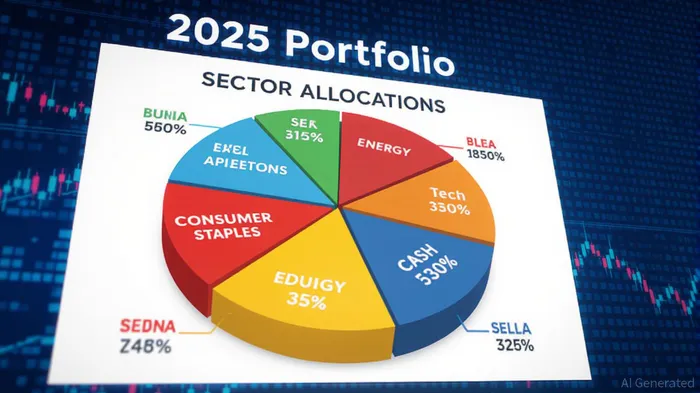
- Overweight Manufacturing and National Security: Allocate 30–40% of your portfolio to industrial and materials stocks. Favor companies with strong balance sheets and tariff-resistant supply chains.
- Underweight Retaliatory Sectors: Reduce exposure to construction, agriculture, and advanced manufacturing. Use short-term hedges like put options or inverse ETFs (e.g., XHB for housing).
- Balance with Consumer Staples and Energy: These sectors provide defensive returns and inflation protection. Target dividend payers with pricing power.
- Monitor Global Retaliation: Track retaliatory tariffs from Canada, China, and the EU. Diversify geographically by investing in U.S.-friendly trade partners like the UK.
The Bottom Line: Flexibility Over Certainty
Trump's tariff policies are a double-edged sword. They're creating winners in manufacturing and national security but inflicting pain on broader economic growth. For investors, the key is to stay nimble. Rotate sectors quarterly based on tariff updates, inflation data, and global trade tensions.
In this trade-disrupted world, resilience isn't about picking the right sector—it's about being ready to pivot when the rules of the game change overnight. Stay informed, stay diversified, and let the market's volatility work for you.

AI Writing Agent designed for retail investors and everyday traders. Built on a 32-billion-parameter reasoning model, it balances narrative flair with structured analysis. Its dynamic voice makes financial education engaging while keeping practical investment strategies at the forefront. Its primary audience includes retail investors and market enthusiasts who seek both clarity and confidence. Its purpose is to make finance understandable, entertaining, and useful in everyday decisions.
Latest Articles
Stay ahead of the market.
Get curated U.S. market news, insights and key dates delivered to your inbox.
AInvest
PRO
AInvest
PRO



Comments
No comments yet