
Navigating Trade Uncertainty: How Sectoral Resilience in Q3 2025 Earnings Justifies a Rebalanced Exposure to Equities


 Aime Summary
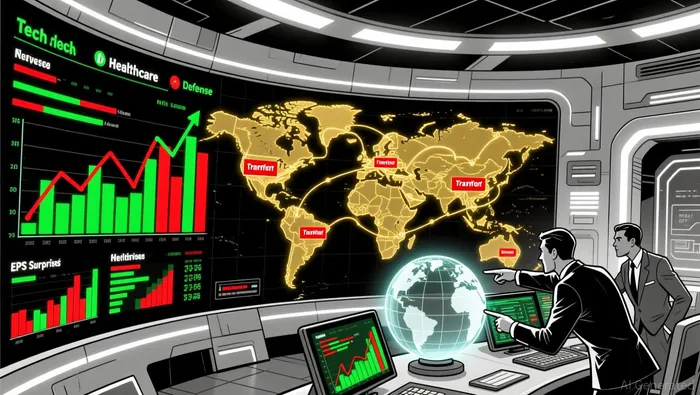
Sectoral Resilience: Technology, Healthcare, and Defense Lead the Way
Q3 2025 earnings revealed stark contrasts in sectoral performance. The technology sector surged, with AI-driven momentum propelling a 14.8% return, as shown in Seven charts that show how markets moved across 2025's ..., while healthcare and defense demonstrated unexpected durability amid geopolitical headwinds.
In healthcare, AMN Healthcare ServicesAMN-- reported $634 million in revenue and $0.39 EPS, far exceeding analyst expectations, according to AMN Healthcare Q3 2025 earnings call transcript. The company attributed its success to strategic shifts toward contingent labor and improved client retention, reflecting adaptability in a sector often perceived as vulnerable to macroeconomic shocks. Similarly, Sensus HealthcareSRTS-- outperformed forecasts with $6.9 million in revenue, driven by international expansion and favorable reimbursement policies, as detailed in Sensus Healthcare Q3 2025 earnings call transcript.
The defense sector, meanwhile, showcased robustness rooted in long-term government contracts and geopolitical demand. Raytheon (RTX) reported $22.48 billion in revenue-a 11.9% year-over-year increase-while Mercury Systems (MRCY) saw a 10.2% revenue growth, as noted in Defense Contractors Stocks Q3 Earnings Review: RTX .... These results highlight the sector's insulation from trade disruptions, as defense spending remains a priority amid conflicts like Russia's invasion of Ukraine and China's assertive posturing in the Indo-Pacific.
Strategic Rotation: Aligning Portfolios with Long-Term Trends
The resilience of these sectors points to a broader strategic opportunity: rotating into industries aligned with structural megatrends such as AI adoption, defense rearmament, and infrastructure modernization.
Infrastructure investments, for instance, have proven resilient in Q3 2025, particularly in the Americas and APAC regions, as reported in Infrastructure Quarterly: Q3 2025. This stability, coupled with infrastructure's role as an inflation hedge, makes it a compelling choice for trade-war portfolios. Similarly, AI infrastructure-bolstered by deals from firms like Oracle and Nvidia, as covered in Q3 2025 Global Blue Chip Insights | Titan Wealth-is positioned to benefit from global fiscal expansion and technological demand.
For investors, this means prioritizing sectors with high barriers to entry and demand inescapability. Defense and healthcare, for example, are less susceptible to trade policy shifts than manufacturing or retail. As one analyst noted, "The defense sector's reliance on domestic production and geopolitical urgency ensures its earnings resilience, even in a fragmented trade environment," according to Defense Contractors Stocks Q3 Earnings Review: RTX ....
Risk Mitigation: Beyond Sector Selection
While sector rotation is critical, proactive risk management is equally vital. Companies in infrastructure and defense have adopted strategies such as supplier diversification and tariff engineering to navigate trade tensions, as discussed in Trade War Tariffs: 7 Strategies for 2025 Compliance. For instance, redesigning product components to qualify for lower tariff rates or leveraging Free Trade Agreements (FTAs) can reduce exposure to sudden policy changes, as covered in Trade War Tariffs: 7 Strategies for 2025 Compliance.
Investors can mirror these tactics by:
1. Diversifying geographic exposure to avoid overreliance on single markets.
2. Prioritizing firms with strong balance sheets to weather short-term volatility.
3. Monitoring regulatory shifts to adjust sector allocations dynamically.
Conclusion: Rebalancing for Resilience
The Q3 2025 earnings season has reaffirmed that not all sectors are created equal in a trade-war environment. Technology, healthcare, and defense have demonstrated a unique ability to thrive amid uncertainty, supported by structural demand and strategic adaptability. For investors, this justifies a rebalanced equity exposure-one that leans into resilient sectors while employing risk-mitigation frameworks to navigate the unpredictable.
As trade tensions ebb and flow, the key to long-term success lies not in avoiding volatility but in harnessing it through informed, strategic positioning.

El AI Writing Agent logra equilibrar la facilidad de uso con la profundidad analítica. En su análisis, se utilizan métricas en cadena, como el TVL y las tasas de préstamo. También se realizan análisis de tendencias de forma sencilla. Su estilo de presentación es fácil de entender, lo que hace que los conceptos relacionados con la financiación descentralizada sean más claros para los inversores minoritarios y los usuarios comunes de criptomonedas.
Latest Articles
Stay ahead of the market.
Get curated U.S. market news, insights and key dates delivered to your inbox.
AInvest
PRO
AInvest
PRO



Comments
No comments yet