
Navigating Trade Tensions: Sector-Specific Resilience and Geopolitical Arbitrage in Asian Markets
The July 9, 2025 tariff deadline looms as a pivotal moment for Asian markets, reshaping supply chains and investment opportunities across sectors. While U.S.-imposed tariffs threaten to disrupt industries from automotive to semiconductors, the crisis has also created asymmetric opportunities for investors to exploit sector-specific resilience and geopolitical arbitrage. Below is an analysis of the industries most affected, the companies poised to thrive, and actionable strategies for navigating this volatile landscape.
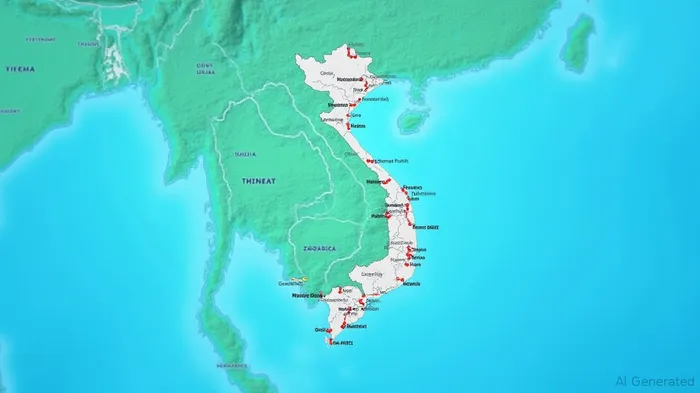
1. Automotive: Vietnam Rides the Tariff Wave as Japan Struggles
The automotive sector faces a stark divergence. Japanese automakers like Toyota (7203.T) and Honda (7267.T) have seen profits drop 18% year-to-date due to U.S. tariffs, while Vietnam's automotive industry emerges as a beneficiary. A 20% tariff rate on Vietnamese exports—far below the initial 46% threat—has lured manufacturers seeking lower-cost production hubs.
Actionable Strategy:
- Short Japanese auto stocks while overweighting Vietnam's industrials. Consider Masan Group (MSN.HM), which operates logistics and consumer goods infrastructure critical to Vietnam's export boom.
-
2. Semiconductors: Taiwan Outperforms as Geopolitical Carveouts Favor Innovation
U.S. tariffs targeting semiconductors have created a paradox: while companies like Taiwan Semiconductor Manufacturing (TSM) face headwinds, their advanced capabilities position them to capture U.S. "onshoring" demand. Taiwan's tech giants have outperformed mainland Chinese peers, which face stricter export controls on critical minerals like rare earths.
Key Insight:
- Taiwanese firms benefit from lower geopolitical risks compared to China's SMIC (688981.CN), which is barred from U.S. chip design tools.
-
Investment Play:
- Overweight Taiwan's semiconductor leaders. Use ETFs like the VanEck Semiconductor ETF (SMH) with downside protection via put options.
3. Automation & Robotics: Japan's Quiet Growth Engine
While Japan's auto sector stumbles, its automation and robotics sector thrives. Companies like Fanuc (6954.T) and Advantest (6857.T) are reaping rewards from global demand for EV components and smart factories. Fanuc's stock rose 14% in 2025 due to EV manufacturer contracts, underscoring the resilience of high-margin tech.
Geopolitical Arbitrage Opportunity:
- Japan's participation in the CPTPP trade deal provides a shield against U.S. tariffs, enabling firms to supply advanced robotics to North America without punitive duties.
Actionable Strategy:
- Allocate to automation ETFs like the iShares MSCI Japan Small-Cap ETF (EWSC), which tracks niche industrial innovators.
4. Green Technology: Japan's Carbon Neutrality Play
Japan's goal of net-zero emissions by 2050 has turbocharged demand for clean energy infrastructure. Daikin Industries (6471.T), a leader in energy-efficient HVAC systems, and Fujitsu (6702.T), which designs semiconductors for renewable grids, are key beneficiaries.
Data Point:
Investment Thesis:
- Overweight green tech through the Invesco Solar ETF (TAN), which includes Asian innovators like Kaneka (4408.T) in solar cell production.
5. Steel & Aluminum: Vietnam's Cost Advantage Shines
U.S. tariffs on non-UK steel (50% effective June 2025) have accelerated consolidation in the sector. Vietnam's lower labor and energy costs make it a magnet for production shifts.
Risk Mitigation:
- Avoid pure-play steel stocks like POSCO (005490.KS). Instead, invest in Vietnam's Ho Chi Minh Stock Index (VNINDEX), where firms like Hoang Anh Gia Lai (HAG.HM) are expanding steel-related agriculture.
6. Agriculture: AgTech and Geopolitical Diversification
Tariffs on Mexican agricultural inputs have forced U.S. farmers to adopt Farmonaut's satellite-based precision farming tools, reducing costs by optimizing fertilizer use. Meanwhile, Southeast Asian markets like Thailand and Indonesia are absorbing displaced agricultural trade.
Investment Play:
- Pair exposure to Farmonaut's B2B platform with ETFs tracking Thailand's SET Index (SET), where CP ALL (2502.BK) benefits from rising domestic consumption.
Geopolitical Arbitrage: Playing the Trade Deal Timeline
The July 9 deadline creates a binary outcome for currencies and sectors:
- Scenario 1 (Trade Deal Achieved):
- Short USD/JPY to target 145.
- Overweight CNY via USD/CNY short positions to 6.8.
Deploy high-yield shorts: USD/MYR to 4.15 and USD/IDR to 16,500.
Scenario 2 (No Deal):
- Hedge yen exposure with USD/JPY put options.
- Shift capital to safe havens like U.S. Treasuries or the yen.
Critical Triggers:
- Monitor the People's Bank of China's gold reserves (target 31.1 tonnes added in six months) as a signal of yuan stability.
- Track Japan's upper house election on July 20, which could force policymakers to accept unfavorable trade terms.
Conclusion: Precision Over Panic
The July 9 tariff deadline is a catalyst for sector rotation, not a market-wide disaster. Investors should focus on:
1. High-margin tech (semiconductors, automation).
2. Geographically diversified supply chains (Vietnam, Thailand).
3. Green infrastructure tied to Japan's decarbonization goals.
Avoid sectors directly exposed to tariffs (autos, steel) unless hedged. Use the volatility to lock in asymmetric upside through ETFs, currency forwards, and targeted stock picks. The path to profit lies in parsing trade signals and betting on resilience.

Stay ahead of the market.
Get curated U.S. market news, insights and key dates delivered to your inbox.
AInvest
PRO
AInvest
PRO



Comments
No comments yet