
Navigating New Trade Realities: How the U.S.-Vietnam Deal Redraws Supply Chains and Opportunities
The U.S.-Vietnam trade agreement, announced on July 2, 2025, marks a pivotal shift in global supply chains, with geopolitical and economic ripple effects extending far beyond the two nations. While President Trump's deal imposes a 20% tariff on Vietnamese imports and a 40% penalty on transshipped goods—primarily targeting Chinese products rerouted through Vietnam—the lack of Vietnamese government confirmation on these specifics introduces both opportunities and uncertainties. For investors, the agreement signals a strategic realignment that could reshape manufacturing dominance, favoring U.S. domestic producers and alternative suppliers while squeezing Chinese exporters.
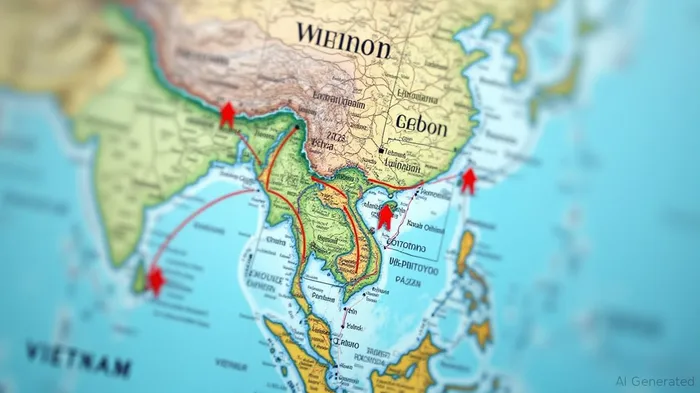
The Geopolitical Pivot: Tariffs as a Weapon of Influence
The agreement's core objective is to counter China's supply chain dominance by closing loopholes that allowed its goods to bypass U.S. tariffs via Vietnam. The 40% transshipment penalty, if enforced, could disrupt $137 billion in Vietnamese exports to the U.S. (mostly Chinese-origin products), forcing manufacturers to either reconfigure supply chains or absorb costs. Vietnam's role as a “transshipment hub” for Chinese goods—a practice critics call “tariff tourism”—is now under direct threat.
However, enforcement remains a hurdle. Vietnam's vague commitment to “reduce reliance on Chinese inputs” lacks specifics, and its reluctance to confirm the 20% tariff rate suggests room for negotiation. The White House's framing of the deal as a “Great Deal of Cooperation” contrasts with Hanoi's muted response, leaving ambiguity about compliance timelines and penalties.
Sector-Specific Impacts: Where to Invest?
The agreement's effects will vary by industry, creating both winners and losers.
1. Textiles & Apparel: A Direct Battlefield
Vietnam's $52 billion apparel exports to the U.S. (70% of which use Chinese fabrics) face immediate pressure. The 40% penalty on transshipped goods could force brands like NikeNKE-- (NKE) and VF Corp (VFC) to source closer to the U.S. or shift to Mexico or Central America.
Investment Play: U.S. domestic suppliers such as HanesbrandsHBI-- (HBI) or ETFs tracking nearshoring (e.g., iShares U.S. Consumer Staples ETF (KXI)) could benefit, while Vietnam-focused apparel stocks (e.g., Vinatex) face headwinds.
2. Electronics: A Balancing Act
Vietnam's electronics sector—driven by firms like Samsung and Foxconn—depends heavily on Chinese components. The 20% tariff on finished goods (e.g., smartphones, laptops) may incentivize companies to localize production or seek non-Chinese suppliers.
Investment Play: U.S. semiconductor firms (e.g., IntelINTC-- (INTC), Texas InstrumentsTXN-- (TXN)) could see demand for domestic chip production, while Taiwan-based manufacturers (e.g., TSMC) may gain as regional alternatives to China.
3. Machinery & Heavy Industry: A Zero-Tariff Bonanza
The U.S. commitment to zero tariffs on its exports to Vietnam opens opportunities for sectors like automotive and industrial equipment. Vietnam's pledge to import more large-engine vehicles (e.g., SUVs) benefits U.S. manufacturers like Ford (F) and CaterpillarCAT-- (CAT), which now face a tariff-free entry into a growing Southeast Asian market.
Investment Play: U.S. machinery ETFs (e.g., iShares U.S. Industrial Goods ETF (IYJ)) or individual stocks like CumminsCMI-- (CMI) could outperform as Vietnam's infrastructure spending rises.
Risks and Uncertainties: Why Caution Matters
- Enforcement Challenges: Distinguishing “Made in Vietnam” from transshipped goods requires rigorous origin tracking, which the U.S. may struggle to implement.
- Vietnam's Market Economy Status: Hanoi's demand for U.S. recognition as a market economy (to qualify for lower WTO tariffs) could prolong disputes.
- Geopolitical Volatility: Trump's “deal-making” approach lacks institutional continuity, raising risks if future administrations renegotiate terms.
Actionable Investment Strategies
- Long U.S. Domestic Suppliers: Allocate to firms in textiles (HBI), machinery (CAT), and semiconductors (INTC) that benefit from reshoring trends.
- Short Vietnam-Exposed Stocks: Avoid companies reliant on transshipment (e.g., Chinese electronics firms) or Vietnam-focused ETFs like VNM unless tariffs are confirmed.
- Monitor Tariff Compliance: Track U.S. Customs rulings on transshipment penalties—early enforcement could validate the deal's teeth.
Conclusion: A Fragile New Order
The U.S.-Vietnam deal is as much a political statement as an economic one, aiming to curb China's influence while stabilizing trade tensions. For investors, the path forward requires balancing sector-specific opportunities with the risks of enforcement gaps and geopolitical instability. The real test lies not in the agreement's terms but in its execution—a lesson the markets will learn over the coming quarters.
Stay vigilant, but stay invested where supply chains are truly reshaping.

Stay ahead of the market.
Get curated U.S. market news, insights and key dates delivered to your inbox.


AInvest
PRO
AInvest
PRO



Comments
No comments yet