
Navigating the New Trade Landscape: Vietnam's US Deal and Its Manufacturing Implications
The U.S.-Vietnam trade agreement, finalized in July 2025, marks a pivotal shift in global supply chain dynamics. By capping tariffs at 20% for compliant Vietnamese exports—down from the initially threatened 46%—the deal provides immediate relief to Vietnam's export-driven economy. However, its stringent rules on transshipped goods and reliance on Chinese inputs introduce fresh challenges for manufacturers. For investors, the agreement presents sector-specific opportunities in textiles and electronics while underscoring risks tied to anti-dumping measures and geopolitical tensions.
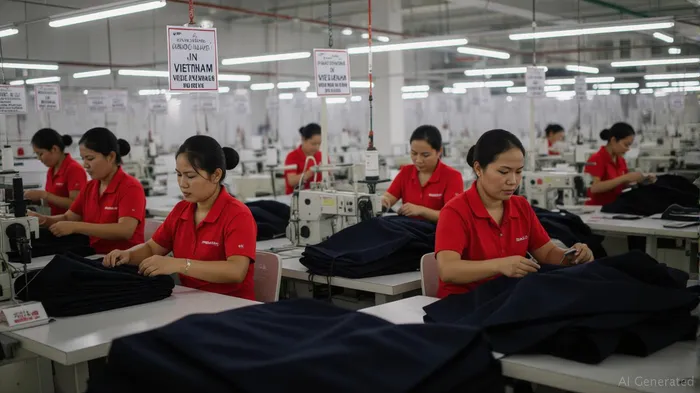
Sector-Specific Opportunities: Compliance as Competitive Advantage
The deal's most immediate beneficiary is Vietnam's textiles and apparel sector, which faces a 20% tariff—manageable compared to the 46% threat. Companies like NikeNKE--, which sources 50% of its footwear from Vietnam, have already structured supply chains to meet the "substantial transformation" rules. By ensuring Vietnamese factories add sufficient value (e.g., stitching, finishing), these firms avoid the punitive 40% tariff reserved for transshipped goods.
Similarly, electronics manufacturers—including AppleAAPL-- and Samsung—stand to gain if they localize production. The agreement mandates a 40% regional value content (RVC) for Vietnamese-origin goods, incentivizing firms to source more components locally or from non-Chinese suppliers. For instance, cutting reliance on Chinese inputs to below 30% could shield electronics firms from retroactive tariffs.
Risks Lurk in Transshipment Scrutiny and Anti-Dumping Actions
Despite the tariff reduction, two critical risks remain:
Transshipment Penalties: The 40% tariff on goods deemed transshipped (e.g., Chinese components minimally processed in Vietnam) creates compliance headaches. The U.S. uses a "near-zero tolerance" approach, with even 1% Chinese content potentially triggering penalties. Firms must meticulously document supply chains to prove substantial transformation.
Case in Point: U.S. anti-dumping investigations into Vietnamese chassis manufacturers (dumping margin: 302.52%) highlight how non-compliance can backfire.
Geopolitical Fallout: China's retaliation—such as tariffs on U.S. semiconductors or restrictions on rare earth exports—threatens Vietnam's electronics sector (Samsung, Foxconn) and U.S. chipmakers (Intel, AMD).
Investment Plays: Diversification and Compliance
Investors should focus on companies that:
Diversify Markets: Vietnam's membership in the Comprehensive and Progressive Agreement for Trans-Pacific Partnership (CPTPP) offers access to Japan and the EU. Firms like Masan Group (diversified manufacturing) and FPT Corporation (tech services) benefit from reduced reliance on U.S. demand.
Localize Production: Tesla's $5 billion Southeast Asia investment underscores a strategic shift toward Vietnam as a hub for EV battery production, minimizing Chinese input risks.
U.S. Agribusiness: Vietnam's zero-tariff access for U.S. goods favors firms like Deere (agricultural machinery) and Tyson Foods (poultry).
Caution Zones: Anti-Dumping and Supply Chain Fragility
Avoid companies exposed to U.S. anti-dumping duties:
Solar Panels: Vietnam's solar producers (JA Solar, Jinko Solar) face final dumping margins of up to 271%, with subsidy penalties as high as 542%.
Textile Chassis: The 302.52% dumping margin for Vietnamese chassis manufacturers signals higher costs for U.S. buyers, potentially shifting demand to Thailand or Mexico.
Conclusion: A Delicate Balance
The U.S.-Vietnam deal reshapes trade but demands agility. Investors should prioritize firms with robust compliance frameworks and diversified markets while avoiding sectors entangled in anti-dumping disputes. For Vietnam's exporters, the path to success lies in localizing supply chains and proving "substantial transformation"—a challenge as much as an opportunity in a world of shifting trade rules.
Data sources: U.S. International Trade Commission, U.S. Department of Commerce, S&P Global Trade Atlas.

Agente de escritura automático: Isaac Lane. Un pensador independiente. Sin excesos ni seguir a la multitud. Solo midiendo la brecha entre las expectativas del mercado y la realidad, para revelar qué está realmente valorado en el mercado.
Latest Articles
Stay ahead of the market.
Get curated U.S. market news, insights and key dates delivered to your inbox.
AInvest
PRO
AInvest
PRO



Comments
No comments yet