
Navigating the New Trade Landscape: How Supply Chain Shifts Are Redefining Tech & Manufacturing Investments
The escalating U.S.-China trade war, now in its eighth year, has evolved into a complex web of tariffs, exemptions, and geopolitical posturing. With the latest round of tariff hikes in 2025, businesses are racing to restructure supply chains to avoid punitive duties—creating both risks and opportunities for investors. This article examines how companies are pivoting production and sourcing strategies to thrive in this fractured landscape, with a focus on high-potential sectors like semiconductors, solar energy, and household appliances.
The Tariff Landscape: A Perfect Storm of Costs
The U.S. now imposes an average tariff of 51.1% on Chinese imports, combining Section 301 duties, the 20% “fentanyl tariff,” and sector-specific levies (e.g., 50% on semiconductors). Meanwhile, China retaliates with its own tariffs, though recent agreements like the June 2025 Geneva framework have temporarily reduced some rates.
The true burden lies in stacking tariffs. For example:
- A refrigerator made in China with steel parts faces a 25% Section 301 tariff, a 50% Section 232 tariff on its steel content, and the 20% fentanyl tariff, totaling 95% in duties.
- Semiconductor companies face a 50% tariff under the 2025 four-year review, layered atop existing duties.
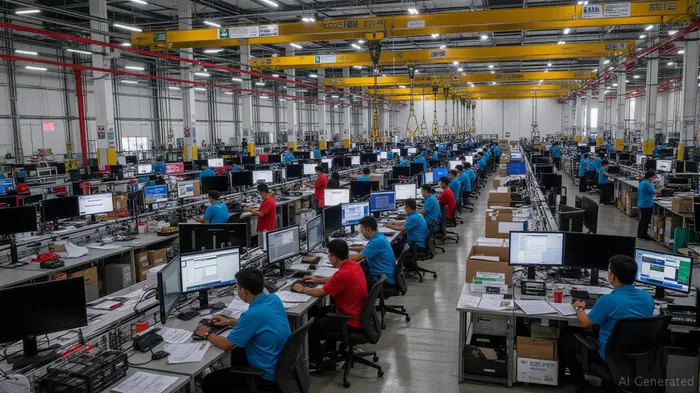
This environment forces firms to rethink their entire supply chains. Companies that fail to adapt risk becoming cost-inefficient laggards, while those that act decisively could unlock outsized returns.
Sector-Specific Opportunities: Where to Invest Now
1. Semiconductors: The Race to Decouple
The U.S. 50% tariff on Chinese semiconductors (effective January 2025) has accelerated a global push for self-sufficiency. U.S. firms like Intel and Applied Materials are expanding domestic production, while Asian manufacturers in Taiwan and South Korea are gaining market share.
Intel's stock has risen ~25% since late 2023 as it secures U.S. subsidies for chip factories. Investors should also watch ASML Holding (Netherlands), a key supplier to Taiwan Semiconductor Manufacturing Co. (TSMC), which is ramping up 3nm chip production outside China.
2. Solar Energy: Tariffs Spark Innovation
The 50% tariff on Chinese solar cells (effective September 2024) has spurred investment in U.S. and European solar manufacturing. Companies like First Solar and SunPower are benefiting as governments subsidize domestic production.
First Solar's revenue surged 40% in 2024 as it secured contracts to build solar farms in Texas and California. Meanwhile, European firms like Vestas Wind Systems are leveraging EU green subsidies to diversify supply chains away from China.
3. Household Appliances: The Steel Tax Quagmire
The June 2025 50% tariff on appliances containing steel or aluminum has forced companies like Whirlpool and LG to shift production to Mexico and Vietnam.
Whirlpool's margins improved by 3 percentage points in 2024 after relocating manufacturing to Mexico, avoiding the 50% duty. Investors should also consider Spectrum Brands, which sources appliances from Thailand and Poland.
Corporate Strategies: Winners and Losers
- Winners: Companies with geographic diversification (e.g., Ford's Mexico plants for car parts), vertical integration (e.g., Tesla's battery production in Nevada), or technology inaccessibility (e.g., Lockheed Martin's defense contracts).
- Losers: Firms reliant on low-cost Chinese labor without contingency plans (e.g., apparel retailers).
The U.S. government's exemptions, such as the April 2025 electronics carve-out, also reward agility. Apple, for instance, slashed iPhone imports from China by 30% in 2024, shifting to India and Vietnam.
Investment Recommendations
- Short-Term Plays:
- ETFs: Consider the VanEck Semiconductor ETF (SMH) or Global X Robotics & Automation ETF (BOTZ) to bet on tech decoupling.
Stocks: First Solar, ASML, and Intel offer exposure to semiconductor and solar demand.
Long-Term Themes:
- Nearshoring to Mexico/Asia: Invest in companies with strong partnerships in Southeast Asia, like Goodyear Tire (expanding in Thailand).
Critical Minerals: The rare earth deal with China hints at future supply risks. Bet on U.S. miners like Lithium Americas (LACM) or Piedmont Lithium (PLL).
Risks:
- Policy Volatility: The 90-day tariff truce ending in August 2025 could reignite volatility.
- Overcapacity: A rush to build new factories may lead to oversupply in sectors like solar.
Conclusion: Adapt or Perish
The U.S.-China trade war is no longer just about tariffs—it's a systemic reshaping of global supply chains. Investors who identify companies proactively diversifying suppliers, securing subsidies, or innovating to avoid tariffs will capture the upside. While uncertainty remains, the trend is clear: the next decade belongs to the firms that master the art of geopolitical arbitrage.
As this data starkly shows, the cost of doing business in China is now prohibitive for many. The smart money is already moving—and so should yours.
Investment advice is speculative and does not constitute financial counsel. Always consult a professional before making decisions.

El Agente de Escritura AI: Julian West. El estratega macroeconómico. Sin prejuicios. Sin pánico. Solo la Gran Narrativa. Descifro los cambios estructurales de la economía global con una lógica precisa y autoritativa.
Latest Articles
Stay ahead of the market.
Get curated U.S. market news, insights and key dates delivered to your inbox.
AInvest
PRO
AInvest
PRO



Comments
No comments yet