
Navigating the New Trade Landscape: U.S. Market Opportunities Amid Tariff Uncertainty
The U.S. tariff regime has undergone seismic shifts in 2025, reshaping global trade dynamics and creating both risks and opportunities for investors. As the White House's 90-day tariff pause with China approaches its July expiration, markets are bracing for volatility. But beneath the noise, strategic insights from UBSUBS-- reveal clear pathways to profit in sectors insulated from protectionism or positioned to benefit from long-term structural trends.
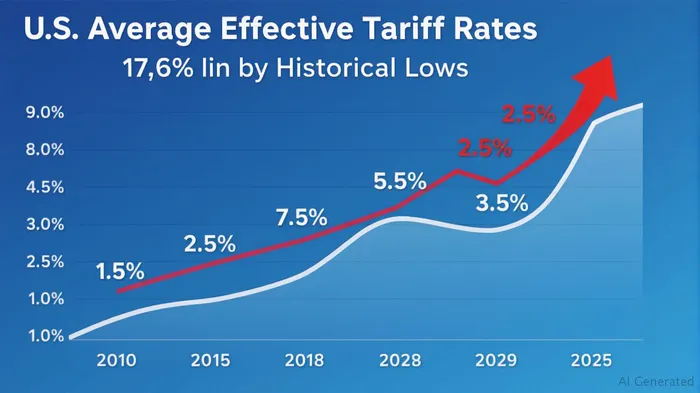
The Tariff Landscape: A Double-Edged Sword
The second quarter of 2025 brought sweeping changes:
- U.S.-China-Vietnam Triangle: New 40% tariffs on suspected Chinese goods transshipped via Vietnam have disrupted supply chains, pushing companies to diversify sourcing.
- Global Tariff Escalation: 14 countries now face tariffs from 25% to 40%, with Southeast Asia (Thailand, Cambodia) and resource-rich nations (Indonesia, Laos) hardest hit.
- Consumer Pain: Motor vehicles now cost $5,100 more on average (long-term), while apparel prices rose 17%.
The economic toll is stark: U.S. GDP growth slowed by 0.7% in 2025, and 538,000 jobs were lost in trade-exposed sectors like construction and agriculture. Yet, manufacturing output grew 2.0%, highlighting a sectoral reallocation of capital and labor.
UBS's Strategic Insights: Where to Look
UBS analysts emphasize two key themes:
1. Trade Deals as Catalysts
The U.S.-UK auto tariff reduction (10% on 100,000 vehicles) and steel/aluminum deal are modest but signal a shift toward targeted agreements. Investors should monitor negotiations with Vietnam and ASEAN nations, where tariff carve-outs could favor U.S. firms with local partnerships.
2. Structural Trends Outpace Tariff Headwinds
- Artificial Intelligence (AI): Even as semiconductors face 36% tariffs from Thailand, AI adoption is accelerating. UBS notes that companies like NVIDIANVDA-- (NVDA) and AlphabetGOOGL-- (GOOGL) are benefiting from enterprise spending on AI tools, which rose 23% YTD.
- Longevity Economy: Healthcare stocks (e.g., RegeneronREGN-- (REGN), UnitedHealthUNH-- (UNH)) are outperforming due to aging populations and breakthroughs in chronic disease management.
3. De-Dollarization and Safe Assets
The euro's 8% rise against the dollar in 2025 has boosted European equity returns for U.S. investors. UBS advises overweighting Eurozone tech stocks (e.g., SAPSAP--, ASML) while hedging with gold ETFs (GLD), which have surged 12% amid uncertainty.
Sector-Specific Opportunities
Tech & Telecom:
- Tariffs on Chinese semiconductors have accelerated U.S. domestic production. Companies like IntelINTC-- (INTC) and TSMC's Arizona plant could see policy-backed growth.
-
Healthcare:
- Medicare Advantage enrollment hit 30 million in 2025, fueling demand for telehealth platforms (Teladoc (TDOC)) and robotic surgery firms (Intuitive Surgical (ISRG)).
Consumer Staples:
- Companies with strong domestic sourcing (e.g., Campbell SoupCPB-- (CPB)) outperformed import-reliant peers, as tariffs pushed brands to “Made-in-America” rebranding.
Risks to Monitor
- Tariff Reversion: If the China pause expires without a deal, consumer prices could spike an additional 1.2%, triggering a 10% correction in cyclicals like retail (WMT, TGT).
- Debt Dynamics: The $36.2 trillion national debt and Fed's delayed rate cuts (expected by year-end) could pressure bond yields, favoring short-duration strategies.
Investment Strategy: Balance Growth and Safety
- Go Long on AI/Healthcare: Allocate 40% of equities to sectors with defensible pricing power.
- Hedge with Euro Exposure: Use European tech ETFs (FEUR) paired with inverse VIX funds (XIV) for volatility protection.
- Avoid Commodity Exposures: Firms reliant on Indonesian or Vietnamese inputs (e.g., footwear) face margin pressures.
UBS concludes that while tariffs create short-term turbulence, the U.S. market's resilience is underpinned by innovation and demographic tailwinds. Investors who focus on structural winners—and remain nimble as trade policies shift—can navigate this new landscape profitably.
Final Note: The clock is ticking on the tariff pause. Position portfolios for a bumpy but ultimately growth-oriented second half.

Delivering real-time insights and analysis on emerging financial trends and market movements.
Latest Articles
Stay ahead of the market.
Get curated U.S. market news, insights and key dates delivered to your inbox.
AInvest
PRO
AInvest
PRO



Comments
No comments yet