
Navigating the Tightening U.S. Labor Market: Sector Rotation Strategies in a High-Continuing Claims Environment
 Aime Summary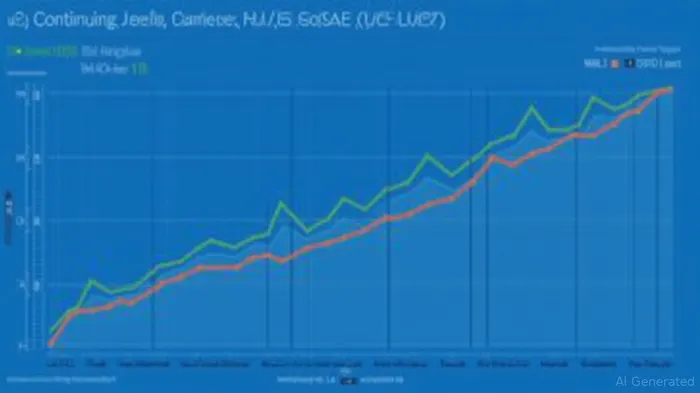
The U.S. labor market in July 2025 presents a paradox: while the headline unemployment rate remains stubbornly low at 4.1%, the data beneath the surface tells a story of uneven growth, sectoral reallocation, and lingering fragilities. Continuing Jobless Claims—a critical barometer of reemployment speed—have risen to 1.955 million, a 4,000-week increase and the highest level since November 2021. This metric, which tracks the number of individuals still receiving unemployment benefits after an initial week of aid, has become a proxy for hiring momentum. Its elevation suggests that labor demand is not uniformly robust, even as the broader economy avoids a sharp downturn. For investors, this divergence underscores the importance of sector rotation strategies that align with the labor market's structural shifts.
The Dual Labor Market: Growth vs. Stagnation
The Bureau of Labor Statistics' June 2025 report reveals stark contrasts in sector-specific employment trends. Healthcare and government employment are thriving, while manufacturing and technology sectors show signs of strain. Total nonfarm payrolls grew by 147,000 in June, but this figure masks uneven dynamics:
- Government jobs increased by 73,000, driven by state and local education sectors, which added 70,000 roles. This reflects both demographic pressures (aging populations requiring expanded healthcare services) and policy-driven hiring in education.
- Healthcare added 39,000 jobs, with hospitals and nursing facilities leading the charge. The sector's 12-month average of 43,000 monthly gains highlights its structural resilience.
- Manufacturing, by contrast, lost 8,000 jobs, raising concerns about the sector's vulnerability to trade policy uncertainty and automation-driven labor displacement.
The labor market's duality is further amplified by wage dynamics. Average hourly earnings rose 0.2% in June, with healthcare and government workers commanding higher compensation. Meanwhile, sectors like retail and professional services are grappling with flat wage growth, signaling a tug-of-war between labor demand and supply constraints.
Sector Rotation: Where to Position Portfolios
Investors must prioritize sectors where labor demand is outpacing supply and where hiring activity aligns with long-term structural trends.
Healthcare and Social Assistance
The healthcare sector's 12-month job gains of 43,000 per month reflect not only demographic tailwinds (aging populations) but also labor shortages exacerbated by burnout and training gaps. Companies like UnitedHealth Group (UNH) and Tenet Healthcare (THC) are benefiting from both employment growth and rising service demand. Social assistance, including mental health and family services, is another area of focus, with Community Health Systems (CHS) seeing robust hiring.Government Employment (State and Local)
State and local government jobs, particularly in education, are insulated from many private-sector headwinds. The 47,000 June gains in state government employment suggest sustained investment in public education and infrastructure. ETFs like the iShares U.S. Government Bond ETF (GOV) or sector-specific plays like Education Management Corporation (EDU) could benefit from this trend.AI-Adjacent Roles in Tech
While overall tech job postings in IT services and software have declined, AI-related roles remain resilient. Positions in machine learning engineering and AI ethics continue to command premium compensation. Firms like NVIDIA (NVDA) and Microsoft (MSFT) are expanding in these niches, offering exposure to labor-driven innovation.Avoiding Overexposed Sectors
Sectors with weak labor demand—such as manufacturing and traditional retail—pose risks. The 8,000-job decline in manufacturing underscores vulnerability to trade policy shifts and automation. Similarly, the 12% drop in IT services job postings signals a shift from expansion to consolidation. Investors should consider hedging or reducing exposure to these areas, particularly as wage growth lags.
The Fed's Tightrope and Market Implications
The Federal Reserve's 4.25%-4.50% rate range reflects a delicate balance between inflation risks and labor market stability. While the Fed has paused rate hikes, its focus on inflation from import duties and wage growth means further tightening is possible. For investors, this environment favors sectors with pricing power and labor cost advantages—such as healthcare, where wages are rising faster than in other industries.
Conclusion: Positioning for Labor-Driven Gains
The U.S. labor market in 2025 is no longer a monolith. As Continuing Jobless Claims rise and sectoral trends diverge, investors must adopt a nuanced approach. Rotating into sectors with strong employment growth—healthcare, government, and AI-driven tech—while hedging against overexposed industries offers a path to outperform in a tightening labor market. The key lies in aligning portfolios with the labor market's evolving narrative: a tale of resilience in some corners, and fragility in others.

Stay ahead of the market.
Get curated U.S. market news, insights and key dates delivered to your inbox.
AInvest
PRO
AInvest
PRO



Comments
No comments yet