
Navigating the Tides: U.S. Rate Cut Expectations and Global Equity Markets
 Aime Summary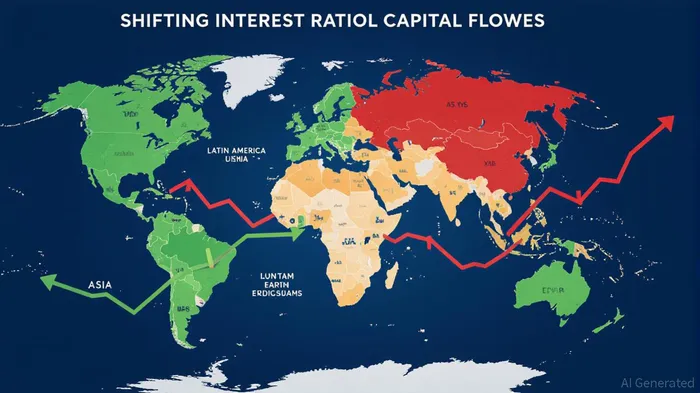
The July 2025 U.S. jobs report, released on August 1, 2025, has become a pivotal turning point in global capital markets. With nonfarm payrolls rising by just 73,000—a stark underperformance relative to the 117,500 consensus forecast—and downward revisions to prior months' data reducing job gains by 258,000, the labor market's fragility has forced a reevaluation of Federal Reserve policy. This shift has triggered a cascade of implications for emerging markets and high-yield sectors, reshaping investor sentiment and asset allocation strategies.
The Fed's Dilemma: Timing and Magnitude of Easing
The July report underscored a slowing labor market, with the unemployment rate holding steady at 4.2% but labor force participation declining and long-term unemployment rising. These signals have intensified pressure on the Federal Reserve to act. Prior to the report, the market priced a 40% chance of a September rate cut, but within hours of the data release, this probability surged to 80%. The CME FedWatch Tool now reflects a 64% probability of two cuts and 20% for three by year-end 2025.
The Fed's internal debate, highlighted by dissenting votes from Christopher Waller and Michelle Bowman, reveals a policy split between doves advocating for preemptive easing and hawks wary of inflation risks. Fed Chair Jerome Powell's “wait-and-see” stance may soon give way to action, particularly if September data confirms a sustained slowdown. The Jackson Hole symposium in late August will likely offer critical clues on the Fed's path.
The yield curve, currently inverted at -0.8%, suggests market expectations of aggressive rate cuts. Historically, such inversions have preceded economic slowdowns, further reinforcing the case for a dovish pivot.
Cascading Effects on Emerging Markets
A U.S. rate-cut cycle typically triggers capital outflows from dollar assets into higher-yielding emerging market (EM) equities and bonds. The July report has accelerated this dynamic, with the U.S. dollar depreciating against major currencies. For example, the Mexican peso and Brazilian real have gained 5% and 3%, respectively, since mid-July, boosting the appeal of local-currency EM bonds.
The EEM has outperformed the S&P 500 by 8% in this period, driven by inflows into EM tech and consumer discretionary sectors. However, political risks—such as Trump's baseless claims about the jobs report and the firing of the BLS commissioner—introduce volatility. Investors must balance the allure of EM growth with geopolitical uncertainties, particularly in markets tied to U.S. trade policies.
High-Yield Sectors: Opportunities and Caution
High-yield bonds, which offer an average yield of 7.2%, have attracted income-seeking investors amid the Fed's easing expectations. However, tight credit spreads (2.99% as of June 2025) leave little room for error. A 50-basis-point rate cut could drive spreads wider, pressuring prices.
The data reveals a narrowing trend, suggesting overvaluation. Investors should focus on select high-quality credits rather than broad exposure. Defensive sectors like utilities and healthcare in EM markets—offering stable cash flows—may outperform amid macroeconomic volatility.
Actionable Strategies for Investors
- Asset Allocation Shifts: Increase exposure to EM local-currency bonds and high-yield EM equities, favoring regions with sound fiscal policies (e.g., Mexico, India).
- Sector Rotation: Overweight AI-driven technology and infrastructure in EM markets, while underweighting energy and industrial sectors sensitive to trade tensions.
- Risk Management: Use currency hedging to mitigate dollar depreciation risks and diversify across EM regions to avoid overexposure to politically unstable economies.
- Timing the Fed: Monitor the September jobs report and Jackson Hole symposium for signals on the Fed's easing timeline. A September cut would likely trigger a rotation into EM assets.
The 4.3% default rate as of May 2025 underscores the need for rigorous credit selection. Prioritize investment-grade corporates and EM bonds with strong liquidity.
Conclusion
The U.S. rate-cut cycle, now seemingly inevitable, presents both opportunities and risks for global investors. Emerging markets and high-yield sectors stand to benefit from capital inflows and a weaker dollar, but geopolitical and trade policy uncertainties demand caution. A disciplined approach—combining tactical sector rotation, currency hedging, and selective credit exposure—will be key to navigating this evolving landscape. As the Fed inches closer to action, investors must stay agile, balancing yield-seeking impulses with the need for resilience in a fragmented global economy.

Stay ahead of the market.
Get curated U.S. market news, insights and key dates delivered to your inbox.






Comments
No comments yet