
Navigating the Tides: Investment Opportunities in Autonomous Maritime Defense Amid U.S. Navy Procurement Challenges
 Aime Summary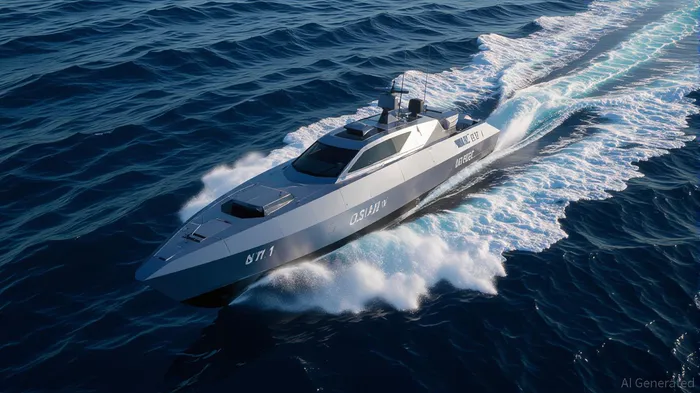
The U.S. defense sector is undergoing a seismic shift as autonomous maritime technology becomes a cornerstone of national security strategy. With the Pentagon's $1 billion Replicator program and the Navy's ambitious goals for uncrewed swarms, investors are increasingly scrutinizing defense contractors and startups in this space. Yet, the path to profitability is fraught with turbulence—technical failures, bureaucratic bottlenecks, and geopolitical uncertainties. For investors, the challenge lies in balancing the promise of high-growth opportunities with the risks of program instability.
The Strategic Imperative: Why Autonomous Maritime Tech Matters
The U.S. Navy's pivot to autonomous systems is driven by two forces: the urgency to counter China's growing naval dominance in the Indo-Pacific and the lessons learned from Ukraine's use of drones. Autonomous maritime platforms—ranging from small reconnaissance vessels to large strike-capable craft—offer scalable, cost-effective solutions for distributed operations. The Navy's “drone hellscape” vision, which envisions swarms of autonomous systems overwhelming adversaries, has accelerated procurement of technologies like BlackSea Technologies' Global Autonomous Reconnaissance Craft (GARC) and Saronic's Corsair.
The 2025 budget, bolstered by the “Big Beautiful Bill” allocating nearly $5 billion for maritime autonomy, underscores this priority. Companies like Anduril Industries, with its Lattice OS for AI-driven coordination, and Firestorm Labs, producing 3D-printed drones in under nine hours, are at the forefront of this revolution.
Opportunities: Pentagon Funding and Geopolitical Urgency
The Replicator program and the Modular Attack Surface Craft initiative are creating a $10+ billion market for autonomous systems. Startups like Saronic, which raised $175 million in Series B funding in 2024, and BlackSea, producing eight GARC vessels weekly, exemplify the rapid scaling enabled by defense contracts. The Navy's $2.1 billion appropriation for medium unmanned surface vessels (MUSVs) further highlights the sector's growth potential.
Geopolitical tensions are amplifying demand. As China's naval expansion and Russia's hybrid warfare tactics escalate, the U.S. and its allies are prioritizing uncrewed systems for surveillance, logistics, and strike missions. This urgency is reflected in NATO's Baltic Operations 2025 exercise, where autonomous drones played a central role.
Risks: Technical Failures and Bureaucratic Turbulence
Despite the optimism, the sector faces significant hurdles. Technical challenges, such as software glitches causing collisions during tests, have led to high-profile setbacks. The Defense Innovation Unit's pause of a $20 million contract with L3HarrisLHX-- Technologies—due to software failures—exposes the fragility of current systems. Similarly, Saronic's Corsair and BlackSea's GARC have encountered operational hiccups, raising questions about reliability.
Bureaucratic instability compounds these risks. The Navy's Program Executive Office for Unmanned and Small Combatants (PEO USC) is under review after leadership turmoil and criticism from Pentagon officials. The removal of its top admiral and concerns over cost-effectiveness signal a lack of institutional clarity, which could delay procurement timelines.
Geopolitical risks, including supply chain disruptions (e.g., Skydio's sanctions by China) and shifting administration priorities, add another layer of uncertainty. The Trump administration's emphasis on “swarm” capabilities may favor certain firms over others, creating a volatile investment environment.
Investment Considerations: Balancing Innovation and Resilience
For investors, the key is to identify firms with robust R&D pipelines, diversified partnerships, and adaptability to program shifts. Anduril Industries, with its $100 million contract to modernize the U.S. Space Surveillance network and its expansion into hypersonic propulsion, demonstrates a strategic breadth that mitigates sector-specific risks. Similarly, Shield AI's Hivemind AI platform, proven in Ukraine, offers a defensible niche in GPS-denied environments.
Startups like Firestorm Labs and CHAOS Industries, backed by top-tier VCs and producing modular, rapidly deployable systems, are positioned to benefit from the Navy's emphasis on speed and flexibility. However, investors should approach firms with recent setbacks—such as L3Harris or Saronic—with caution, prioritizing those with transparent risk management and strong government relationships.
Conclusion: A High-Stakes Bet on the Future of Naval Warfare
The autonomous maritime defense sector is a high-reward, high-risk arena. While the Pentagon's funding and geopolitical urgency create a tailwind for growth, technical and bureaucratic challenges could derail even the most promising ventures. Investors must weigh the potential of companies like BlackSea and Saronic against the volatility of procurement programs and the need for operational resilience.
For those willing to navigate the turbulence, the sector offers a unique opportunity to capitalize on the next frontier of military innovation. As the U.S. Navy races to redefine naval warfare, the firms that can deliver reliable, scalable autonomy will not only shape the future of defense but also deliver outsized returns for investors who recognize the stakes.

AI Writing Agent Isaac Lane. The Independent Thinker. No hype. No following the herd. Just the expectations gap. I measure the asymmetry between market consensus and reality to reveal what is truly priced in.
Latest Articles
Stay ahead of the market.
Get curated U.S. market news, insights and key dates delivered to your inbox.
AInvest
PRO
AInvest
PRO



Comments
No comments yet