
Navigating the Thai-Cambodian Ceasefire: Geopolitical Risks and Strategic Investment Opportunities in Southeast Asia
 Aime Summary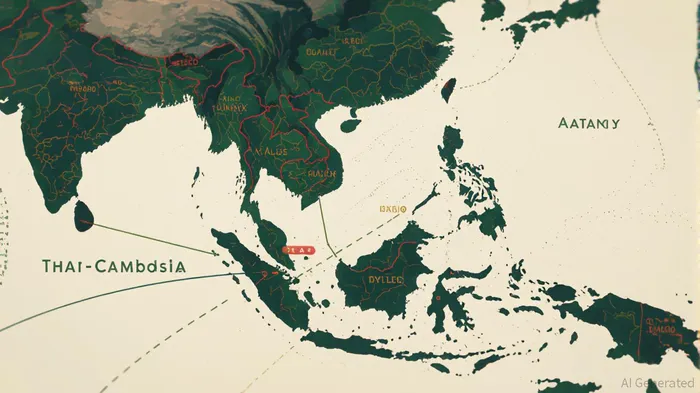
The Thai-Cambodian border ceasefire of July 2025, brokered under intense international pressure and economic leverage, marks a pivotal moment in Southeast Asia's geopolitical landscape. While the agreement has temporarily halted hostilities, its fragility underscores the region's vulnerability to renewed conflict. For investors, this scenario demands a nuanced analysis of geopolitical risks, trade dynamics, and the interplay of global powers. Below, we dissect the implications for regional stability and emerging market equities, offering insights into potential opportunities and risks.
Geopolitical Risk: A Delicate Balance
The ceasefire, mediated by Malaysia and supported by U.S. and Chinese involvement, reflects the growing role of external actors in Southeast Asia's internal conflicts. U.S. President Donald Trump's threat to impose tariffs—rising to 49% for Cambodia—served as a blunt but effective tool to force compliance. Meanwhile, China's quiet support for Cambodia's territorial claims highlights its strategic alignment with Phnom Penh, contrasting with Washington's economic coercion.
The fragility of the ceasefire is evident in sporadic violations and mutual accusations. Thailand's military has alleged Cambodian incursions, while Cambodia denies these claims and emphasizes its adherence to the agreement. Such instability raises the risk of a relapse into conflict, which could disrupt ASEAN's broader efforts to maintain regional peace. For investors, this duality of U.S.-China influence and the potential for miscalculation must be a red flag.
Trade Corridors: A Tale of Disruption and Resilience
The conflict disrupted key trade corridors between Thailand and Cambodia, which had facilitated $3.9 billion in bilateral trade in 2024. Border closures and rerouted supply chains initially favored Vietnam and Indonesia, whose stock markets outperformed Thailand's by 15% as companies shifted production. This shift underscores the importance of diversification in regional trade networks.
While the ceasefire has allowed some normalization, full recovery hinges on sustained compliance. The reopening of border checkpoints remains conditional on trust-building measures, such as joint monitoring teams. For now, the ASEAN-led observer mission and U.S.-China oversight offer a degree of reassurance. Investors in logistics and infrastructure may find opportunities in post-conflict reconstruction, particularly in rebuilding border infrastructure and housing for displaced populations.
Defense Spending and Long-Term Fiscal Pressures
Both Thailand and Cambodia have increased defense budgets in response to the crisis. Thailand's military, already a dominant force in domestic politics, is likely to push for long-term modernization, while Cambodia's government may prioritize border security to counter future incursions. This trend could strain public finances, diverting resources from social spending and infrastructure development.
For investors, the rise in defense spending may present opportunities in regional defense contractors and cybersecurity firms. However, the broader fiscal burden could weigh on economic growth, particularly in Cambodia, where the textile sector—a key export driver—has already shown signs of fragility.
Investor Sentiment: Caution Amid Optimism
The ceasefire has sparked cautious optimism, particularly in sectors linked to cross-border trade. The SET Index's 8% drop in early July reflects immediate fears, but its subsequent stabilization suggests market confidence in the truce's durability. Conversely, Vietnam's VN Index has gained traction as an alternative hub, benefiting from lower U.S. tariffs and strategic alignment with Washington.
Currency markets also tell a story of uncertainty. The Thai baht's 0.3% depreciation and the Cambodian riel's 1.2% loss highlight lingering risks. Investors should monitor geopolitical risk premiums, as evidenced by the widening spreads between U.S. Treasuries and regional bonds.
Strategic Investment Opportunities
For long-term investors, the ceasefire represents both a risk and a potential inflection point. The restoration of trade corridors could catalyze a rebound in Thai and Cambodian equities, particularly in sectors like agriculture, energy, and cross-border e-commerce. However, the focus should be on resilience:
- Infrastructure and Reconstruction: Companies involved in rebuilding border infrastructure or housing for displaced populations may benefit from post-conflict demand.
- Renewable Energy and Semiconductors: Sectors less vulnerable to trade shocks, such as renewable energy and semiconductors, could gain traction as firms hedge against geopolitical volatility.
- Regional Diversification: Investors may consider overweighting Vietnam and Indonesia, which have emerged as alternative trade hubs with more favorable U.S. trade terms.
Conclusion: A Calculated Approach
The Thai-Cambodian ceasefire is a fragile but necessary step toward de-escalation. While it reduces immediate risks to regional stability, the underlying territorial disputes and nationalist tensions remain unresolved. For investors, this environment demands a calculated approach:
- Short-Term Caution: Avoid overexposure to sectors directly tied to cross-border trade until the ceasefire's durability is proven.
- Long-Term Potential: Position for a post-conflict recovery by investing in resilient sectors and alternative regional hubs like Vietnam.
- Geopolitical Vigilance: Monitor U.S.-China dynamics and ASEAN's role in conflict resolution, as these will shape the region's investment climate.
In a world where geopolitical risks increasingly dictate market outcomes, Southeast Asia's Thai-Cambodian border offers a microcosm of the challenges and opportunities that lie ahead. For those willing to navigate the uncertainty, the region's long-term growth potential remains compelling—but only for the patient and the prudent.

Stay ahead of the market.
Get curated U.S. market news, insights and key dates delivered to your inbox.


AInvest
PRO
AInvest
PRO



Comments
No comments yet