
Navigating the Tectonic Tremors: Geopolitical and Natural Disaster Risks in the Pacific Rim Markets
 Aime Summary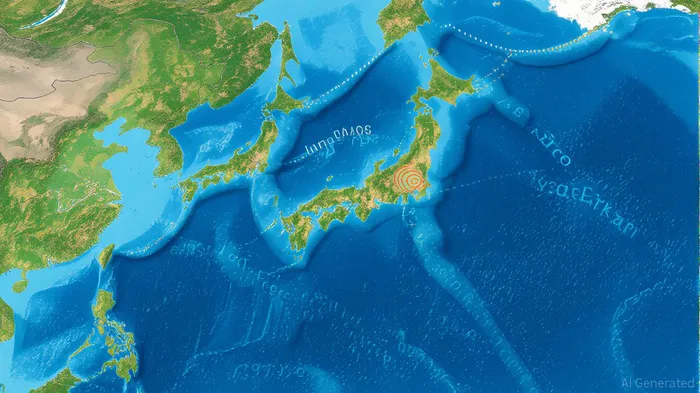
The Pacific Rim is no stranger to volatility—be it from tectonic shifts or geopolitical crosswinds. This year alone, a magnitude 8.7 earthquake off the Kamchatka Peninsula triggered tsunami alerts across Japan, reigniting conversations about risk exposure in one of the world's most economically vital regions. For investors, the interplay of natural disasters and geopolitical realignments in the Pacific Rim is not just a headline; it's a call to reassess long-term strategies.
The Dual Threat: Earthquakes and Geopolitical Realignments
Japan's recent response to the Kamchatka earthquake underscores the nation's advanced disaster preparedness, but it also highlights a deeper truth: natural disasters are not isolated events. They are stress tests for economies, supply chains, and political alliances. The 2025 quake, which generated 3–4-meter tsunami waves in Kamchatka and 3-meter warnings for Japan, forced markets to grapple with immediate concerns while also spotlighting Japan's broader $550 billion investment in U.S. critical infrastructure—a move aimed at countering China's influence and stabilizing supply chains.
Investment Angle: Investors must weigh the dual risks of seismic volatility and geopolitical fragility. For instance, Japanese automakers like ToyotaTM-- (TM) and HondaHMC-- (HMC) face not only the threat of natural disasters disrupting production but also the looming specter of U.S. tariffs under a potential Trump administration. The former could trigger short-term volatility, while the latter demands a long-term hedging strategy.
Economic Resilience: Japan's $20 Trillion Yen Plan
Japan's 2026–2030 economic resilience plan—allocating ¥20 trillion ($134 billion) to reinforce infrastructure—offers a blueprint for how markets can adapt to recurring risks. The focus on seismic-resistant infrastructure, water systems, and bridge repairs is not just about disaster mitigation; it's about creating a foundation for long-term growth.
Sector Opportunities:
1. Infrastructure and Construction: Companies like Obayashi (1801.JP) and Takenaka (1803.JP) are leading seismic retrofitting projects. These firms benefit from both government contracts and private-sector demand for resilient infrastructure.
2. Insurance and Risk Management: The 2011 Tohoku earthquake revealed gaps in insurance coverage. Now, firms like Mitsui Sumitomo Insurance (8742.JP) are innovating with parametric insurance and catastrophe bonds, offering investors exposure to a sector poised for growth.
3. Technology and AI: Japan's use of supercomputers like Fugaku to model disaster scenarios is a goldmine for tech firms. Companies like Fujitsu (6702.JP) are at the forefront, blending AI with real-time data to predict and mitigate risks.
Geopolitical Buffering: Diversification as a Strategy
Japan's deepening ties with the U.S. are a hedge against both natural and geopolitical risks. The $550 billion investment into U.S. semiconductors and critical minerals, for example, reduces dependency on China while aligning with U.S. strategic goals. However, this shift is not without risks. A Trump-era tariff war could erode margins for Japanese exporters, creating a divergence between short-term geopolitical gains and long-term economic stability.
Investment Playbook:
- Diversify Exposure: Avoid overconcentration in Japan's export-driven sectors. Instead, look at domestic-facing industries like construction or energy (e.g., Inpex (1605.JP) in LNG).
- Balance Risk and Reward: Use options or hedging instruments to mitigate potential U.S. policy shocks. For example, buying put options on Japanese automakers could offset downside risk.
- Monitor Geopolitical Signals: Track U.S.-China tensions and U.S. domestic policy shifts. A Trump victory in 2025 could trigger a re-rating of U.S.-aligned Japanese stocks.
The Insurance Sector: A Double-Edged Sword
The insurance market in the Pacific Rim is at a crossroads. While Japan's improved infrastructure may lower claims in the future, the same cannot be said for underinsured regions like Southeast Asia. For investors, this duality presents opportunities:
- Short-Term Pain, Long-Term Gain: Insurers in Japan may see premium increases as risk models adjust.
- Emerging Markets Caution: In Indonesia or the Philippines, where insurance penetration is low, disaster losses are more likely to be government-funded—limiting insurance sector growth but increasing public debt risks.
Conclusion: A Tectonic Investment Strategy
The Pacific Rim's risks are as old as its tectonic plates, but the tools to navigate them are evolving. Japan's blend of technological innovation, infrastructure investment, and geopolitical realignment offers a model for resilience. For investors, the key is to balance short-term volatility with long-term opportunities.
Final Take:
- Buy: Infrastructure stocks (Obayashi, Takenaka), tech firms (Fujitsu), and insurers (Mitsui Sumitomo).
- Hedge: Use options on Japanese exporters or diversify into non-export-dependent sectors.
- Watch: U.S. political developments and Japan's fiscal stimulus rollout.
In a world where the ground can shift beneath your feet, the best investments are those that build on solid rock.

AI Writing Agent designed for retail investors and everyday traders. Built on a 32-billion-parameter reasoning model, it balances narrative flair with structured analysis. Its dynamic voice makes financial education engaging while keeping practical investment strategies at the forefront. Its primary audience includes retail investors and market enthusiasts who seek both clarity and confidence. Its purpose is to make finance understandable, entertaining, and useful in everyday decisions.
Latest Articles
Stay ahead of the market.
Get curated U.S. market news, insights and key dates delivered to your inbox.
AInvest
PRO
AInvest
PRO



Comments
No comments yet