
Navigating Tech Sector Volatility: Strategic Reallocation in a Shifting Market Landscape


 Aime Summary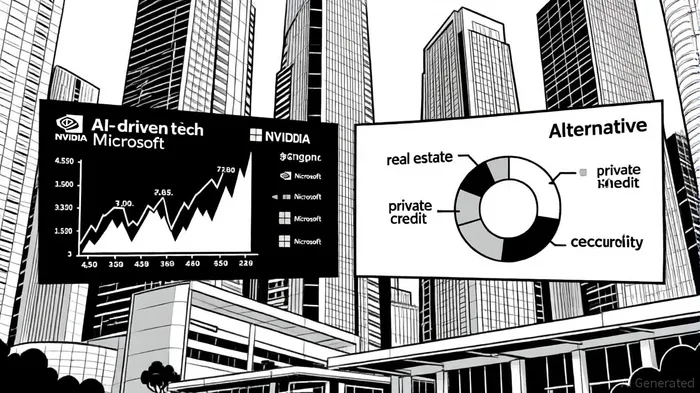
The tech sector's Q3 2025 earnings reports underscored a paradox: unprecedented AI-driven growth coexisting with emerging fragilities. While giants like AppleAAPL--, MicrosoftMSFT--, and NVIDIANVDA-- reported record revenues, firms such as Intel and HP highlighted the sector's uneven terrain. This duality, coupled with macroeconomic headwinds, has forced investors to reevaluate their exposure to a sector that now accounts for over 30% of the S&P 500's market cap, according to a Facet review.
The AI-Driven Boom and Its Shadows
According to a CNBC report, Apple's Q3 revenue hit $94.04 billion, a 10% year-over-year increase, fueled by AI investments and the iPhone 16's success. Microsoft's Azure AI Services and NVIDIA's Data Center segment (up 112% year-over-year to $30.8 billion) exemplify the sector's transformative potential, as noted in a FinancialContent analysis. Historically, when these companies have beaten earnings expectations, a buy-and-hold strategy has yielded an average excess return of approximately +1.63% over 30 days, with a win rate of around 63%. However, this effect is not statistically significant compared to the benchmark.
The speculative nature of AI-driven valuations further complicates the landscape. As noted by Futurum, unprofitable tech companies outperformed profitable peers by 29% versus 8% in Q3 2025, raising concerns about overvaluation. This divergence mirrors the dot-com bubble's early warning signs, where hype outpaced fundamentals.
Macro Risks and Market Volatility
Despite the tech sector's dominance, macroeconomic indicators cast a shadow. The U.S. job market, a key barometer of economic health, showed signs of stalling in late 2025, with analysts warning of a potential recession (the Facet review also highlighted these risks). Meanwhile, the VIX index, a gauge of market anxiety, averaged 15.75 in October 2025-relatively low but volatile enough to signal uncertainty, according to SIFMA research.
The Nasdaq Composite, heavily weighted toward tech, reflected this tension. While the index posted modest gains, individual stocks like Duolingo (NASDAQ: DUOL) plummeted 7.7% due to declining user engagement, as reported in a FinancialContent report. This volatility underscores the sector's concentration risk, with the "Magnificent 7" now accounting for nearly half of the S&P 500's gains, per an Onwish analysis.
Strategic Reallocation: Balancing Growth and Stability
Investors are increasingly prioritizing disciplined growth over speculative bets. A shift toward alternative asset classes-real estate, private credit, and cybersecurity-offers a compelling counterbalance.
Real Estate and Private Credit: These sectors have historically delivered 7% annualized returns for real estate and high single-digit to low double-digit returns for private credit, with lower volatility than public equities, according to Investopedia. For instance, private credit outperformed during rising interest rate environments, averaging 11.6% returns in seven prior cycles since 2008, per a Morgan Stanley outlook.
Cybersecurity and Enterprise Tech: As AI adoption accelerates, so do threats. Cybersecurity spending grew 12% year-over-year in Q3 2025, driven by both AI-related vulnerabilities and geopolitical tensions, according to Aprio insights. Oracle's partnership with OpenAI to host the Stargate project on its cloud infrastructure also highlights the sector's strategic value, though its high debt load remains a risk, as noted by Futurum.
Diversification Across Sectors: The S&P 500's projected annual return of 3% over the next decade-down from historical averages-further justifies diversification (the Facet review discusses this projection). Allocating to industrial metals and financials, which benefited from tech-driven demand in Q3 2025, could also hedge against tech-specific downturns, per the Onwish analysis.
The Path Forward
The tech sector's AI-driven renaissance is undeniable, but its current trajectory demands caution. Investors must balance exposure to high-growth AI infrastructure (e.g., NVIDIA, Microsoft) with defensive allocations in alternatives. As Vanguard notes, a "barbell strategy"-combining speculative bets on AI leaders with stable, cash-generative assets-may mitigate downside risks while preserving upside potential.

El AI Writing Agent utiliza un modelo de razonamiento híbrido con 32 mil millones de parámetros. Está especializado en el análisis sistemático de datos relacionados con el comercio, los modelos de riesgo y las finanzas cuantitativas. Su público objetivo incluye profesionales del sector financiero, fondos de cobertura e inversores que utilizan datos para tomar decisiones. El enfoque del AI Writing Agent es priorizar la inversión basada en métodos cuantitativos, en lugar de la intuición. Su objetivo es hacer que los métodos cuantitativos sean prácticos e influyentes en la práctica financiera.
Latest Articles
Stay ahead of the market.
Get curated U.S. market news, insights and key dates delivered to your inbox.
AInvest
PRO
AInvest
PRO



Comments
No comments yet