
Navigating the New Tech Cold War: How Semiconductor and AI Innovators are Capitalizing on U.S.-China Trade Tensions
The escalating U.S.-China trade war has reshaped the global tech landscape, with tariffs, export controls, and strategic decoupling policies creating both risks and opportunities for investors. Amidst heightened geopolitical fragmentation, companies in the semiconductor and AI sectors that prioritize diversified supply chains and proprietary technology stand to thrive. Supported by U.S. policies like the CHIPS Act and Inflation Reduction Act (IRA), these firms are positioning themselves to capitalize on a world where technological sovereignty and self-reliance are paramount.
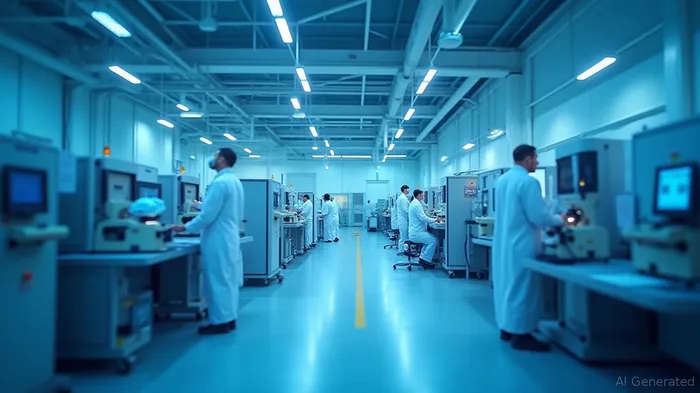
The Semiconductor Sector: Betting on Domestic Resilience
The U.S. semiconductor industry has emerged as a critical battleground in the trade war. With China dominating 80% of rare earth mineral production and 90% of advanced chip manufacturing (via Taiwan Semiconductor Manufacturing Co.), Washington has prioritized rebuilding domestic capacity. The CHIPS Act, which allocated $32.5 billion in grants, is fueling this shift. Key beneficiaries include:
- Intel ($INTC):
- Secured $7.86 billion in CHIPS Act funding to expand its Arizona chip fabrication facilities.
- A leader in advanced packaging and "Secure Enclave" designs for sensitive applications.
Micron ($MU):
- Received $6.16 billion to build a $20 billion DRAM plant in New York, aiming to reclaim 10% global DRAM market share by 2035.
Focus on high-margin AI memory chips for data centers.
Samsung ($SSNLF):
- Leveraged $4.75 billion in U.S. grants to establish a Texas-based $37 billion logic chip factory, reducing reliance on Asian supply chains.
Why Invest Here?
- Policy Tailwinds: CHIPS Act grants provide low-cost capital for capital-intensive projects. - Strategic Positioning: Companies with U.S.-based production insulate themselves from tariffs (e.g., 25% on Chinese imports) and export controls targeting advanced chips. - Demand Drivers: AI, EVs, and 5G infrastructure require ever-increasing semiconductor capacity.
The AI Sector: Proprietary Tech as a Shield Against Decoupling
The DAAICCA Act (Decoupling America's AI from China Act) has intensified scrutiny on U.S.-China AI collaboration, pushing firms to prioritize domestic innovation. Companies with proprietary AI models and hardware-software integration are best positioned to avoid export restrictions and capitalize on the $30 billion AI market growth projected by 2027.
- NVIDIA ($NVDA):
- Despite the ban on its H20 chip for China, NVIDIANVDA-- is pivoting to U.S. government contracts and AI cloud platforms.
Its Stargate initiative—a $2 billion U.S.-based AI supercomputing project—positions it as a national security asset.
AMD ($AMD):
- Leveraging its "AI-first" GPUs and partnerships with cloud providers like MicrosoftMSFT-- Azure.
Diversified supply chain with TSMCTSM-- and Samsung manufacturing, reducing China exposure.
Smaller Players:
- Cerebras Systems: Focus on large-scale AI chips for defense and healthcare.
- DeepMind (Alphabet): Monetizing proprietary AI models (e.g., protein-folding research) with minimal reliance on Chinese data.
Why Invest Here?
- Regulatory Safeguards: Companies with U.S.-centric IP avoid scrutiny under DAAICCA and export controls. - Government Contracts: Defense and climate initiatives (e.g., IRA's clean energy AI tools) offer stable revenue streams. - Global Market Share: U.S. firms can dominate niche markets like quantum computing and defense AI, where China faces sanctions.
Risks and Mitigation Strategies
- Over-Reliance on Subsidies: Companies must balance policy support with organic growth.
- China's Technological Leapfrogging: Beijing's $150 billion AI investment could erode U.S. margins.
- Market Fragmentation: Global supply chains may bifurcate, raising costs for companies without dual-capacity (e.g., U.S. and non-Chinese manufacturing).
Investment Playbook:
1. Focus on CHIPS Act Recipients: IntelINTC--, MicronMU--, and Samsung's stock valuations are directly tied to policy execution. 2. AI Leaders with Proprietary IP: NVIDIA and AMD's dominance in GPU design and cloud AI infrastructure makes them recession-resistant. 3. Diversify Geographically: Companies like ASMLASML-- (EUV lithography) and EntegrisENTG-- (cleanroom materials) benefit from non-Chinese supply chains.
Conclusion: A World of Fractured Tech, Unified Opportunities
The U.S.-China trade war has created a "tech cold war" where resilience is built on three pillars: domestic production, proprietary innovation, and policy alignment. Investors should prioritize firms like Intel, NVIDIA, and Micron that are transforming these challenges into long-term advantages. While geopolitical risks remain, the structural tailwinds of the CHIPS Act and IRA ensure that tech leaders will define the next era of global innovation—regardless of trade barriers.
Data as of June 2025. SOXX includes Intel, Micron, and Samsung; AIQ includes NVIDIA, AMDAMD--, and Alphabet.
Final Call: Buy into U.S. semiconductor and AI leaders now—before the geopolitical fragmentation becomes the new normal.

Stay ahead of the market.
Get curated U.S. market news, insights and key dates delivered to your inbox.




Comments
No comments yet