
Navigating Tariff Turbulence: Building Resilience in a Volatile Market
The second quarter of 2025 has been marked by a crescendo of tariff announcements and trade disputes, reshaping global markets with unprecedented speed. From the U.S.-Canada border to the shores of Brazil, tariffs have become both a weapon and a shield in a geopolitical chess match. For investors, the challenge lies not in predicting the next tariff hike but in fortifying portfolios against the volatility these policies unleash. Drawing on recent developments and the frameworks of Wealth Enhancement, this analysis explores how long-term resilience can be achieved through diversification, disciplined rebalancing, and a focus on structural opportunities.
The Tariff Landscape of Q2 2025: A Perfect Storm of Volatility
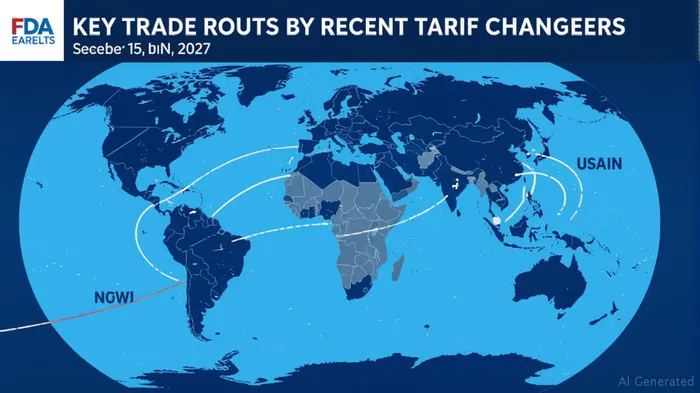
The quarter began with President Trump's administration rolling out a labyrinth of tariffs, targeting allies and adversaries alike. Canada faced a 35% tariff on non-USMCA-compliant goods, while Vietnam negotiated a reduced 20% rate after initial threats of 46%. Brazil's looming 50% tariffs on U.S. imports ignited BRICS tensions, and the EU's delayed retaliatory measures on agricultural goods added to the uncertainty. Meanwhile, steel tariffs spiked to 50% for non-UK goods, and copper imports faced a 50% duty starting August 1.
These moves, coupled with reciprocal tariffs and non-tariff barriers like China's export controls on critical minerals, created a volatile backdrop. reveal sharp swings: equities rebounded in June despite Q2 retail sales declines, while bond markets faced “outsized volatility,” as Wealth Enhancement's Doug Huber noted in his May 25 blog.
Volatility Through a Historical Lens: Why This Time Feels Different
Tariffs have historically been a catalyst for market instability—think Smoot-Hawley or the 2018 U.S.-China trade war. But Q2 2025's turbulence is unique. Unlike past crises driven by interest rates or geopolitical shocks, today's volatility stems from a confluence of trade disputes, supply chain reshaping, and sector-specific targeting (e.g., copper for infrastructure and defense).
Aya Yoshioka, Wealth Enhancement's lead strategist, highlighted this in her April 4 analysis: “Tariffs are now weaponized to influence sectoral competitiveness, not just fiscal policy.” For example, the copper tariff directly impacts energy and tech sectors, creating ripple effects across global supply chains. Meanwhile, Doug Huber's May 25 blog emphasized how municipal bond markets—previously insulated—now face “outsized volatility” due to trade-related inflation risks.
Wealth Enhancement's Framework: Anchoring in Uncertainty
Wealth Enhancement's structured approach, detailed in their “7 Market Movers” series, offers a roadmap for navigating this environment. Their framework evaluates six pillars: global growth, fiscal/monetary policy, inflation, interest rates, macro risks, and investor sentiment. Applied to tariffs, this means:
- Sectoral Diversification: Avoid overexposure to trade-sensitive sectors (e.g., industrials, semiconductors) while favoring defensive sectors like healthcare or utilities.
- Geographic Spread: Reduce reliance on any single region. For instance, China's shift toward EU and ASEAN markets post-tariffs creates opportunities in Asian equities.
- Private Markets: As public markets gyrate, private assets (infrastructure, real estate) offer lower correlation and steady cash flows.
Their May 19 blog, “Six Planning Opportunities,” underscores the need to avoid “emotional selling” and instead use dips to rebalance toward resilient assets. “Discipline, not timing, is key,” Yoshioka noted, referencing the 2020 pandemic recovery where long-term holders outperformed reactive traders.
Private Markets and Disciplined Rebalancing: Tools for Resilience
Private markets—often overlooked in volatile quarters—are proving critical. Their illiquidity and lower correlation to public markets shield portfolios from tariff-driven swings. For instance, infrastructure investments tied to renewable energy (untouched by current tariff lists) offer stability.
Rebalancing is equally vital. Wealth Enhancement advises trimming overperforming sectors (e.g., tech) and reinvesting in undervalued areas like emerging-market bonds. Doug Huber's June commentary added a tactical twist: “Focus on quality assets—those with pricing power or secular tailwinds—to weather tariff-induced headwinds.”
Conclusion: Embrace the Storm, Build the Ark
Tariffs are here to stay, but their impact need not dictate long-term outcomes. By anchoring in Wealth Enhancement's frameworks—diversifying geographically and sectorally, leveraging private markets, and rebalancing with discipline—investors can turn volatility into opportunity. As Yoshioka concluded in her June 6 analysis: “Resilience isn't about avoiding turbulence; it's about flying through it with a well-constructed portfolio.”
In this era of trade wars, the wisest course is to prioritize structural advantages over short-term noise. The markets of Q2 2025 may be choppy, but the horizon remains navigable for those who stay steady.
This analysis synthesizes data from Wealth Enhancement's Q2 commentary, trade policy developments, and expert insights. Always consult a financial advisor before making investment decisions.

Delivering real-time insights and analysis on emerging financial trends and market movements.
Latest Articles
Stay ahead of the market.
Get curated U.S. market news, insights and key dates delivered to your inbox.


AInvest
PRO
AInvest
PRO



Comments
No comments yet