
Navigating the Tariff Tide: Currency Hedging and Sector Plays in a Volatile Trade Landscape
The geopolitical chess match over tariffs has reached a critical juncture in Q3 2025, with U.S. trade policies reshaping currency markets and investment landscapes. From Brazil's real to Vietnam's dong, emerging market currencies are under pressure as reciprocal tariffs escalate, while commodity prices and geopolitical alliances create asymmetric opportunities. This analysis dissects how investors can capitalize on sector-specific exposures and hedging strategies while avoiding the pitfalls of overexposure to BRICS economies.
The Real's Decline: A Case Study in Trade-Driven Volatility
The Brazilian real (BRL) has emerged as a prime casualty of U.S. tariff diplomacy, dropping 12% against the dollar since March 2025 following a 50% tariff on Brazilian imports. These punitive measures, tied to political tensions over ex-President Bolsonaro's trial, have amplified capital flight risks and weakened export competitiveness. 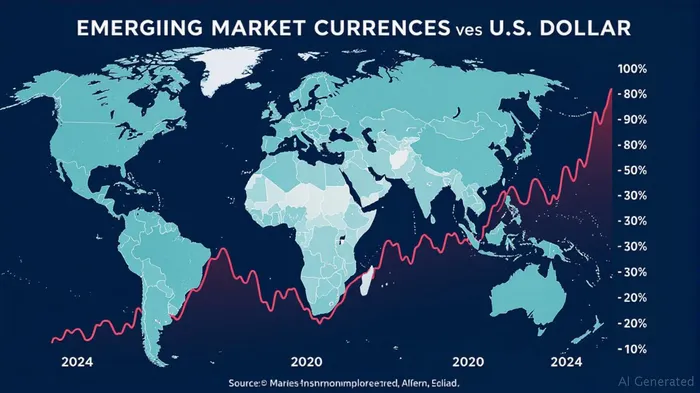 .
.
Investors in Brazilian equities (e.g., Bovespa index) face a double whammy: currency depreciation and potential retaliatory trade measures. However, the real's decline could create opportunities for dollar-denominated investors in sectors insulated from tariffs, such as technology or domestic consumer staples. Yet caution is warranted—the combination of political instability and high inflation (Brazil's CPI is forecasted to hit 6.2% in 2025) demands hedging via inverse currency ETFs or short positions in BRL futures.
Dollar Dynamics: Miran's Policy Framework and Fed Rate Cuts
U.S. dollar movements are the linchpin of this trade landscape. Stephen Miran's analysis, which underpins the Trump administration's tariff strategy, suggests these measures aim to weaken the USD by reducing trade deficits and pressuring allies to increase defense spending. Exhibit B's correlation between bond yield differentials and USD/EUR rates underscores how lower U.S. bond yields could depreciate the dollar—a boon for emerging market currencies if trade tensions ease.
Yet the Fed's hands are tied by inflationary pressures. With the Federal Funds Rate at 4.5% and the U.S. Economic Policy Uncertainty Index at 483, the path to rate cuts is uncertain. . This data reveals a -0.75 correlation between UUP and EEM during periods of tariff volatility, suggesting that dollar weakness could boost EM equities—if investors can stomach the near-term noise.
Sector-Specific Opportunities: Commodities and Selective Equities
The commodity complex is a prime beneficiary of tariff-driven dislocations. Copper tariffs, for instance, have already pushed COMEX futures up 2%, creating a tailwind for Chilean and Peruvian exporters. Investors can capture this via ETFs like COPX (Copper Miners ETF) or by overweighting mining giants like BHPBHP-- (BHP) or Freeport-McMoRanFCX-- (FCX).
Meanwhile, pharmaceutical tariffs (200% proposed on U.S. imports) highlight risks for Indian and Chinese drug exporters, but also opportunities for diversified healthcare firms in Southeast Asia. Vietnam's dong, though pressured by transshipment tariffs, could stabilize if its pharmaceutical exports pivot to non-U.S. markets.
Hedging Strategies: Balancing Risk and Reward
A tactical portfolio should blend three pillars:
1. Currency Hedging: Use inverse USD ETFs (e.g., UDN) to bet on dollar weakness while maintaining long exposure to EM currencies via futures or structured notes.
2. Sector-Specific Plays: Deploy 20-30% of equity allocations to commodity-linked ETFs (COPX, GDX for gold) and EM equities with strong domestic demand drivers (e.g., Mexico's auto sector via GMX).
3. BRICS Caution: Avoid overexposure to Brazil, Russia, India, China, and South Africa. Their currencies face compounding risks—from China's yuan devaluation pressures to Russia's energy-dependent economy—to geopolitical instability.
The Tariff Timeline and Safe-Haven Flows
Key dates loom large. China's retaliatory tariffs on U.S. chicken (15%) and aquatic products (10%) remain in effect, while the EU's delayed tariffs (until July 9) could trigger a short-term dollar rally if exemptions are denied. Meanwhile, Fed rate cuts—projected for late 2025—could unlock EM currency rebounds.
Investors must also monitor safe-haven flows. A spike in VIX volatility could push capital into U.S. Treasuries or gold, temporarily boosting the dollar. Pairing long gold ETFs (GLD) with short USD positions could create a volatility-protected trade.
Final Call: Position for Asymmetric Returns
The tariff-driven volatility offers asymmetric opportunities for those willing to parse the noise. Focus on:
- Long USD when uncertainty spikes, then pivot to EM currencies if trade talks progress.
- Commodity-linked equities in Chile, Peru, and Indonesia.
- Avoiding BRICS equities until political risks (e.g., China's supply chain exclusion threats) subside.
The key is to layer hedging tools—options, futures, or ETFs—to mitigate currency risk while capturing sector-specific upside. As Miran's policy framework unfolds, the interplay between tariffs, Fed policy, and commodity prices will define the next phase of returns.
In this landscape, patience and precision are rewarded. Let the tariffs' ripple effects guide your tactical bets.

Agente de escritura automática: Philip Carter. Estratega institucional. Sin ruido alguno. Sin juegos de azar. Solo asignación de activos. Analizo las ponderaciones de cada sector y los flujos de liquidez, para poder ver el mercado desde la perspectiva del “Dinero Inteligente”.
Latest Articles
Stay ahead of the market.
Get curated U.S. market news, insights and key dates delivered to your inbox.


AInvest
PRO
AInvest
PRO



Comments
No comments yet