
Navigating the Tariff Storm: Sector-Specific Risks and Opportunities in a Protectionist Era
The resurgence of tariffs under the Trump administration in 2025 has reshaped global trade dynamics, creating both vulnerabilities and unexpected growth opportunities across industries. With steel tariffs hitting 50%, retaliatory measures from China reaching 145%, and supply chains strained by geopolitical tensions, investors must discern which sectors to avoid and where to deploy capital for resilience.
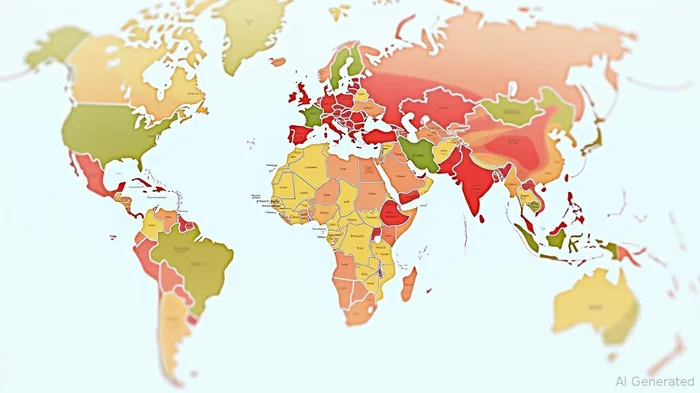
Vulnerable Sectors: The Cost of Protectionism
1. Steel & Aluminum: A Double-Edged Sword
The doubling of steel and aluminum tariffs to 50% by June 2025 has sent shockwaves through industries reliant on these materials. Construction, manufacturing, and appliances face soaring costs. Companies like CaterpillarCAT-- (CAT) and BoeingBA-- (BA) may struggle with margin pressures, while smaller firms could face insolvency.
Investment Caution: Avoid overexposure to companies with thin margins in these sectors unless they have hedged against input costs.
2. Automotive & Auto Parts: Geopolitical Whiplash
Auto tariffs at 25%—excluding Canada and Mexico—have disrupted supply chains, particularly for U.S. automakers reliant on foreign parts. The EU's retaliatory tariffs on U.S. whiskey and goods add further complications.
Key Insight: Electric vehicle (EV) manufacturers with vertically integrated supply chains, like TeslaTSLA--, may outperform peers due to reduced reliance on traditional steel and global parts sourcing.
3. Semiconductors & Pharmaceuticals: A Clouded Horizon
Proposed tariffs on semiconductors and pharmaceuticals remain ambiguous but threaten to disrupt global tech and healthcare supply chains. China's dominance in rare earth minerals and drug ingredients adds strategic risks.
Investment Strategy: Favor companies with domestic manufacturing capabilities or partnerships in regions unaffected by U.S.-China tariff wars.
4. Agriculture & Lumber: Retaliation's Ripple Effect
U.S. farmers face a double blow: China's retaliatory tariffs on agricultural exports and domestic lumber tariffs that inflate construction costs. The June 2025 trade deal temporarily easing China's retaliation offers a reprieve but no long-term solution.
Recommendation: Shift toward agribusiness firms with diversified export markets or invest in alternative protein companies (e.g., Beyond Meat) to capitalize on shifting consumer preferences.
Resilient Industries: Where Growth Thrives Amid Chaos
1. Defense & Cybersecurity: A Safe Harbor
With global tensions high, defense spending and cybersecurity investments are surging. The U.S. government's push for domestic production of critical technologies ensures steady demand for companies like Raytheon (RTX) and cybersecurity firms like Palo Alto NetworksPANW-- (PANW).
Play: Long positions in defense contractors and cybersecurity leaders offer insulation from trade volatility.
2. Renewable Energy & Critical Minerals
The push for energy independence and green infrastructure creates opportunities in solar, wind, and battery storage. Companies with U.S. mineral sourcing or partnerships in Africa or Latin America (outside China's reach) will thrive.
Investment Thesis: Renewable energy is a “win-win,” benefiting from both policy support and reduced exposure to tariff-sensitive sectors like fossil fuels.
3. Healthcare & Diagnostics
The pharmaceutical tariff uncertainty has accelerated consolidation and R&D in U.S. biotech. Firms like ModernaMRNA-- (MRNA) or Exact SciencesEXAS-- (EXAS), focused on domestic innovation, are less vulnerable to supply chain disruptions.
Edge: Invest in companies with strong intellectual property and FDA-backed pipelines, shielded from tariff-driven input cost spikes.
Strategic Playbook for 2025–2026
- Short the Tariff-Exposed: Consider short positions on steel producers (e.g., NucorNUE-- Corp.) and automakers without EV dominance.
- Double Down on Resilience: Allocate to defense, renewables, and healthcare firms with domestic supply chains.
- Monitor Legal Battles: The pending IEEPA tariff court ruling (which could invalidate key tariffs) creates a potential upside catalyst for tariff-hit sectors.
- Hedge with Commodities: Gold and copper ETFs (e.g., GLD, COPX) may stabilize portfolios as trade tensions inflate inflation.
Conclusion
The tariff storm of 2025 demands a sharp focus on sector-specific risks and structural shifts. While industries like steel and agriculture face headwinds, resilience lies in sectors that prioritize domestic innovation and diversification. Investors who pivot early to defense, renewables, and healthcare—while avoiding tariff battlegrounds—will position themselves to weather the storm and seize the next wave of growth.
Stay vigilant, stay adaptive.

Stay ahead of the market.
Get curated U.S. market news, insights and key dates delivered to your inbox.




Comments
No comments yet